Boxing Calories Burned Calculator
Estimate boxing calories, adjusted MET, round load, weekly burn, and conditioning score from body weight, boxing type, rounds, round length, rest, intensity, footwork, and weekly sessions.
📌Boxing Presets
Presets load realistic boxing sessions with different body weights, boxing types, rounds, work-to-rest timing, intensity, footwork demand, and weekly frequency.
⚙Calculator Inputs
Boxing calorie snapshot
Enter your round plan to estimate calories, MET, round load, weekly burn, and conditioning score.
📊Metrics Grid
📑Boxing Reference Tables
| Boxing type | Base MET | Best fit | Model note |
|---|---|---|---|
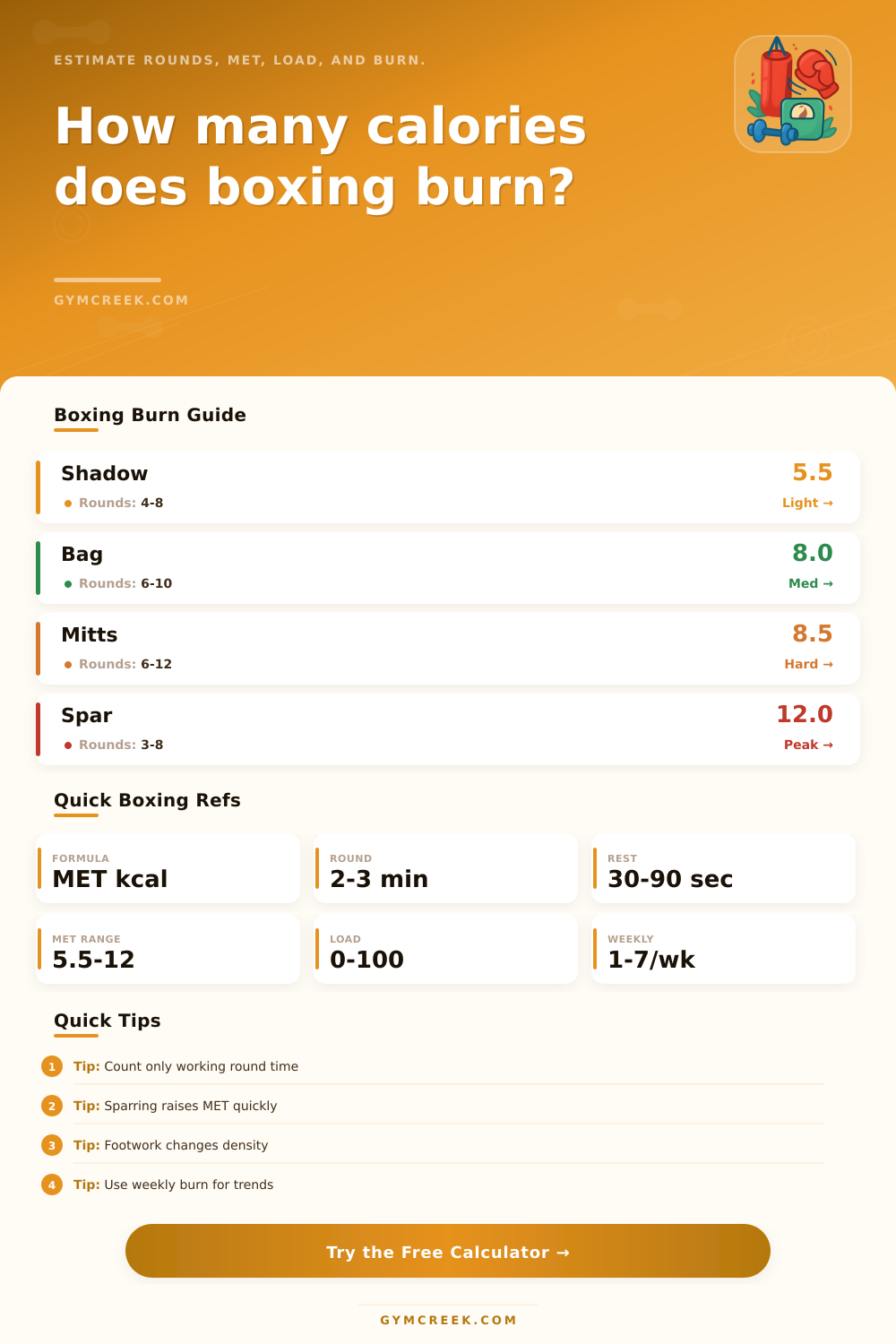
| Shadowboxing | 5.5 | Warmups, technique rounds | Lower impact with controllable pace |
| Speed bag or double-end bag | 6.5 | Rhythm, timing, shoulder endurance | Steady arms with moderate footwork |
| Heavy bag rounds | 8.0 | Power punches and combinations | Baseline hard bag-work estimate |
| Coach mitt work | 8.5 | Reactive combinations and movement | Higher tempo from coach-led cues |
| Technical sparring | 9.5 | Controlled ring rounds | Movement and reaction cost rise |
| Hard sparring | 12.0 | Competitive rounds | Highest strain option in this calculator |
| Footwork drills | 7.0 | Angles, pivots, defensive movement | Leg demand with fewer punches |
| Boxing conditioning circuit | 10.5 | Bag, calisthenics, and punch-outs | Dense work with limited rest |
| Modifier | Multiplier | Use when | Effect |
|---|---|---|---|
| Light technical pace | 0.85 | Learning form or drilling slowly | Lower breathing and strike volume |
| Moderate steady pace | 1.00 | Repeatable class or bag effort | Baseline boxing burn |
| Hard training pace | 1.15 | High punch output with pressure | Higher MET and round load |
| Fight-pace bursts | 1.30 | Flurries, sparring surges, finishers | Peak calorie and fatigue estimate |
| Mostly planted stance | 0.92 | Power bag work with limited movement | Slightly lower total energy cost |
| Constant bounce or ring movement | 1.15 | Active feet nearly every round | Raises density and leg demand |
| Session pattern | Typical setup | Load band | Planning cue |
|---|---|---|---|
| Technique block | 3-6 rounds, light pace | Light | Useful before lifting or skill practice |
| Fitness class | 6-10 rounds, 2-3 min | Moderate | Repeatable two to four times weekly |
| Bag conditioning | 8-12 rounds, hard pace | Hard | Watch shoulder and hand fatigue |
| Sparring day | 3-8 rounds, high intensity | Very high | Space hard days and protect recovery |
| Fight camp | 10-15 rounds, dense work | Peak | Use with coaching and recovery checks |
| Step | Formula | Output | Why it matters |
|---|---|---|---|
| Work time | Rounds x round minutes | Minutes | Separates punching time from rest |
| Adjusted MET | Base MET x intensity x footwork | MET | Models boxing style and pace |
| Calories | MET x 3.5 x kg / 200 x min | kcal | Standard exercise energy estimate |
| Rounds load | MET, rounds, density, level | 0-100 | Rates session strain |
| Weekly burn | Session calories x sessions | kcal | Shows repeatable weekly effect |
💡Tips
Boxing is a type of physical exercises. The energy that you burn while boxing depend on various factors. One of the factors is the type of boxing that you performs.
Another of the factors that affects the energy expenditure during boxing is the pace at which you boxes. Many people want to know the number of calories that is burned during boxing. However, boxing session vary in terms of the number of calories that can be burned.
How Boxing Style and Training Change Calories Burned
For instance, boxing sessions that include alot of footwork will burn a more different number of calories than boxing sessions that exclude alot of footwork. Therefore, people must consider certain feature of boxing sessions to determine how many calories are burned during boxing. Two of the most important types of boxing are shadow boxing and sparring.
Shadowboxing is a type of boxing that occurs when individual box by themselves. These types of boxing sessions allow for an individual to control the pace at which they shadowbox. Sparring, on the other hand, occur when two individuals fight each other.
Sparring use a lot of mental and physical effort from the participants. Therefore, boxing sessions that include sparring will burn more energy than boxing sessions that only include shadowboxing. This is due to the fact that boxing sessions that include sparring will place more demand on an individual’s leg and shoulders.
Individuals can change the energy use during boxing by changing the length of boxing rounds and rest period between rounds. For example, boxing sessions that have three-minute rounds and sixty-second rest periods will use more energy during boxing than boxing sessions with shorter rounds and longer rest periods. This is because higher heart rate result in the burning of more energy.
By using the calculator that is available to user, individuals can input the length of the boxing rounds and the length of the rest periods between rounds. The calculator will automatically calculate the energy use by boxing for individuals. Additionally, the calculator will take into account the energy that boxing with active footwork uses.
The number of boxing sessions that you perform each week will change the energy use. For instance, three boxing session a week with high level of intensity will use a different amount of energy than five boxing sessions a week with lower levels of intensity. User must track the number of boxing sessions that they perform each week.
By tracking the number of boxing sessions that individuals perform each week, the tool will allow individuals to monitor there health in terms of their shoulders and their boxing breathing rhythms. The tool will calculate the energy use each week by boxing. This estimate will allow individuals to avoid overtraining there body.
The level of conditioning that you are in will change the energy use during boxing. For example, boxing sessions performed by beginner will use a higher amount of energy than trained boxers. This is because beginners are not yet efficient in performing boxing movement or breathing rhythms while boxing.
The reference tables include information about the various boxing style and the energy use that they can create. Additionally, these tables include information about how active an individual’s footwork is during boxing and the effect that this has on the energy use during boxing. These reference tables are critical for those who is planning to engage in boxing or for those who have taken a break from boxing.
Rather than focus on creating one boxing session with high levels of intensity, individuals should focus on boxing with consistency. By tracking the calories that are burned and the load that is placed on the body during boxing, individuals can measure their progress each several week. Furthermore, by understanding the various factors that impact boxing, individuals can adjust the type of boxing that they perform.
By understanding these factor, individuals will be able to sustain and improve their boxing training over a long period of time.