Box Jump Calorie Calculator
Estimate calories burned from box height, reps, sets, bodyweight, rest periods, step-down or rebound style, jump power, and session density.
📌Box Jump Presets
Each preset loads a realistic box jump session and recalculates height demand, rest impact, estimated burn, and safety notes.
⚙Calculator
Box jump calorie snapshot
Enter bodyweight, height, reps, sets, style, power, rest, and cadence to estimate the session.
📊Metrics Grid
🧮Calculation Logic
Calories per minute = adjusted MET x 3.5 x body weight in kg / 200. The adjusted MET changes with style, height, power, and density.
Mechanical work uses body mass, gravity, box height, and total jumps. It is useful for comparing sessions with different box heights.
Rest between sets changes calories per minute even when total jumps stay the same. Shorter rest raises density but can reduce jump quality.
The calculator flags high boxes, high density, rebound work, and poor landing quality because calorie targets should not override safe landings.
📑Reference Tables
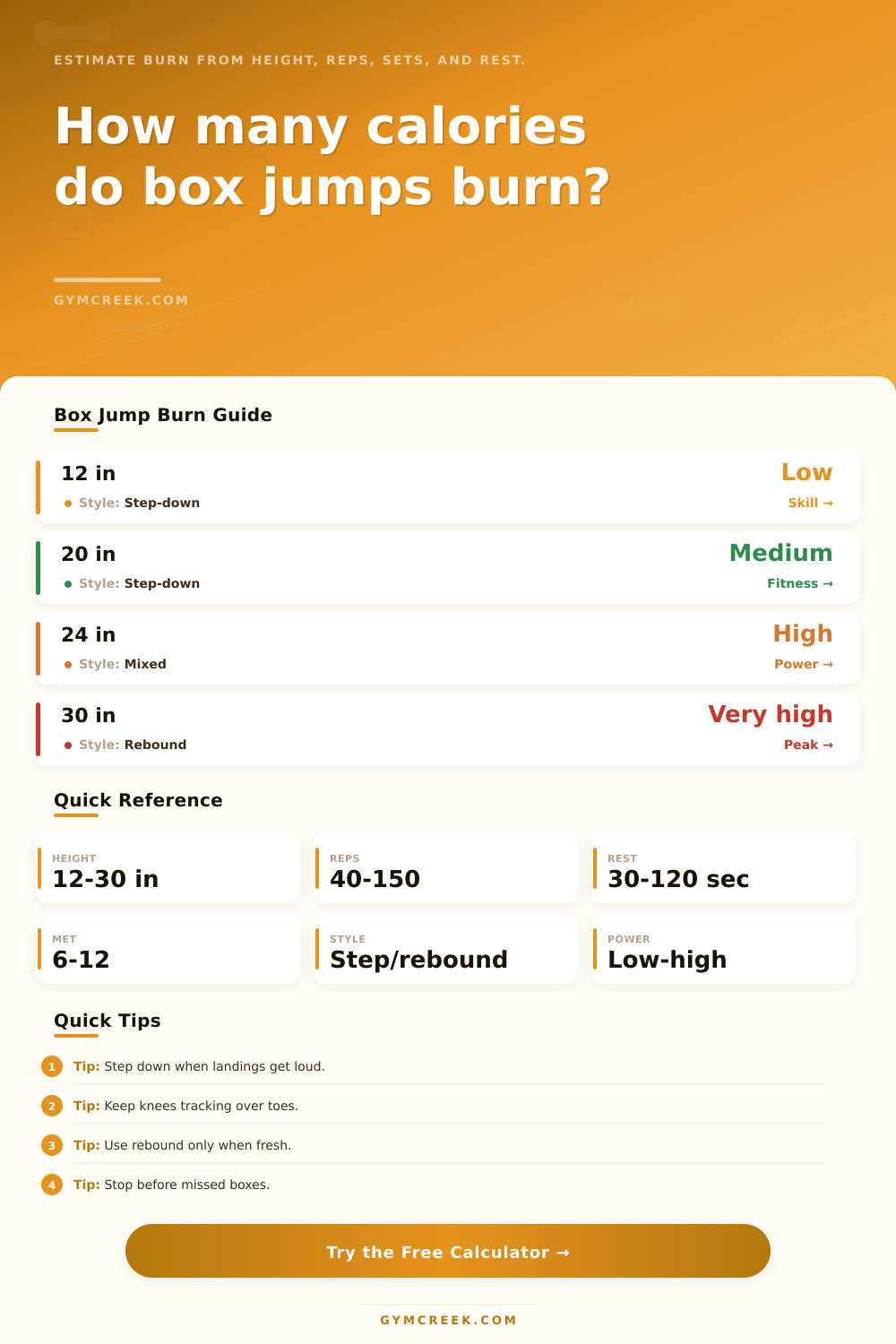
| Box height | Relative demand | Best style | Use case |
|---|---|---|---|
| 12-16 in | Low | Step-down | Learning mechanics and warm-ups |
| 18-20 in | Moderate | Step-down or mixed | General fitness circuits |
| 24 in | High | Controlled reset | Power and conditioning work |
| 30 in | Very high | Low-rep reset | Advanced power sessions |
| Descent style | Base MET | Impact | Best fit |
|---|---|---|---|
| Step down reset | 7.0 | Lower | Volume and technique |
| Controlled drop reset | 7.8 | Moderate | Conditioning with control |
| Rebound cycle | 9.2 | High | Skilled fast intervals |
| Burpee box jump | 10.6 | Very high | Metabolic circuits |
| Weighted vest jump | 9.8 | High | Short, controlled sets |
| Session type | Reps | Rest | Density clue |
|---|---|---|---|
| Skill practice | 15-40 | 60-120 sec | Low calorie focus |
| Power training | 25-60 | 90-180 sec | Quality over burn |
| Fitness circuit | 60-120 | 30-90 sec | Moderate burn |
| HIIT finisher | 80-180 | 10-45 sec | High density |
| Formula piece | Variables | Output | Why it matters |
|---|---|---|---|
| MET burn | MET, kg, min | Calories | Main session estimate |
| Jump work | Mass, gravity, height | Kilojoules | Compares box heights |
| Duty cycle | Work and rest | Percent | Shows density |
| Mifflin BMR | kg, cm, age | Baseline | Daily burn context |
💡Safety Tips
If you train enough with box jumps, there comes a time when what you see on the screen doesn’t match what’s happening in reality. You start reducing rest periods and racking up reps to get more bang for your buck. This help you burn more calories.
But instead, your landings become shit. Your knees collapses inward a bit. The sound of impact gets louder. Your clean explosive landing turn into a sloppy scramble across the box.
Why Safety Is More Important Than Burning Calories
That’s the plyo trap: If you haven’t been there before, people think all they have to do is go harder and it’ll all be better. It’s a common mistake to treat box jumps like any other cardio exercise. It’s a specific movement.
The physics aren’t forgiving, and how you come down affects the energy cost. Less isn’t always best. It’s not just about burning a certain number of calories. It’s about controlling the stress on your joints without sacrificing good workout.
You can see how this plays out in the calculator above, which breaks the session down into active work/rest/afterburn time. Instead of just giving total calorie count, like most, it considers the style of descent.
Do you step down between each jump? This prioritizes technique and joint longevity. Or do you opt for rebound style (immediately jumping back down and up again)? That one spikes intensity, but drops the metabolic demand. The calculator notes this increased density and scales the MET estimate to match. You’ll see a much higher calorie burn per minute.
And it flags if your combination of poor landing quality, speed and height put you at risk. That’s what most people don’t get. They don’t pay attention to safety warning, because their eye is on the calorie counter, unaware that one bad landing can throw them back weeks.
Height is everything. Climbing onto a dozen inch box feels like a skill drill or a warm up. You’re learning to land softly, but jumping isn’t burning many calories since there’s minimal vertical movement. A thirty-inch box require more power and creates a bigger impact force when you hit it.
That’s why the reference table on the page link box heights to their proper use cases and style. Taller boxes are for power athletes who can handle the force, not beginner sessions meant to burn off lunch.
Those inputs feed into the calculator, which estimates amount of kilojoules (a measurement of mechanical energy) spent doing the vertical work. Now you can compare a low rep, high height session to a high rep, low height session. They burns similar calories but create completely different muscular stress. One is endurance building, and the other is power building.
Another lever people yank on without knowing what they’re doing is their rest periods. If you want to make your workouts denser (e.g., do more work in less time), go ahead and shorten them: instead of resting for 90 seconds, take only 30 seconds off. Your heart rate remains elevated longer, leading to greater overall calorie burn.
But you also gets tired fast. That’s why the calculator warns you when you’re getting aggressive with your duty cycle, and displays exactly how it impacts session density. I know there’s an allure to the “less rest is better” mentality for fat loss… But it isn’t.
When your form breaks down, you’re doing nothing but harming your joints for a minor metabolic spike. With this tool, you can play around with these levers in a safe environment. See what happens when you switch from jumping onto a box to a burpee-style box jump. How about adding weighted vest?
Both will greatly raise your base metabolic equivalent. More burn = yes. More risk = yes. The point is to know where you’re at so you can work within your mechanics.
You don’t want to overdo it. The calorie count in that column isn’t everything. Find an intensity level that allows you to stay tight but also maintain for long enough to do something. So begin with some real-world examples from the presets, such as a power athlete workout or an EMOM from CrossFit.
Play with the inputs to determine effects of small variations (style-wise or in terms of rest). Watch the indicator light for when you land well. Listen to the tool if it’s telling you you’re going too hard, too fast.
The numbers aren’t there to encourage us beyond our means; they’re there to show us what we should of work with. Jumping is a skill, and treating it like a generic calorie-burner is a disservice to yourself.
Go slow, focus on the feel of the movement and the quietness of landing. Focus on the quiet landings and the controlled movement. The calories will follow, and your knees will thank you later.