Bouldering Calories Burned Calculator
Estimate gross calories, net climbing calories, active load, rest recovery burn, and weekly bouldering volume from grade, attempts, rest timing, and session style.
📌Bouldering Presets
Presets load realistic bouldering profiles with grade, attempt count, rest length, wall angle, warm-up, and weekly frequency, then calculate immediately.
⚙Session Inputs
Bouldering session snapshot
Enter your grade, attempts, rest time, and body weight to estimate session burn.
📊Bouldering Metrics Grid
📑Reference Tables
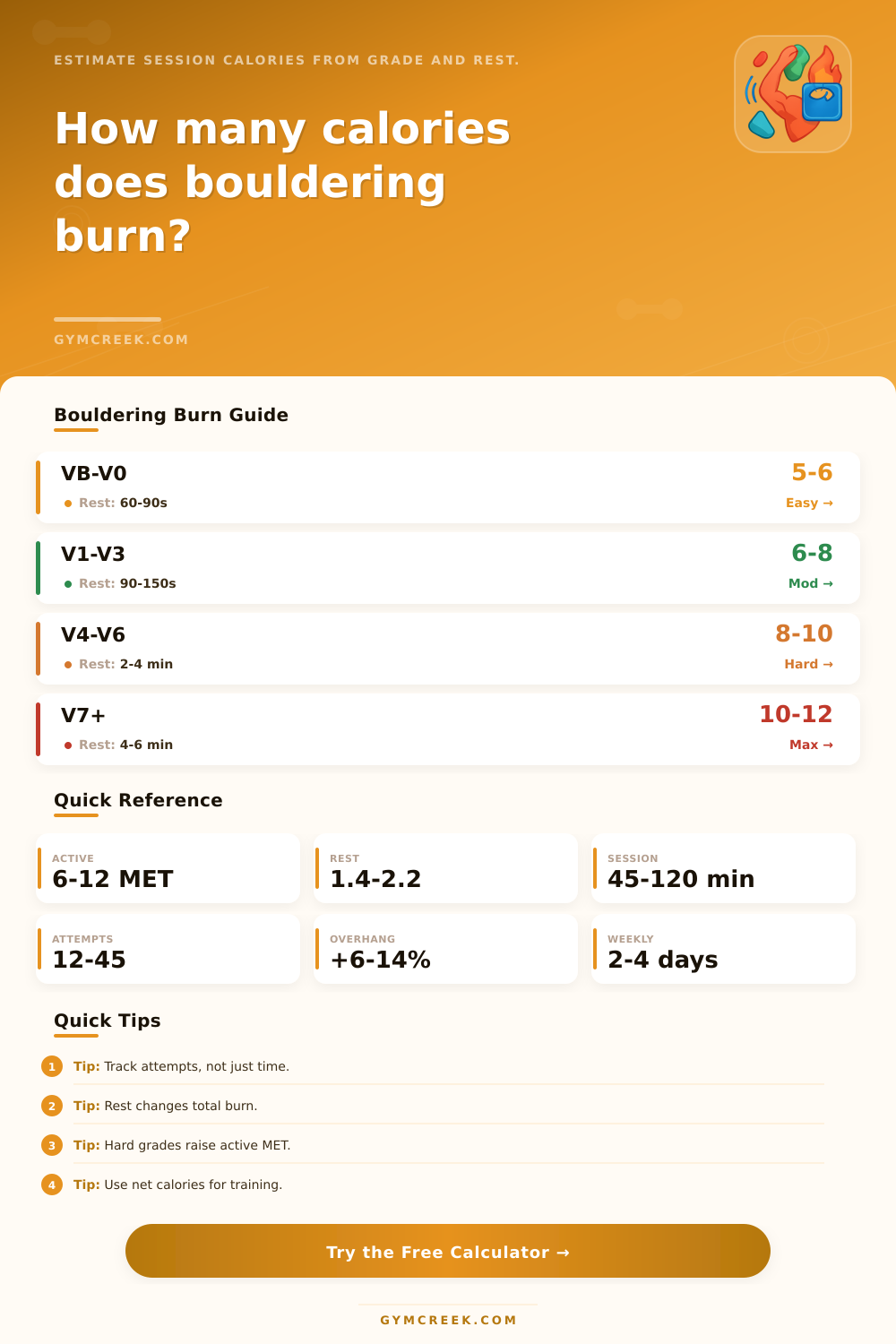
| Grade Band | Base MET | Typical Rest | Session Focus |
|---|---|---|---|
| VB-V0 / 3-4 | 5.4 MET | 60-90 sec | Movement skill |
| V1-V2 / 5-5+ | 6.5 MET | 90-150 sec | Volume |
| V3-V4 / 6A-6B | 7.8 MET | 2-3 min | Strength skill |
| V5-V6 / 6C-7A | 9.2 MET | 3-5 min | Projecting |
| V7-V8 / 7A+-7B+ | 10.4 MET | 4-6 min | Limit power |
| V9+ / 7C+ | 11.5 MET | 5-8 min | Max strength |
| Wall Type | Factor | Energy Effect | Common Use |
|---|---|---|---|
| Slab or vert | 0.94x | Lower pull demand | Technique days |
| Slight overhang | 1.00x | Balanced demand | Most gym sets |
| Steep overhang | 1.06x | Higher tension | Power endurance |
| Cave or roof | 1.14x | High core load | Compression |
| Training board | 1.11x | Dense pulling work | Board sessions |
| Formula | Variables | Use | Output |
|---|---|---|---|
| Active kcal | MET x kg x hr | On-wall tries | Calories |
| Rest kcal | Rest MET x kg x hr | Between tries | Calories |
| Net kcal | (MET - 1) x kg x hr | Above rest | Calories |
| Load score | Attempts x MET | Session stress | Points |
| Rest ratio | Rest / climb | Pacing | Ratio |
| Session Type | Attempts | Rest Pattern | Expected Burn |
|---|---|---|---|
| Technique | 20-40 | Short to steady | Low-moderate |
| Volume | 25-55 | 60-180 sec | Moderate-high |
| Projecting | 12-30 | 2-5 min | Moderate |
| Limit | 8-20 | 4-8 min | Low hourly |
| Comp sim | 16-35 | Timed rounds | High density |
💡Tips
The first time you hang from a boulder wall, there are two things going on at once. Your fingertips pains as they clutch onto jagged rock and your forearms screams with strain. Then, there’s the fatigue that settles in after twenty minutes. You hop down off the mat and wonder just how tired you was just standing there.
It’s this gap between effort and how much energy people think they used that leads them to use calorie calculators after a workout. “I felt like I did so much work!” “but my scale didn’t move”, “or it moved, but not the way I’d expect given what I ate.” So the calculator above take care of the numbers, provided you enter in your bodyweight, grade level, and rest breaks.
Why Bouldering Calories Are Hard to Count
Avoid the guesswork of asking, “Was that a marathon? Or was it a light jog? Bouldering isn’t a sport that works well with most fitness trackers: They tend to count time rather than intensity. An hour-long casual stroll on the treadmill will burn a steadier number of calories then thirty seconds of pure hell followed by five minutes of muscle-recovery rest. Bouldering is interval training masquerading as playtime.
To compensate, the tool differentiate between climbing calories (active) and resting recovery (burn). That’s important because your metabolism flips-flops in these two modes. Your metabolic equivalent rate skyrockets during a send, say, a V3. But plummets almost to zero when you’re sitting on the crash pad with a mouthful of water. If you don’t take that trough into account, you’ll overestimate your effort level and skew how much you think youve burned.
What about wall angle? Hanging upside-down from a roof is going to recruit different muscles than climbing a vertical face. As the page’s reference table shows, steeper walls adds as much as a fourteen-percent metabolic load. It’s not just about gravity though, it’s also about shoulder stability and core engagement. Your body pays a tax in oxygen consumption every time you lean that torso into an overhang. If you’re looking to fuel endurance or shed some pounds, then you’re underestimating the price of power days if you ignore this variable.
You may have thought a slab day was easier, as it felt smoother but unless you take into account the angle multiplier, you’re missing half the picture.
The real planning occurs in the rest strategy. Beginners tend to chase pump and rest too little while seasoned climbers tend to over-rest so they can maintain precision on hard project routes. This result in different calorie numbers. Resting long lets you climb higher grades and do more powerful moves, which raises your intensity per minute on the wall. Resting short raise the heart rate during rest periods, increasing total burn but restricting the difficulty level of problems you tackle. It’s up to you: do you want to develop anaerobic power or build aerobic capacity? Adjust the rest ratio, run the calculator, and it will show you both.
For example, a low climb-to-rest ratio mean an anaerobic workout focused on peak effort rather than total volume.
For many climbers, climbing grade is the only metric that really matters. Like “I sent X level V- this week, and Y level last month.” But that doesn’t tell you anything about fatigue or volume. There’s a secret currency to bouldering fitness: attempts. Linking ten moderate problems burns fewer calories than sending one hard problem, even though both sessions might take an equal amount of time on the wall. Separate rest and active load by looking at your attempts. This will help you see how dense your session was and why one day feels heavier then another, even if they were the same length. It’s a small thing, but it matters, especially as you’re trying to plan your nutrition around peak exertion windows or avoid overtraining.
Your calories burned aren’t a number on an app. They’re a measure of respect paid to how hard your body worked.
There’s something deceptive about bouldering. When it’s not loud, you’re not panting between each attempt. Your muscles scream silent in pain. Learning how much the angles, rest, and grade matter helps end the guessing game: Did I deserve that climb? Instead, you see the workout in front of you as a series of energy exchanges, all structured in time instead of an undefined block. The sting of hanging off that wall, that’s the burn. Feeling becomes data, which turns into better performance, right down to the details of knowing exactly what it cost.