Boiled Egg Calorie Calculator
Estimate boiled egg calories, protein, fat, carbs, sodium, yolk adjustments, egg size differences, and meal-prep servings from your exact count and prep choices.
📌Boiled Egg Presets
Presets use edible cooked egg weight without shell. Adjust the custom weight when eggs are peeled, chopped, or weighed after boiling.
⚙Calculator Inputs
Boiled egg nutrition snapshot
Enter egg size, count, yolk pattern, salt, and meal-prep details to estimate the batch.
📊Boiled Egg Metrics Grid
📑Reference Tables
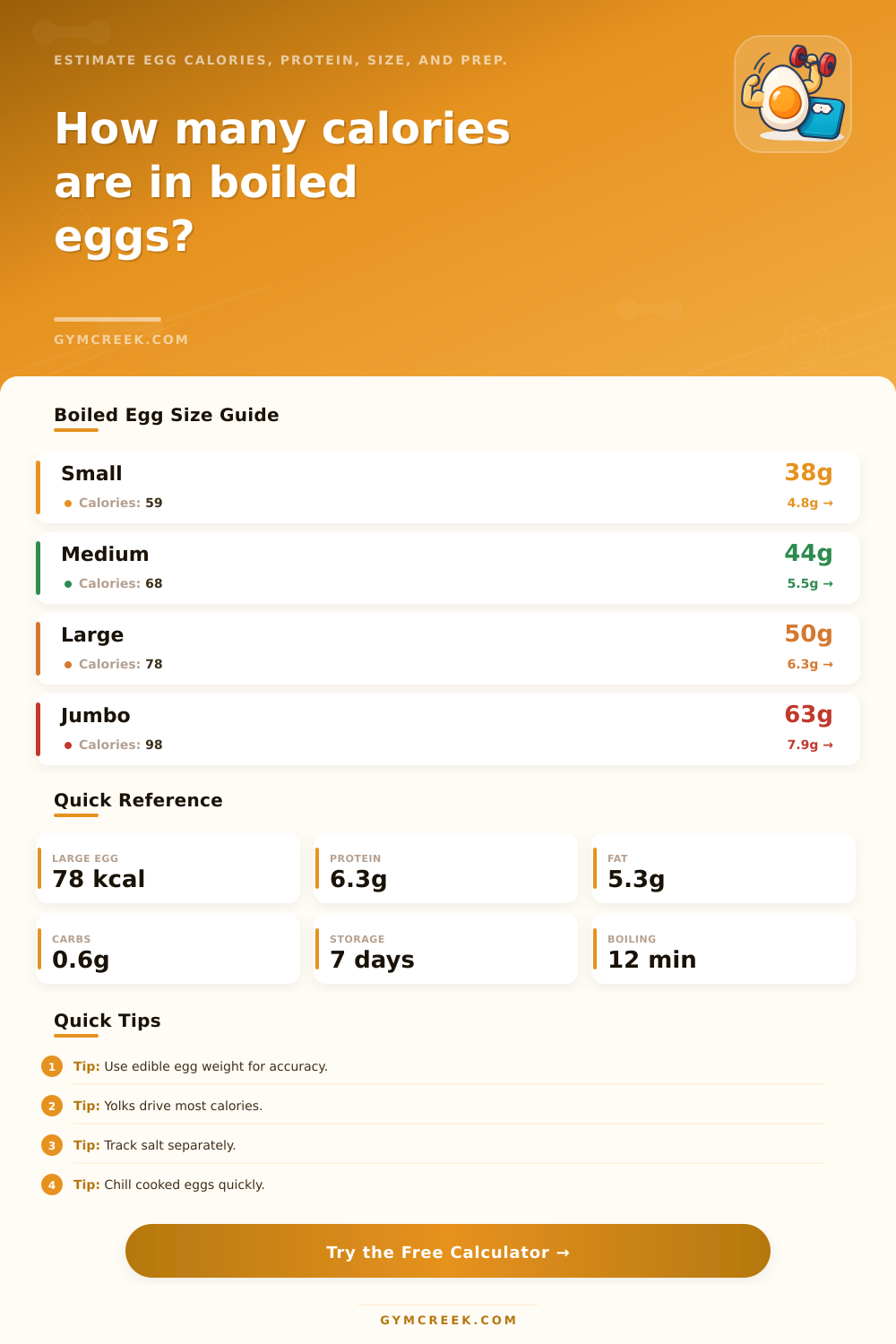
| Egg Size | Edible Weight | Calories | Protein |
|---|---|---|---|
| Peewee | 35 g | 54 kcal | 4.4 g |
| Small | 38 g | 59 kcal | 4.8 g |
| Medium | 44 g | 68 kcal | 5.5 g |
| Large | 50 g | 78 kcal | 6.3 g |
| Extra large | 56 g | 87 kcal | 7.0 g |
| Jumbo | 63 g | 98 kcal | 7.9 g |
| Yolk Pattern | Best Use | Calorie Shift | Macro Note |
|---|---|---|---|
| Whole eggs | Balanced snack | Full calories | Fat and protein |
| Whites only | Lean protein | Much lower | Very low fat |
| Half yolks | Calorie cut | Moderate | Keeps flavor |
| One per three | Batch prep | Lower | Protein heavy |
| Extra whites | Protein boost | Small add | More protein |
| Boiling Style | Time Guide | Calories | Prep Note |
|---|---|---|---|
| Soft boiled | 6 minutes | No change | Eat soon |
| Jammy | 8 minutes | No change | Chill quickly |
| Hard boiled | 12 minutes | No change | Best for prep |
| Very firm | 14+ minutes | No change | Drier texture |
| Storage Days | Status | Meal-Prep Use | Calculator Flag |
|---|---|---|---|
| 0 to 3 days | Fresh | Flexible | Good |
| 4 to 5 days | Plan soon | Use first | Watch |
| 6 to 7 days | Limit | Finish batch | Use soon |
| 8+ days | Too long | Do not plan | Replace |
💡Tips
Boiling an egg are one of the simplest tasks in your kitchen. But what does it look like? It’s a rock-solid block of protein. For most people, the egg is a static number floating around inside their heads. One egg = seventy-five calories.
That assumption hold up if you’re eating eggs casually, for example, grabbing one at 9am before work. But it doesn’t hold up when you prep out several meal for the week. It also fails when you change size of your eggs or vary amount of yolk. Finally, it doesn’t work when you start tracking calories/macros. Food doesn’t follow nutrition labels; nutrition follows physics.
Why You Should Weigh Your Boiled Eggs
Portion size is more than it looks. What looks like one big egg in the carton could be a JUMBO and vice versa, which pack very different nutritional values. Did you know that a JUMBO egg could contain almost twenty percent more calories then a SMALL? If you consume 3 or 4 per day, that adds up fast! No more guessing which size you purchased.
By weighing your peeled eggs, you’re measuring exactly how much you’ll be eating. Since eggshell thickness and moisture levels varies, weighing what you will actualy eat removes the guesswork regarding how much weight is lost from shells. When precision is important, it’s usually better to input a custom weight instead of trusting default categories.
Most of the nutritional difference occur in the yolk. That’s where you get virtually all the fat (and cholesterol), but also plenty of micronutrients and protein. When you’re trying to cut calories, one tactic is to go down to half-yolks. This cuts the fat drasticly without making the dish taste like nothing at all. But it changes the calorie breakdown massiveley.
Whole eggs offer an even distribution of macronutrient: a good bit of protein, a little bit of fat, and some nutrients as well. On their own, egg whites contains only trace amounts of fat, just protein. Use the calculator here to take care of those divisions for you. Try a serving with fewer yolks and more whites to see how it impact your diet. Learn about tradeoff between caloric density and flavor volume.
Preparation time affects the texture, even though the calories are mostly the same. Even if we put a 6-minute soft boiled egg next to a hard boiled egg on the counter for an hour, it’s still going to contain nearly the exact same number of calories. Nutrients don’t get burned by heat, they merely change how they feel in your mouth.
When meal prepping, the issue isn’t necessarily nutrient loss; it is often about keeping food safe while it is stored. You can keep hard boiled eggs in fridge for up to a week before their quality declines and safety becomes a concern. If you know exactly how long you’ve had each of your batches, you’ll avoid throwing out wasted food and maintain a realistic grasp of your weekly plan.
Sodium is another sneaky one. Eggs are naturaly salty. Add some seasoning and/or brine them, and then throw in some more seasoning, well, now we’re talking. Especially if you’re watching sodium, it’s important to account for this. You can enter any additional salt into the calculator, which will adjust the grand total to reflect actual sodium content going into your bowl. Small amounts won’t derail your careful tracking for the rest of the day.
Lastly, putting the numbers into context makes them more meaningful. That knowledge of the caloric content of your egg batch isn’t as useful without knowing what you’re doing with it. Will this batch power you through a heavy lift session or act as a rest day snack? How does this food fit in your overall energy budget? What is its cost and where did it come from?
It’s not so much about counting, rather it’s about planning. You’re not just eating; you’re eating to reach a goal. And an egg is simple. But getting the math right should of only takes a moment and will pay out every time you see it sitting there on the shell.