
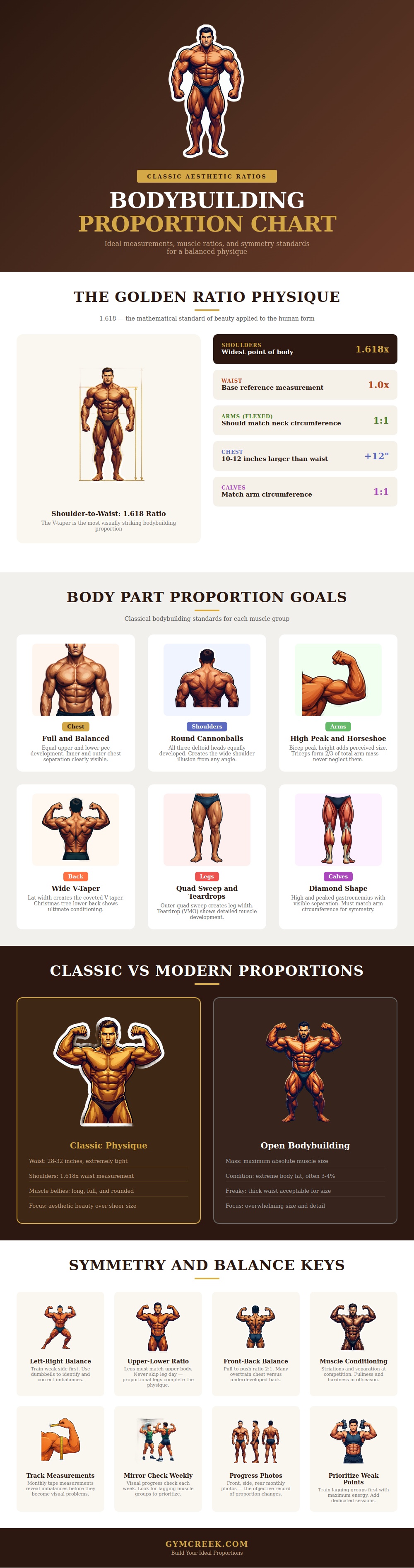
When you begin to train serious, you may focus on increasing your size without considering how your bodys various part are meant to fit together. If you focus on increasing the size of your muscles without considering there proportion to each other, you may have powerful muscles in some areas of your body, but they may not appear finished in other areas of your body. Proportion means making sure that each part of your body relates to each other part of your body so that it appears balance from all angles.
Proportion is not about achieving a certain measurement for your body, but about the relationship of the measurements of each part of your body to each other part of your body. One of the aesthetic standard regarding proportion is that each part of the body should visually balance the other parts of the body. For instance, one of the widest parts of your body should contrast with an narrow waist that you have.
How to Make Your Body Look Balanced
This contrast creates the appearance of a V in your upper body that makes you appear larger in size without having to grow more muscle. The width of your shoulders should be approximately one and a half times the width of your waist to appear strong and athletically. The same principle can be applied to the relationship between the size of your arms and the size of your calves.
If the sizes of these two parts of your body are approximately the same in size, your body will appear complete. Many body lifter and body builders dont realize the importance of proportion until they have trained for many years. For instance, many lifters may spend many years building their chest and biceps, but they do not build their legs as much.
While the growth of the chest and biceps may be satisfying to those lifters, the lack of growth in the leg muscles is overlooked. However, the lack of leg muscles becomes apparent when they stand in their photo or next to another bodybuilder who trained there legs. The same is true of the arms of the body build.
Many lifter focus on training their biceps because it provides a pump and grows quick. However, the triceps make up the majority of the size of the arm. One way to test the proportion of the arm is to compare the size of the arm to the circumference of the neck.
If the arm is small in comparison with the neck, the triceps area need to be trained more. The same is true of the shoulders of the body. Those with round deltoids (shoulder muscles) appear to have wide shoulders even if they have average bone structure.
Each of the three heads of the deltoid muscles need to be trained to appear balanced. Many training programs focus on the front and side deltoids, but do not focus on training the rear deltoids enough. If you do not train your rear deltoids, your physique may appear wide in the front but narrow in the side view of your body.
The deltoid muscles are the frame for the body, hence their appearance is checked early in the evaluation of physique. The back of the body also has an aesthetic standard for proportion. The lat muscles of the back should develop in a way that the waist of the body appear smaller.
The development of the lower back muscles indicates that the body has trained its entire back muscles as opposed to just the upper back. There is a difference between the classic bodybuilding approach to physique and the moddern approach to physique regarding the waist measurements of the body. The classic bodybuilding approach maintained that the waist of the body should be tight.
This was based off the idea of achieving visual harmony to the body. The modern approach to bodybuilding allow the waist to be thicker as the goal is to have maximum muscle in the body. Symmetry is difficult to achieve because one side of the body is naturally stronger than the other side.
Therefore, one should work the weaker side of the body before working the stronger side of the body so that the muscles has full energy. After working the weaker side of the body, the stronger side should be trained to match the effort of the weaker side. While one can check their physique in the mirror to monitor symmetry, the best way to determine this is with progress photos from the front, the side, and the rear of the body.
Progress photos are the most honest way of showing physique changes because they do not reflect daily fluctuation in self-perception of the body. One more standard for evaluating physique is the conditioning of the body. The muscles of the body may appear large when the body fat is low, but if the individual gains weight during the offseason, those muscles may dissapear.
Therefore, the body is assumed to have a certain level of conditioning in the measurement chart. While the body does not have to be always shredded in size, it should be able to maintain sufficient conditioning for the measurements to read correct. Overall, determining the proportions of the body is something that can be measured periodically.
However, obsessing over these measurement is not necessary. Instead, one should use the measurements to understand the status of each body part to make any needed adjustments to the training of that part. For instance, if any part of the body appears to be growing more slow than the others, that part should be trained earlier in the bodybuilding schedule so that the muscles receive the energy they require to grow.
If the body part need additional training, an extra session should be added to the training program to ensure that the lagging body part begin to develop. In this way, bodybuilders dont have to obsess over the ratio of each body part, but have a physique in which no part of their body appears out of place when they view themselves in a mirror or on stage.
