
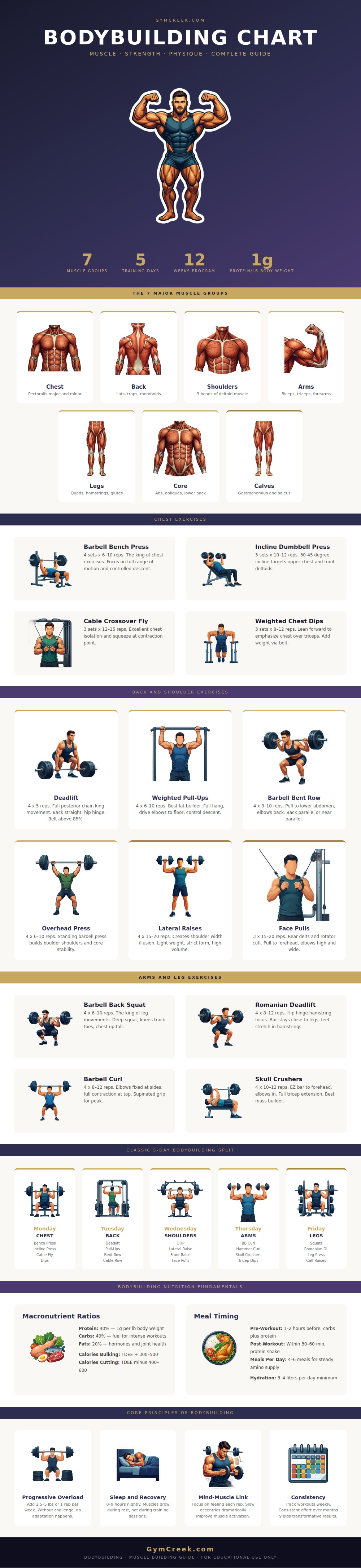
Bodybuilding charts exists because the sport of bodybuilding is more complex than it appear to be from the outside. For individuals with broad shoulder and a narrow waist, it may appear to be true that all they have to do is to lift weight frequently. However, individuals who have such physiques has typicaly completed seven different major muscle group in a specific order, trained them according to a schedule that allows each muscle group to rest, and maintained high level of protein intake to ensure that their muscle tissues could recover after training.
The bodybuilding chart helps to show these various element of the sport, and it is helpful to the individuals who use the chart in that it help them to create their own training plan for bodybuilding. Many bodybuilding programs starts with a focus on the muscles that are most visible to the individual when they look in a mirror; these are typically the chest and arm muscle. The bodybuilding chart places these included muscle into the context of the seven major muscle groups that must be trained to achieve a physique with broad shoulders and a narrow waist.
Bodybuilding Chart: Plan for Muscles, Food and Rest
Additionally, many bodybuilding programs include training for the chest and arm muscle, as others easily see these muscles when the individual display their physique. Other muscles that are trained include the back muscles, such as the lats and upper back muscle; these muscles contribute to the formation of a V-taper on the body, which makes the waist of the body appear small. Other muscles that are trained include the shoulder muscle, as they have separate training days for the shoulders; the side and rear head of the shoulder muscles are typically not worked enough during training for the chest and arm muscles.
Additionally, the bodybuilding chart includes separate training for the arm, leg, core, and calf muscle to ensure that each group is emphasized separate. A five-day training split that many bodybuilding programs follow assign separate days to training for each of the muscle groups. Training for the chest muscles can be performed at the opening of the five-day split, as the chest muscles recover quickly from training; however, the chest muscles also get rest day following their training session.
Following the chest muscles, back muscles are trained, including muscles that perform deadlifts and rowing exercises; deadlifts and rowing exercises target the rear shoulder muscle, which are also targeted during training for the back muscles. Following back muscle training, the shoulder muscles gets their own separate training day; this allows for the front, side, and rear heads of the shoulder muscles to be trained separately with exercises that target each of these head muscle. Following the training of the shoulder muscles, the arm muscles are trained; training the arm muscles during the middle of the five-day split allow the large muscles of the body to be strong enough to perform heavy training of the biceps and triceps muscle.
The legs are trained at the end of the five-day split; training for the legs require the muscles to have rest days because leg training is the most demanding of the muscle groups. Such a split include five days of training because each muscle group is trained enough to grow strong, and each muscle group has forty-eight hour of rest between training sessions. The bodybuilding chart also includes information about the nutritional requirement of bodybuilders.
The chart indicates that bodybuilders should consume protein at a rate of roughly one gram of protein per pound of the body weight; this protein is required to enable muscle tissue to recover after training. Bodybuilders should consume the same percentage of carbohydrates as protein; these carbohydrates refuel the body for training. Fat content should be lower than the percentage of protein and carbohydrates in the body’s diet; however, fat is not absent from the diets of bodybuilders because too low of a percentage of fat will negatively impact joint and endocrine system health.
The bodybuilding chart also includes information about when bodybuilders should consume the nutrient; consuming carbohydrates and protein two hour before training sessions will boost the energy of bodybuilders; a fast-digesting protein should be consumed within one hour after training sessions to begin the recovery of muscle; bodybuilders should consume four to six meal throughout the day to maintain an even percentage of amino acid in the body; consuming meals spread throughout the day is useful because bodybuilders need to consume a significant amount of protein each day. The bodybuilding chart includes information about the use of progressive overload to boost the size of muscle group. Progressive overload can be explained as the concept of gradually adding more weight to the weights that are lifted, or adding one more repetition to the number of repetitions that are performed each week; this prevents the body from maintaining the same level of strength with the same type of training each week.
The concept of progressive overload is placed next to the bodybuilding chart’s information about sleep and recovery; muscle tissue grow during recovery periods after intense training. Bodybuilders require sleeping for eight to nine hour per night because growth hormone level are highest during sleep; sleeping allows the nervous system to rest and become accustomed to the muscle training that is performed during the week. A focused mind-muscle connection when performing training exercises will improve the results of those training effort; focusing on the muscles that are to be strengthened enables those muscles to recruit more muscle fiber during the exercises.
Slowing the lowering phase of muscles during training increases the length of time that the muscles are under tension; increasing the length of time that muscles are under tension will allow for a bodybuilder to exhibit improvement in their muscle strength without having to gradually increase the amount of weight that they lift. Finally, the length of time that an individual bodybuilder follows the bodybuilding chart is perhaps the most important aspect of the plan; bodybuilding requires consistency over many month, and the consistency of following the bodybuilding chart is more important than perfection in any given month. The bodybuilding chart does not promise a shortcut to achieving the physique that is required of bodybuilders.
The bodybuilding chart includes information about the fact that each of the muscle groups, including the chest, back, shoulders, arms, legs, core, and calves, each require training. The bodybuilding chart indicates that training each muscle group every five to seven day will prevent any fatigue of those muscles. Finally, the bodybuilding chart includes information about the importance of protein and recovery as the requirement for bodybuilders to exhibit gain in the muscle strength of their body; if bodybuilders dont consume the amount of protein and take the necessary recovery days, bodybuilding results will be limited.
An individual who has achieved the physique that is required of bodybuilders has simply started the bodybuilding process earlier in their lifetime, and has continued using the bodybuilding chart for longer periods of time than many other individual who attempt to exhibit the same results.
