Body Weight Bench Press Calculator
Compare your bench press to bodyweight, estimate a fair one-rep max from a recent set, classify the ratio, and see the exact loads needed for common bodyweight-bench milestones.
📌Presets
Each preset loads bodyweight, bench set performance, technique standard, goal ratio, and rounding so the calculator behaves like a real training-log comparison.
⚙Calculator
Bench-to-bodyweight snapshot
Enter your bodyweight and recent bench set to estimate ratio, level, and target loads.
📊Bench Metrics
📑Reference Tables
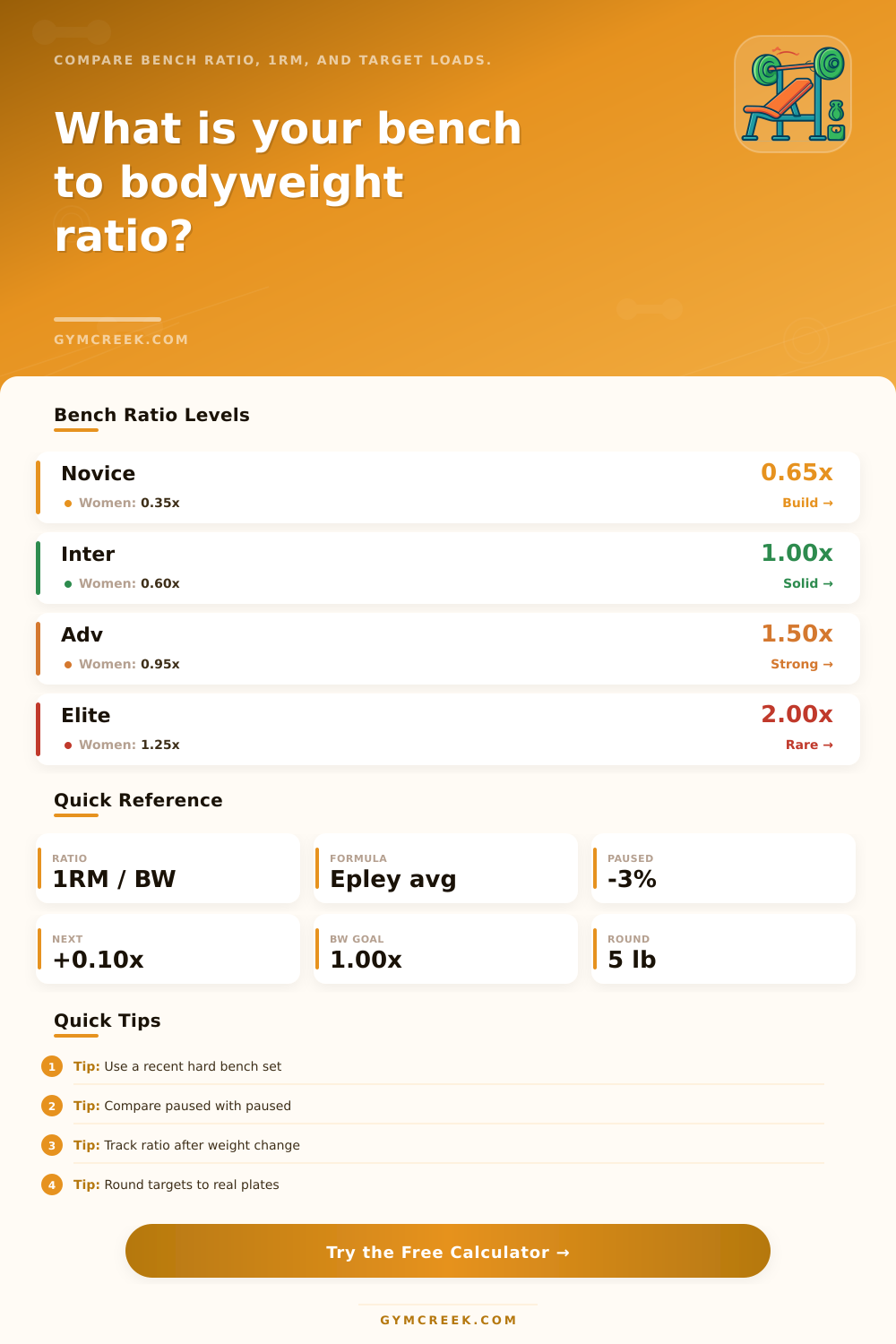
| Level | Men ratio | Women ratio | Interpretation |
|---|---|---|---|
| Developing | Below 0.65x | Below 0.35x | Early technique and strength base |
| Novice | 0.65 to 0.99x | 0.35 to 0.59x | Working toward bodyweight relevance |
| Intermediate | 1.00 to 1.24x | 0.60 to 0.79x | Solid gym-level bench strength |
| Strong | 1.25 to 1.49x | 0.80 to 0.94x | Well-trained pressing strength |
| Advanced | 1.50 to 1.99x | 0.95 to 1.24x | High relative strength |
| Elite | 2.00x plus | 1.25x plus | Rare competitive-level ratio |
| Ratio target | What it means | Example at 180 lb | Example at 80 kg |
|---|---|---|---|
| 0.75x | Three-quarter bodyweight bench | 135 lb | 60 kg |
| 1.00x | Bodyweight bench press | 180 lb | 80 kg |
| 1.25x | Strong recreational benchmark | 225 lb | 100 kg |
| 1.50x | Advanced gym benchmark | 270 lb | 120 kg |
| 2.00x | Elite relative benchmark | 360 lb | 160 kg |
| Item | Calculator method | Why it matters | Best use |
|---|---|---|---|
| Epley 1RM | Weight x (1 + reps / 30) | Stable for low and mid reps | Main anchor |
| Brzycki check | Weight x 36 / (37 - reps) | Often a little conservative | Formula balance |
| RIR adjustment | Adds reps in reserve | Accounts for non-max sets | Training sets |
| Paused bench | Small standard discount | Harder than touch-and-go | Fair comparison |
| Overload bench | Assistance discount | May not transfer directly | Cautious estimate |
| Profile | Current ratio | Likely next step | Watch item |
|---|---|---|---|
| New lifter | 0.50 to 0.75x | Technique and volume | Consistent touch point |
| Bodyweight chase | 0.85 to 1.00x | Small weekly progress | Bodyweight changes |
| Strength block | 1.10 to 1.40x | Heavy triples and back-offs | Shoulder tolerance |
| Advanced push | 1.50x plus | Specific pauses and peaking | Recovery cost |
💡Tips
Bench press strength can be measured in many differance ways. However, one of the easiest of those comparisons is to compare an individual’s bench press strength to there bodyweight. Bench press to bodyweight ratio are useful in that they remain relevant regardless of whether an individual gains weight, loses weight, or remains the same in their body weight.
While many individuals focus upon the absolute weights that they can lift on the bar, those weights do not account for any changes to an individual’s body weight; thus, using a bench press to bodyweight ratio allows for those two variable to remain consistent to one another. Bench press to bodyweight ratio calculations includes a number of different main inputs that allow individuals to determine their strength relative to their body weight. The bodyweight of the individual is one of the main calculations utilized in determining that ratio; if an individual’s bodyweight change, the ratio will change.
Bench Press Strength Compared to Body Weight
Additionally, the set performed during the bench press can impact that ratio; a set of five repetitions at a certain weight is not the same as a set of two repetitions at the same weight. Formulas account for the number of repetitions performed by an individual to calculate the one-repetition maximum for that individual; sets performed that are not true one-repetition maximums may also be used to account for repetitions in reserve that can increase the accuracy of that one-repetition maximum estimate. The calculator utilizes these values to determine the estimate for the individual’s one-repetition maximum strength; the calculator remove any need for an individual to utilize mathematical formulas to determine that one-repetition maximum strength.
Techniques used for the bench press can also impact the strength of the individual; different technique can make a bench press more difficult than others. Techniques that may increase the difficulty of a bench press relative to others may include using pauses between sets, using close or wide grips, or incorporating training or competition pauses into those sets. Each of these techniques may alter the one-repetition maximum strength that is calculated; if not accounted for, the ratio may not be accurate for the individual.
Beyond calculating the one-repetition maximum strength for an individual, the ratio also determines the strength category into which the individual fall. Categories may differ between men and women; for instance, the novice category for men is a ratio that is below the body weight of those men, but the novice category for women is a ratio that is well below the body weight of those women. Additionally, intermediate lifter for men are those who can bench press their body weight, but intermediate women may be able to bench press only approximately 60% of their body weight.
Categories for both men and women continue into advanced and elite categories, which require strength levels that are much higher than intermediate lifters. Additionally, the strength categories for men and women are different due to the difference in average upper-body strength among those two groups of individuals. Knowing into which strength category an individual falls is useful for determining the type of training that individual should perform to continue to increase their strength.
The individual can calculate the target load for an individual’s bench press strength based off their determined ratio; by picking a target ratio, that calculator can provide the individual with the weight that they must lift in order to reach that specific ratio. That target load can help an individual to decide whether they should focus upon increasing their absolute strength, their technique for performing a bench press, or if they should focus upon increasing the consistency of their bench press strength relative to their changes in body weight. Additionally, such a target load can provide an indication to the individual of how close their current strength is to their goal.
Finally, the body weight trends of the individual can impact the strength ratio of their bench presses. For instance, if an individual is in a cutting phase for their body weight, their strength to body weight ratio may improve even if their bench press strength dont increase; the ratio would decrease due to their decreasing body weight. Additionally, if an individual is gaining body weight, their absolute strength may increase at a faster rate then their ratio increases at the beginning of this process; the calculator accounts for these differences in the trends of body weight to ensure that an individual does not think that their gains in strength are failing when, in reality, their body weight is changing.
Reference tables are provided for different level bands and the loads that are considered to be equivalent to various body weights. These tables allow for an individual to see what a certain ratio may be in pounds or in kilograms, without having to perform the calculations themselves. Additionally, a table that explains the adjustments to the formula for each of the various types of bench presses will allow those who wish to compare the results of their bench press relative to their training logs, or the results of others, become more familiar with the different types of calculations and their implications.
Individuals may commit a few common mistake when calculating their ratio. For instance, using a paused bench press to compare the strength of an individual to their touch-and-go bench press may create inaccuracies in that ratio. Additionally, individuals that ignore their changes in body weight will find that their ratio becomes erratic; the ratio should account for body weight changes.
Additionally, as with many estimations of an individual’s one-repetition maximum strength, individuals may treat the estimate of the one-repetition maximum as though that is their true one-repetition maximum strength; treating the two as the same may result in injury to the individual. These adjustments should of been made to ensure that the ratio continues to accurately reflect an individual’s strength. The strength ratio may be useful for designing a training program for that individual.
For instance, an individual that has a strength ratio of 0.9x may have to increase their volume of bench press or their technique relative to their ability to bench press heavier loads. In contrast, an individual with a strength ratio of 1.4x may have to increase their use of pauses in their bench press lifts, or their recovery periods after performing those bench press lifts; such an individual may be able to achieve a ratio of 1.6x after incorporating these changes into their training program. While the ratio does not select a training program for the individual, it may limit the option of training programs that can be created for that individual.
The body composition and energy expenditure of an individual may impact their ability to increase their bench press strength relative to their body weight. For instance, an individual that has a higher body weight may be able to bench press more weight, but may require more recovery periods following those sets; a lower body weight may allow for an individual to increase their ratio more quickly, but may limit their absolute strength for other types of lifting. These parameters are reflected in the estimate provided for an individual’s Total Daily Energy Expenditure (TDEE) and Body Mass Index (BMI).
Beyond strength alone, the ratio may become a point of reference for an individual. An individual may use the ratio after each training cycle for that individual, after each change in body weight for that individual, or even before entering a weightlifting meet. Thus, while the ratio does not perform the training for the individual, it may allow for the individual to eliminate guesswork regarding the effectiveness of that training for the individual.