Body Proportion Calculator
Compare shoulder, waist, chest, hip, arm, and thigh measurements against ratio targets for balanced fitness tracking.
📌Presets
Each preset loads realistic circumference measurements and recalculates the ratio profile.
⚙Calculator
Body proportion snapshot
Enter circumference measurements to compare ratios.
📊Ratio Grid
🎯Target Measurements
📑Reference Tables
| Ratio | Formula | Common range | Use |
|---|---|---|---|
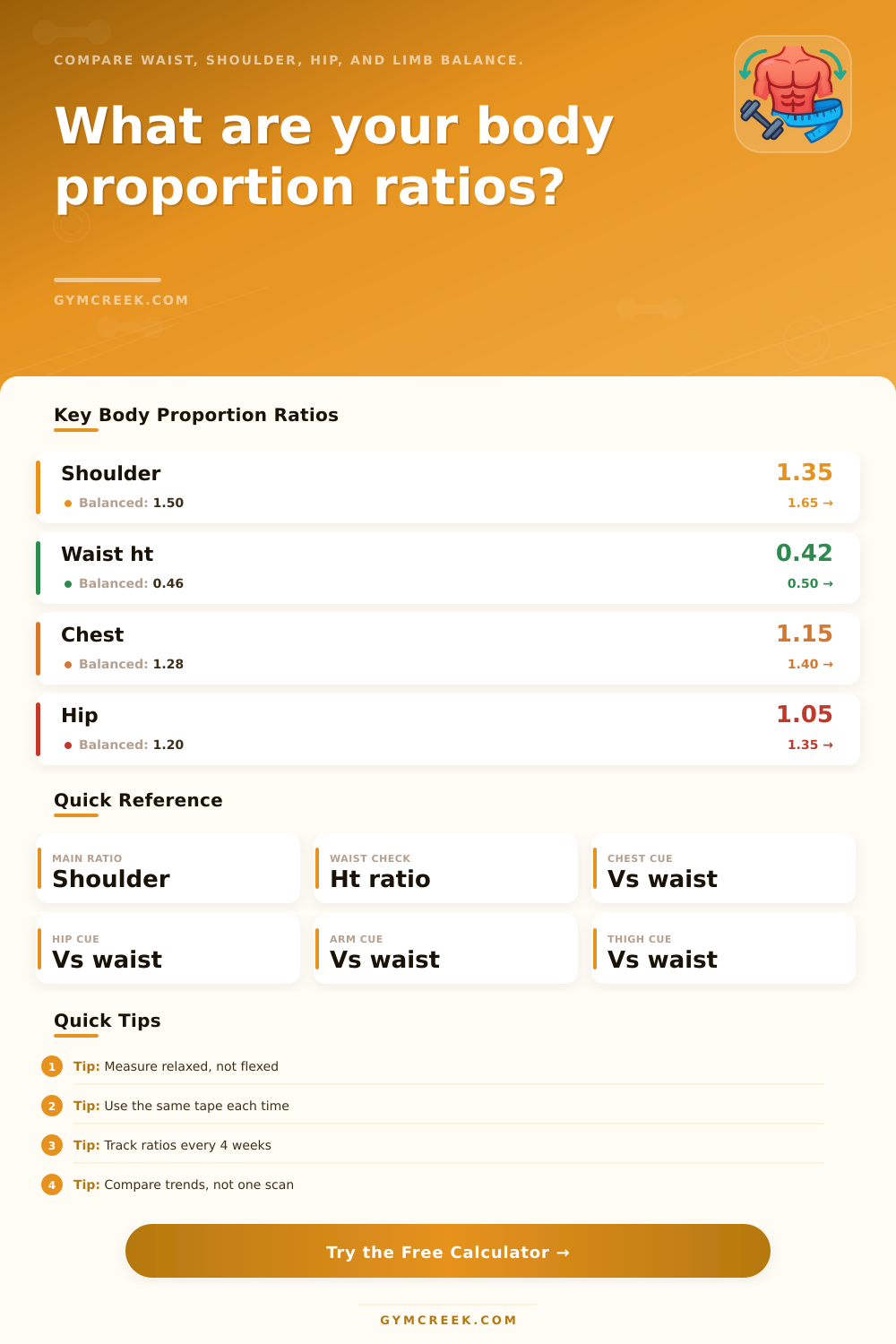
| Shoulder waist | Shoulder / waist | 1.30-1.70 | V-taper |
| Waist height | Waist / height | 0.40-0.55 | Lean context |
| Chest waist | Chest / waist | 1.10-1.45 | Torso balance |
| Hip waist | Hip / waist | 1.00-1.40 | Lower shape |
| Goal | Shoulder | Waist ht | Hip |
|---|---|---|---|
| Balanced M | 1.52 | 0.46 | 1.08 |
| V-taper M | 1.65 | 0.44 | 1.05 |
| Balanced F | 1.38 | 0.43 | 1.28 |
| Lower F | 1.34 | 0.43 | 1.36 |
| Scenario | Signal | Next metric | Review |
|---|---|---|---|
| Recomp | Waist down | Chest hold | 4 weeks |
| Bulk | Chest up | Waist pace | 3 weeks |
| Cut | WHtR down | Arm hold | 2 weeks |
| Balance | Side gap | Hip thigh | 4 weeks |
| Method | Variables | Output | Note |
|---|---|---|---|
| Ratio score | 6 ratios | 0-100 | Goal based |
| Target waist | Height | Measure | WHtR based |
| Lean mass | Weight BF | Context | Estimate |
| BMI | Ht weight | Context | Not shape |
💡Tips
Your body isn’t a number on the scale. It’s tempting to think of it as such, but it’s a false idea. When you stand on the scale, all it show is amount of mass you have. It doesn’t differentiate fat vs. Muscle, or bone vs. Water. Step on the scale each morning, and depending upon your hydration level, those numbers will fluctuates. So now you don’t know whether your training has reshaped your form at all.
Proportions solve this problem. They remove noise of weight. Instead, they zero-in on geometry of your frame, how are you constructed? This flips the inquiry: not what is your weight, but what is your build? Once you enter the numbers (see the calculator above), it spits out a bunch of math for you; there’s no need to mess around with conversion factors and coefficients and guessing what everything means. That’s where vanity metrics end, and understanding the basic workings begin.
Why Body Ratios Are Better Than Weight
This isn’t about having large shoulders specifically; it’s about how wide your shoulders are relative to how thick your waist is. You can increase your shoulders without reducing your waistline, so the results does not look as obvious visually. This ratio accounts for that tug-and-pull effect, which causes you to view your own body in terms of two parts instead of one part alone.
It’s tougher than it seems. People always tighten the tape when measuring themselves (or else they pick a different point along their anatomy with each measurement). Relaxed is best. Not flexed. If you flex, you’re temporarily changing your shape; that doesn’t describe your resting structure. Also: Pick the same landmarks on your anatomy, use the same tape, every four weeks. Compare trends over months (not just single snapshots, like right before a big leg day or after you’ve eaten some salty meal.) You don’t need precise measurements; consistency matter more.
On this page, I lay out standard ranges for Strong, Balanced, and Lean body types, giving you some context as to where your numbers fall different than most common fitness goals. Lastly, maybe the most underused is the waist-to-height ratio. It takes all muscle size out of equation and just looks at how lean/healthy you are. Generally speaking, the lower the ratio, the better; this means your body has a healthier fat distribution. But don’t go crazy trying to hit some magical decimal point. We’re looking for progress toward your desired outcome, not perfection on day one.
If you start seeing your chest grow but your waistline creep upward during a bulking phase, then you’re probably gaining some muscle but also a bit too much fat. That’s an imbalance flagged by the calculator before it turns into a long-term habit. It also accounts for gender. Hormonal baseline and skeletal structure differ between men and women, which means that the same hip-to-waist ratio is going to look very different on a man versus a woman with a naturaly wider hip frame. There’s no need to force yourself into ratios meant for men if you want to achieve something healthier and less unrealistic.
Your profile determines what the tool thinks you should of aim for. It keeps you measuring yourself against a realistic standard, so you won’t get frustrated by trying to reach an impossible shape that your body just can’t support efficienty. The lower body is more difficult to train, which is why many lifters ignore it. Leg training demands are high: squats and deadlifts is demanding. Neglecting leg work leads to a look that doesn’t match. Having a good-looking upper body won’t help if you have puny thighs.
Think of your core and waist as the fulcrum for your overall balance. Don’t worry so much about strength; think symmetry too. Thigh-to-waist ratio will make sure the rest of the frame look good. Keep the waist and core as your center. When your limbs get bigger while keeping that stable center, the entire picture looks better.
All this is a guidebook, though. It is not a bible. Remember, it can be easy to chase weight without shape. You could drop five pounds but see your waistline expand by several inches. “The scale says I’m lighter,” you tell yourself in the mirror and look back, “and I feel softer.” That’s when ratios show you the truth, forcing you to ask yourself if it was worth it: were you trying to get bigger or to get more defined?
Take the data into your workouts. Then go hide the measuring tape for a while. Follow the process you’ve established. Shape follows logic.