Body Measurement Calculator
Compare tape measurements, waist ratios, shoulder-waist estimate, and proportional balance, then generate realistic target changes for your selected physique goal.
📌Physique Presets
Presets fill all tape inputs and calculate instantly. Use them as examples, then replace every value with your own relaxed tape measurements.
⚙Calculator
Measurement balance
Enter your measurements to calculate ratios, proportional score, and target changes.
📊Metrics Grid
📑Reference Tables
| Metric | Lower range | Middle range | High attention |
|---|---|---|---|
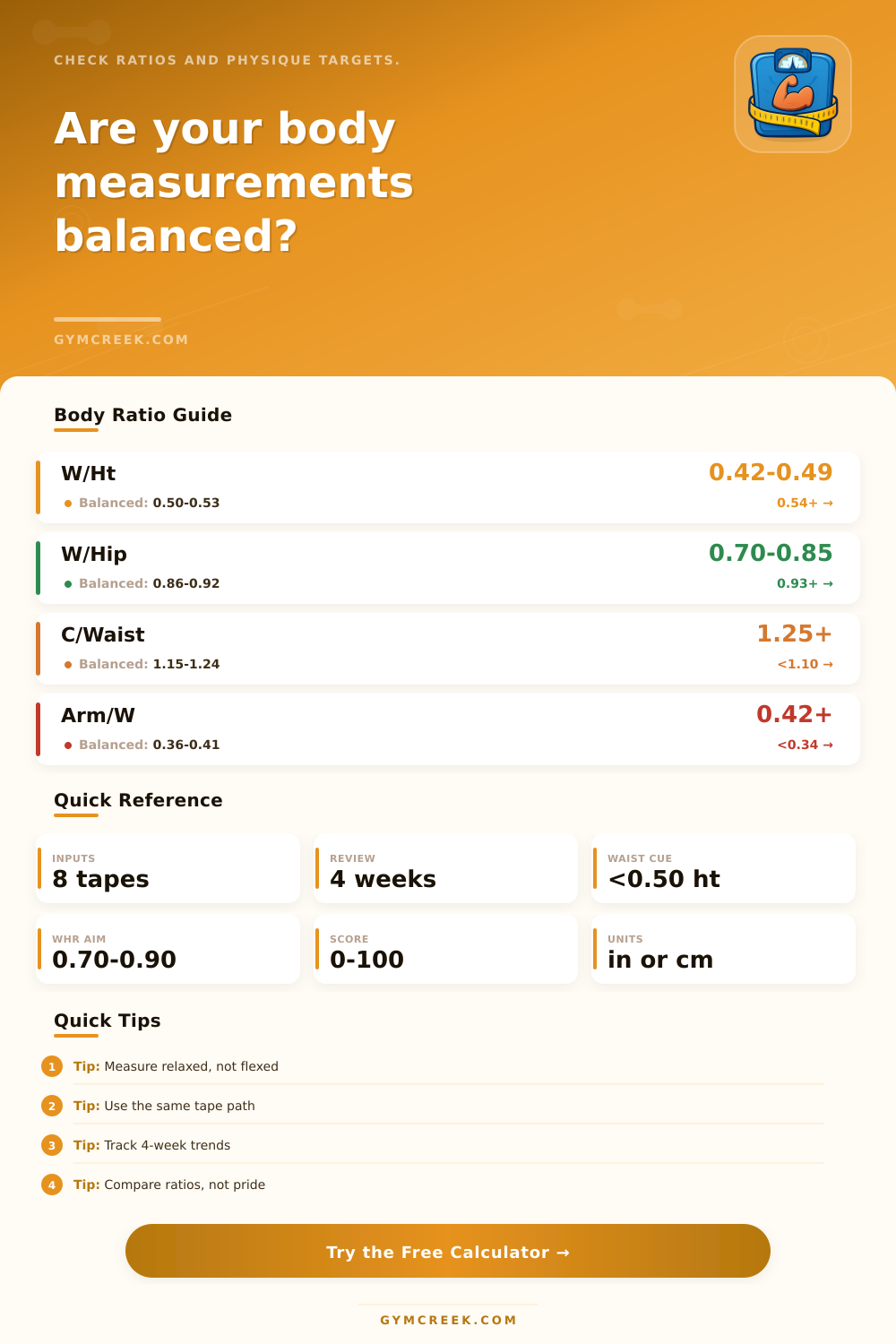
| Waist-to-height | Under 0.42 may be very lean | 0.42 to 0.50 is a common fitness band | 0.54+ deserves health context |
| Waist-to-hip | 0.70 to 0.80 often reads tapered | 0.81 to 0.92 is common balance | 0.93+ shifts priority to waist |
| Waist change | 0.25 to 0.5 in per month is conservative | 0.5 to 1.0 in per month is noticeable | Faster changes need recovery checks |
| Trend window | Weekly tape can be noisy | Four weeks shows clearer change | One reading is not a trend |
| Goal | Waist/height | Chest/waist | Best target cue |
|---|---|---|---|
| Classic V taper | 0.43 to 0.48 | 1.25 to 1.35 | Keep waist tight, build upper body |
| Athletic balance | 0.46 to 0.50 | 1.18 to 1.28 | Even chest, hip, thigh progression |
| Lean endurance | 0.42 to 0.48 | 1.10 to 1.22 | Light waist with stable limbs |
| Power build | 0.49 to 0.54 | 1.18 to 1.30 | Strength frame without runaway waist |
| Measurement | If below target | If above target | Review timing |
|---|---|---|---|
| Waist | Hold steady unless health focus | Reduce gradually through fat loss | Every 2 to 4 weeks |
| Chest | Add upper body size slowly | Maintain while waist changes | Every 4 to 8 weeks |
| Arm | Small increases can shift score | Maintain if symmetry is high | Every 4 to 8 weeks |
| Thigh | Build if lower-body ratio lags | Maintain for endurance goals | Every 4 to 8 weeks |
| Output | Formula | Uses | Interpretation |
|---|---|---|---|
| Waist-to-height | Waist divided by height | Height and waist | Lower is generally leaner |
| Waist-to-hip | Waist divided by hips | Waist and hip tape | Shows trunk-to-hip shape |
| Shoulder estimate | Chest times 1.12 | Chest and waist tape | Approximate upper-frame ratio |
| Proportion score | Weighted ratio closeness | All tape measurements | Planning score, not diagnosis |
💡Tips
Body measurements provides more information than weight measurements because weight measurements can change for a variety of temporary reason. Weight measurements will tell you nothing about your body shape, but body measurements will show you how your body shape is changing. While many people focus on the number on the scale to determine their body composition, focusing only on that number will make it possible for an individual to miss understand how their bodys proportions are even changing.
Proportions are important for determining both how an individual’s clothes will fit on the body, as well as how strength feel within that body. The calculator will perform calculations using the numbers entered into the tape measurements. Those measurements will compare the waist to the height, the waist to the hips, the chest to the waist, and the limbs to the trunk.
Body Measurements Matter More Than Weight
These comparisons are important to provide an understanding of the balance of the body rather than the size of the body. For instance, having a large chest with a soft waist will exhibit different than an individual with a large chest and tight waist. Additionally, the calculator will estimate the shoulder width using the chest measurement, which will allow for an understanding of whether the upper body is growing in comparison to the middle of the body.
Many individuals who use the calculator will not take the body measurements themselves. However, it is important to take these measurements consistent in order to gather accurate data regarding the body composition of the individual. These measurements should be taken at the same time of day, with the body parts measured to the same point on the body, without flexing the muscles of the body or sucking in the stomach.
The waist measurement is often the most useful of these measurements, as it tends to change more faster than any other body measurement. Additionally, measurements of the hips and thighs will provide information regarding the size of the lower body, while the arm and neck measurements will indicate whether the individual is creating even growth in each portion of the body through the training that is performed. Individuals can adjust the calculator according to the body composition goal that each person creates for themselves.
For instance, if an individual desires to have a more tapered look to their body, they will have different ratio compared to an individual who is performing physical activity to enhance their endurance. The calculator can be adjusted to display each individual’s goal, which removes the guesswork in creating goals for their body composition. Tables are provided on the calculator that display typical body composition ratios for each body measurement.
These tables are not rules that each individual should follow, but they do help to provide an understanding of where each individual’s body composition ratios are compared to others with similar body compositions. For instance, a waist-to-height ratio under 0.50 is common among those with fit bodies and low body fat percentages, but a ratio above 0.54 suggests that an individual should focus upon there waist measurements for health related reasons. Similar rules applies to the waist-to-hip ratio.
A waist-to-hip ratio within the 0.80s is considered to be normal, but any ratios higher than this indicate that the waist measurement should be the focus of an individual’s body composition effort. As with any measurement tool, the most important measurements for body composition will be the trends within that body over several weeks. Changes in body composition that are visible after several weeks are more important than those that are visible after only a few day.
For instance, if an individual’s chest-to-waist measurement is increasing while their waist-to-height ratio is remaining the same, this is a positive sign in terms of the success of their body composition training routine. However, if both ratios is decreasing, the individual will need to adjust their routine for their body composition efforts. Some of the most common mistake that individuals can make with these calculators are in the fact that each individual does not take the same body parts as other days.
Additionally, each individual might attempt to adjust their body composition to reach each target at once. The calculator helps to avoid these mistakes by indicating which body measurements are the most distant from each individual’s goal. Thus, each individual can focus their effort on specific areas within the body, rather than attempting to adjust each portion of the body at once.
Additionally, because the calculator provides specific targets in inches or centimeters, it allows for individuals to plan each individual’s training program for the upcoming body composition cycle. While the tape measurement of each individual’s body parts is a helpful measurement of each portion, it does not provide information regarding posture or muscle quality within each body part. However, the tape measurement of each body part will remove the emotional noise that can result from measuring oneself in comparison to others with similar body compositions.
According to the calculator, the ratios of each portion of an individual’s body can be compared to their current routine with the body. If the ratio measurements indicate that each portion of their body is performing in relation to their body routine, then it is acceptable to continue that routine. However, if the data suggest that certain portion of their body are changing in the wrong direction, those adjustments can be made to their body routine.
The body composition calculator should not be used daily to measure each portion of the body. Instead, each individual should enter their body measurements every three or four week to note the change in each ratio measurement for their body. By noting the changes in these ratios, each individual will be able to determine if any change need to be made to their body composition routine.