Body Fat Measurement Calculator
Estimate body fat percentage, lean mass, fat mass, and measurement categories with tape-based Navy formulas.
📌Presets
Each preset loads a realistic tape-measure profile and recalculates the body composition snapshot.
⚙Calculator
Body fat snapshot
Enter your measurements and calculate a tape-based estimate.
📊Measurement Snapshot
📑Reference Tables
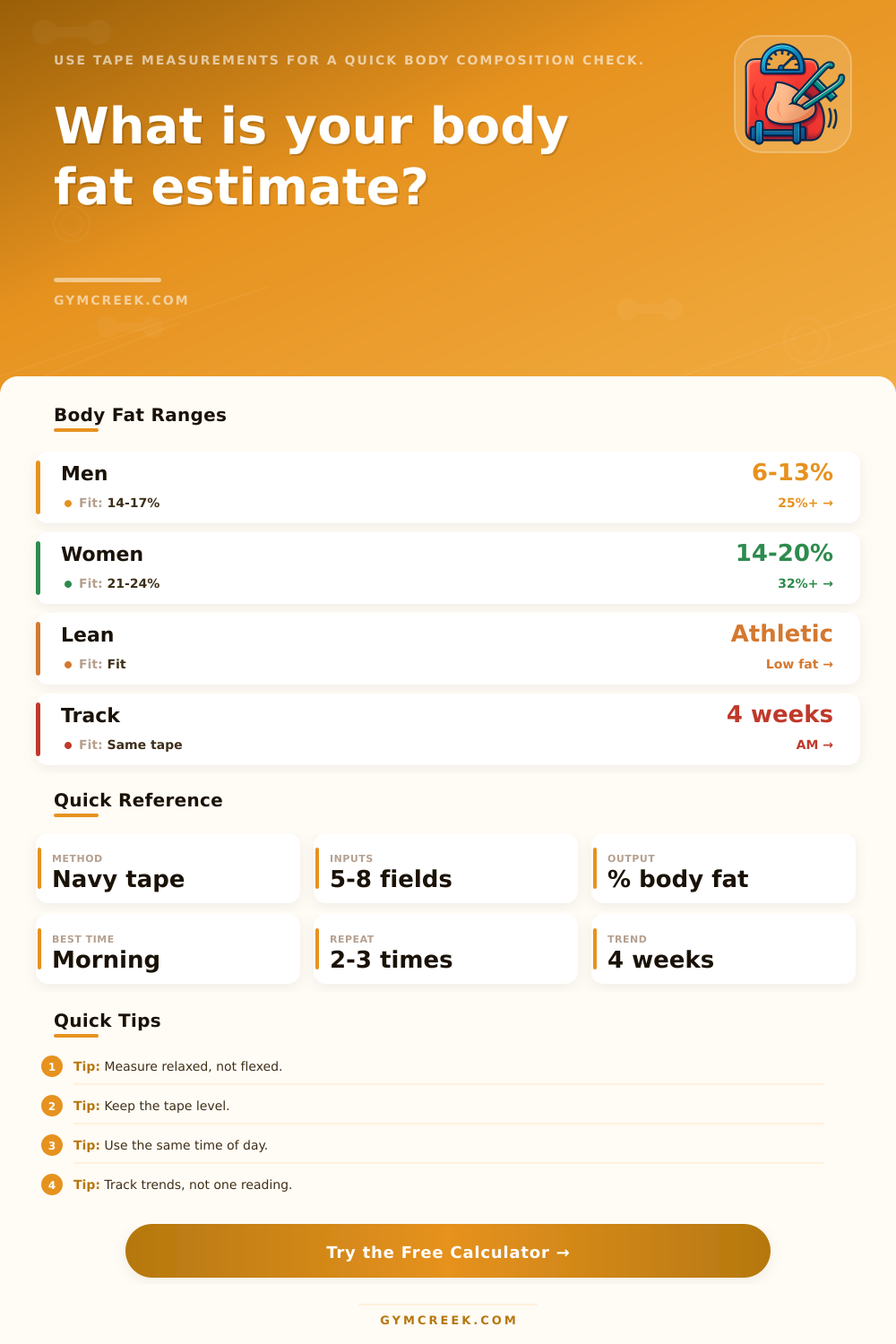
| Men | Body fat | Category | Context |
|---|---|---|---|
| Essential | 2-5% | Very low | Not a goal |
| Athletes | 6-13% | Lean | Sport build |
| Fitness | 14-17% | Fit | Visible shape |
| Average | 18-24% | Moderate | Common range |
| Higher | 25%+ | High | Track trend |
| Women | Body fat | Category | Context |
|---|---|---|---|
| Essential | 10-13% | Very low | Not a goal |
| Athletes | 14-20% | Lean | Sport build |
| Fitness | 21-24% | Fit | Visible shape |
| Average | 25-31% | Moderate | Common range |
| Higher | 32%+ | High | Track trend |
| Measurement | How to take it | Repeat | Common error |
|---|---|---|---|
| Neck | Below larynx | 2-3 times | Tape angled |
| Waist | Navel level | 2-3 times | Stomach held in |
| Hip | Widest point | 2-3 times | Tape too high |
| Height | Flat stance | Once | Shoes included |
| Formula | Inputs | Best use | Output |
|---|---|---|---|
| Male Navy | Height, waist, neck | Adult tape estimate | Body fat % |
| Female Navy | Height, waist, hip, neck | Adult tape estimate | Body fat % |
| BMI | Height, weight | Size context | kg/m2 |
| Lean mass | Weight, body fat | Composition trend | Mass estimate |
💡Tips
Weight doesn’t tell you how much of it is muscle and how much is fat. That’s why the number on the scale might be higher or lower than last month even though you’re actualy in better or worse shape. Body composition, not just weight (determines your health outcomes). So if you want to know if all those added pounds were earned with hard work or simply collected lazily, a simple solution exists: use a tape measure to measure yourself. It’s an accurate measurement for distinguishing fat from muscle, and there’s no need for any fancy tools. Just input the measurements into the calculator above, let it do the math for you, and you’ll know exactly where you stand.
It relies on the US Navy formula for body density based off circumference measurement (for men: your neck and waist sizes plus your height; for women: add in hip circumference as well). Basically, the larger your neck compared to your waist (compared to your height), the greater amount of muscle is in your upper body, and the less fat are stored around your gut. It’s simple enough math. Put those ratios together and it gives you a percentage that matches up fairly closely with results of clinical hydrostatic weighing tests. Why? Because its inputs represent a closer approximation of our human form, geometry-wise, different than any number on the scale can ever hope to be.
Why Measuring Your Body Is Better Than Weighing It
The accuracy comes down to measurement. Most folks mess up here. Hold the tape measure at the navel, parallel to the ground, after a normal exhale. This prevents you from sucking in your gut and making the waist numbers look lower then they are, which gives you a false sense of accomplishment. For neck measurements, place the tape around your voice box (just under). The key is consistency; trends gets distorted by water weight changes if you measure at different times of the day. The cleanest baseline is first thing in the morning before training or eating. See reference table for average/athletic range norms (but keep in mind context is more important then label).
The one percentage alone doesn’t tell you what comes out; this tool will break it down for you into how much is lean mass (not fat = muscle, bone, organs, water) versus fat mass. That’s key if you really wanna know how you’re doing. For instance, if you’re strength training, you may see no change in your body fat percentage but an increase in lean mass, indicating you’re making progress when the overall number hasn’t budged yet. Or you may drop a lot of body fat quickly but see no change in weight, and realize: oh sh-t, I’m losing muscle. You don’t want that, you’ll need that base of lean to maintain and add on. So shed the extra storage but keep the lean.
Your body composition takes time to change, so tracking it for multiple weeks is going to give you more information than just one snapshot (unless you’re on an extreme program). Daily changes like your hydration, sodium intake, and glycogen stores causes noise. Averaging across a week smooths this out and allows you to see what’s actualy going on. Athletes requires different monitoring frequencies than sedentary people, which is why the calculator suggests a review interval based on your training context. Data from weeks, not days, are necessary before adjusting your workout plan or diet.
In the end, keep perspective; your goal is to get leaner, so remember what inspired you to start tracking metrics in the first place: the scale no longer made sense. Body fat percent adds clarity to an otherwise fuzzy photo; it helps distinguish between non-functional stuff you want gone and the functional stuff that is merely heavy. Measure carefuly and precisely. Repeat this three times. Average them. Don’t let day-to-day jitters get you riled up, focus instead on the trend line (months at a time). Give it time, and the numbers will predictably tell you what the mirror already knows…but not until then.