Body Fat BMR Calculator
Estimate lean mass, Katch-McArdle or Cunningham BMR, TDEE, calorie target, and macro support from body weight and body fat percentage.
📌Lean-Mass Presets
Each preset loads weight, body fat, lean mass handling, sex, activity, training frequency, goal, and protein settings.
⚙Calculator
Body fat adjusted BMR snapshot
Enter weight, body fat, activity, training, goal, and protein settings to calculate.
📊Fitness Metrics
📑Reference Tables
| Method | Formula | Inputs | Use when |
|---|---|---|---|
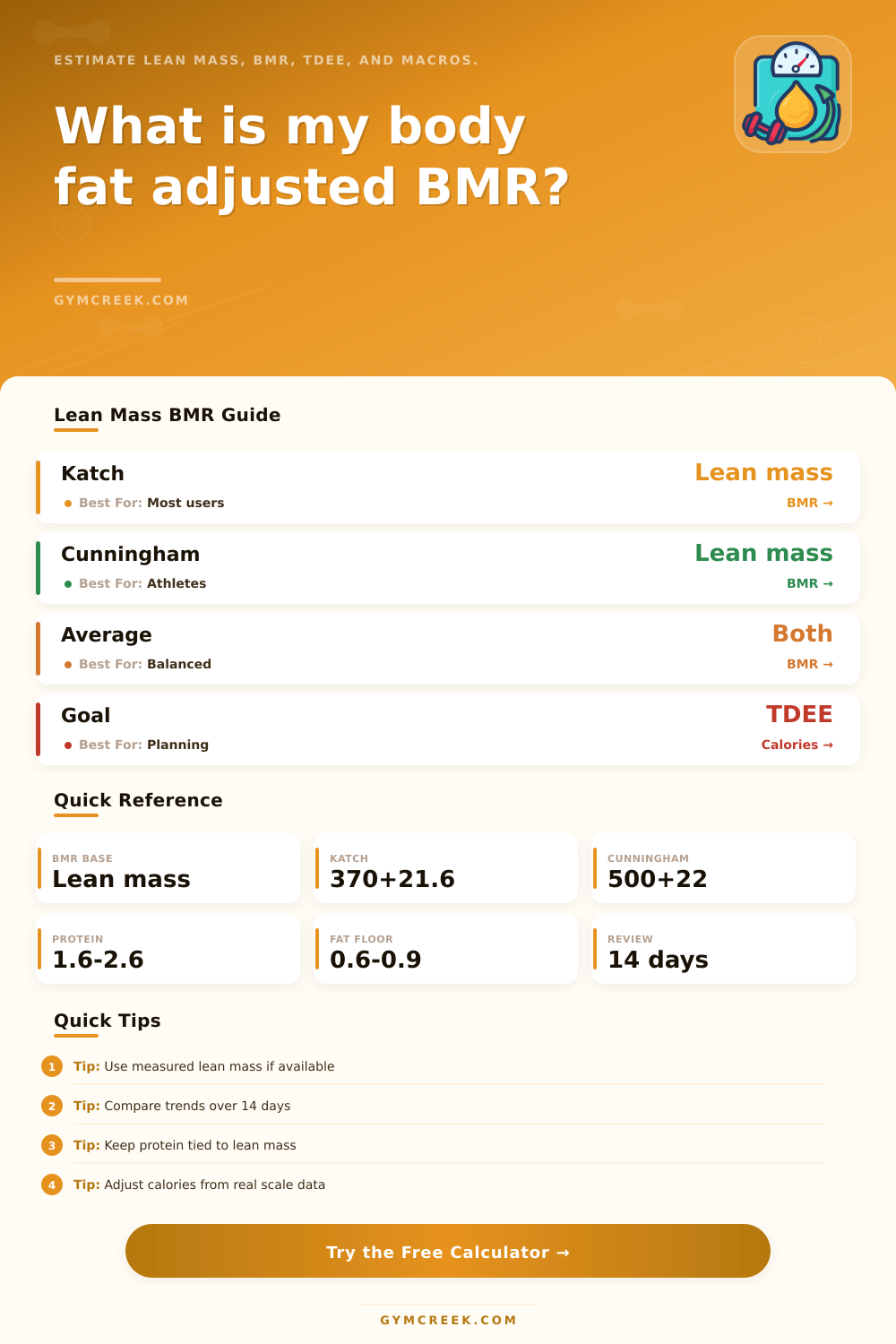
| Katch-McArdle | 370 + 21.6 x LBM kg | Lean body mass | General lean-mass BMR estimate |
| Cunningham | 500 + 22 x LBM kg | Lean body mass | Trained or high-output athletes |
| Average | Mean of both | Both formulas | Balanced estimate when unsure |
| TDEE | BMR x activity + training | Activity and lifting | Daily intake planning |
| Goal | Bias | Best fit | Review cue |
|---|---|---|---|
| Hard cut | -15% | Short fat-loss phase | Watch recovery |
| Fat loss | -10% | Steady cut | Trend weekly |
| Recomp | -5% | Lift and trim slowly | Use photos too |
| Maintain | 0% | Stable weight | Hold habits |
| Lean gain | +5% | Slow muscle gain | Small surplus |
| Phase | g/lb LBM | g/kg LBM | Use |
|---|---|---|---|
| Maintenance | 0.8-1.0 | 1.8-2.2 | Stable energy |
| Recomp | 1.0-1.2 | 2.2-2.6 | Most lifters |
| Cut | 1.1-1.4 | 2.4-3.1 | Lean mass support |
| Lean gain | 0.9-1.1 | 2.0-2.4 | Surplus phase |
| Range | Men | Women | Planning cue |
|---|---|---|---|
| Lean | 10-14% | 18-22% | Small deficits |
| Athletic | 14-18% | 22-26% | Recomp friendly |
| Average | 18-25% | 26-33% | Steady cut |
| Higher | 25%+ | 33%+ | Consistency first |
💡Tips
To understand how many calories your body burn, you must separate the body tissue that burns calories from the body tissue that stores calories. Your body fat percentage measure this split between the two type of tissue. Once you know your lean body mass, you can calculate your resting metabolism rate (RMR).
The resting metabolism rate take into consideration the lean body mass because it is the tissue that burns the most calories when you are resting. Using the concept of lean mass to calculate resting metabolism is more helpful than using old formulas for calculating resting metabolism because these old formulas use total body weight, which does not always reflect the number of calories that your body burns. The calculator do the math for you once you enter your weight and body fat percentage.
Use Lean Body Mass to Calculate Your Daily Calories
It calculates your lean body mass through subtraction or through direct measurement of your lean body mass if you have an direct measurement of your lean body mass. Once the calculator determine your lean body mass, it uses either the Katch-McArdle equation or the Cunningham equation to calculate your resting metabolism rate. Both of these equation are helpful because they use lean body mass to calculate resting metabolism rate as opposed to total body weight.
Using lean body mass as the measurement for resting metabolism rate is beneficial because it remove noise from the calculation. Body fat or muscle mass causes noise in this instance. Your resting metabolism rate is only an estimate of the number of calories that you burn daily when you are resting.
To get a more accurately measurement of daily calories, you must use your activity level and the number of days each week that you lift weight. The activity level accounts for the number of calories that your body burns when you are not using the gym. The lifting sessions adjustment account for the calories that your body burns when you lift weights.
Many people dont account for the number of calories that lifting burns once the lifting sessions are over; therefore, the adjustment to resting metabolism rate for lifting sessions ensure that people do not significantly underestimate the number of calories that they burn each day. Your goal will change the amount of calories per day that your body require to reach that goal. A ten percent calorie deficit will allow most people to lose fat steadily over time.
A fifteen percent calorie deficit can work for a shorter period of time as it may lead to increased feeling of hunger over time. A calorie surplus will encourage your body to gain muscle as your body will have enough calories to encourage muscle growth without gaining excessive body fat. A calorie surplus that is modest will be similar to the calorie intake of individuals who perform lifting sessions.
The reference tables will show the difference between the number of calories per day that individuals need if they choose to have a daily calorie deficit in the range of ten to fifteen percent; however, the goal that you choose will determine that number. Tables on the website show how body fat percentage relate to different planning decisions. For example, individuals with lower body fat percentages will have smaller calorie deficit.
This is true because these individuals have less fat to lose and it is easier for them to recover from increased calorie demands. Individuals with higher body fat percentage will have larger calorie deficits over a longer duration of time. These individuals have more stored energy within their body that their body can use as fuel.
These examples are not rules, but the explanations for why individuals with the same body fat percentages may require different calorie intake or deficits. A common mistake with the calorie calculator is treating the first number that come out of the calculator as the permanent number for the bodys calories burned daily. Since body weight and body fat fluctuate over time, you must update the body periodically.
This calculator should of been run every two to four week to account for any changes in body composition. Another mistake is to ignore the minimum fat intake that the body requires. If there are not enough calories left over for carbohydrates after protein and fat intake, the bodys performance in the gym will diminish.
Thus, if performance in the gym decreases, it is likely that the body will not be able to achieve it’s goal. The benefit of focusing on lean body mass rather than total body weight when determining resting metabolism rate create a change in the focus of the bodys energy expenditure calculations. Even a small change in body fat percentage or training frequency can change the number of calories that the body burns daily by a significant amount.
Thus, it is more important to make adjustment to the calculator than to focus on the number that the calculator calculate. The value of these calorie estimations is that they focus on the variable that can most accurately reflect calorie expenditure: lean body mass. The calculator make decisions for the person using the calculator regarding the number of calories the body should consume daily.
Thus, the calculator remove the focus on decisions on guesswork and focuses the person using the calculator on observable signal. Youll find that most moddern methods work better based off these values. It is actualy alot easier to track progress when you use the right tools.
The results will be much more luxurius for your training plan.