Board Press Load Calculator
Estimate board press maxes, rounded working loads, overload percentage, and session tonnage for lockout-focused bench training.
📌Presets
Each preset loads a complete board press scenario and recalculates with the current unit labels.
⚙Calculator
Board press snapshot
Enter your bench and board setup to calculate a working load.
📊Fitness Metrics Comparison
📑Reference Tables
| Board Setup | Typical ROM Change | Expected Load Effect | Best Use |
|---|---|---|---|
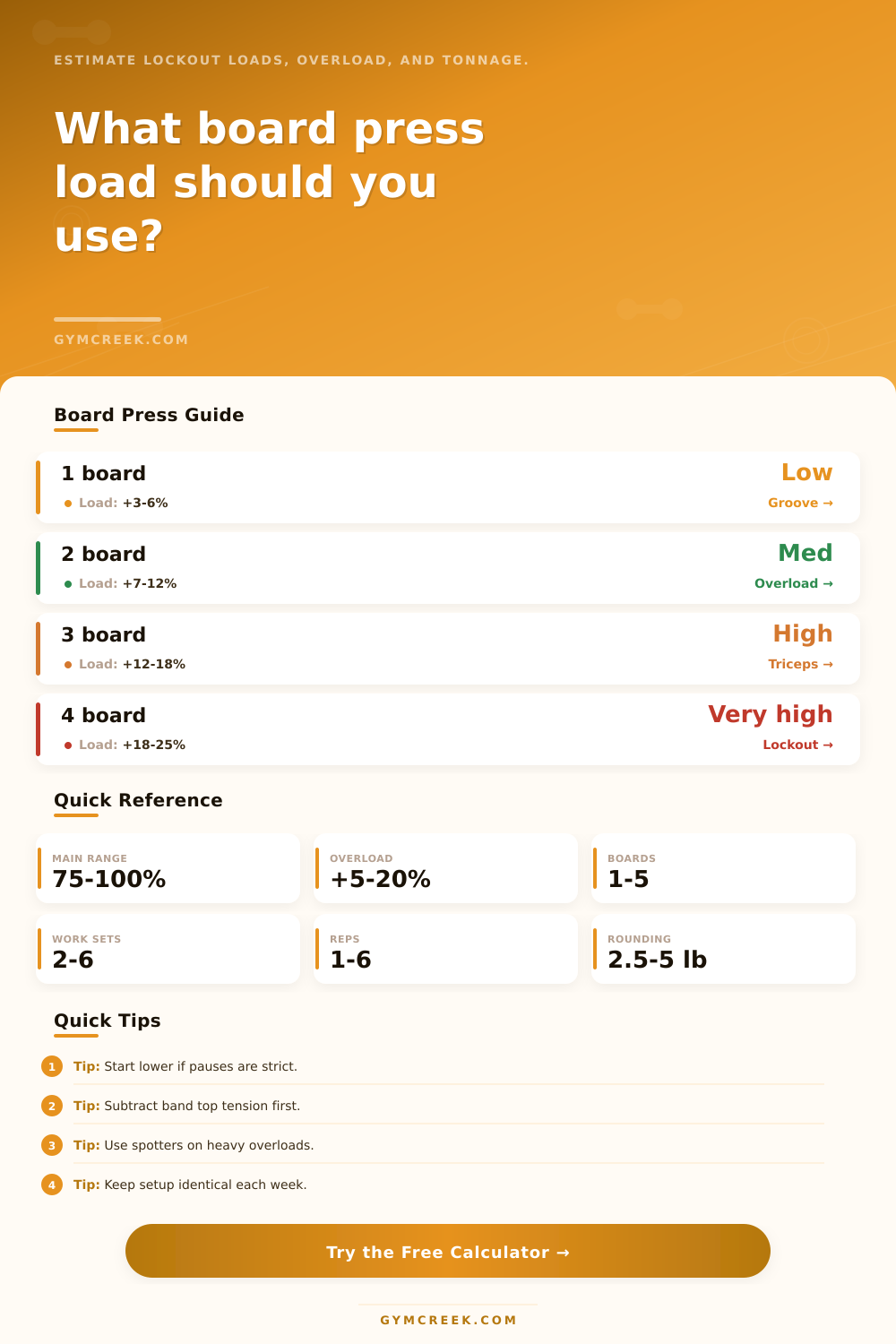
| 1 board | Small chest-range reduction | About 3-6% above full bench | Groove work and paused confidence |
| 2 boards | Moderate mid-range reduction | About 7-12% above full bench | Common overload work |
| 3 boards | High triceps emphasis | About 12-18% above full bench | Lockout strength and triples |
| 4-5 boards | Very short range of motion | About 18-28% above full bench | Heavy top-end practice |
| Training Purpose | Common Intensity | Reps | Loading Note |
|---|---|---|---|
| Technique practice | 65-80% board max | 3-6 | Clean contact and consistent touch point |
| Speed lockout | 60-75% board max | 2-4 | Move fast without losing tightness |
| Volume builder | 70-85% board max | 4-8 | Moderate load with repeatable reps |
| Heavy overload | 85-100% board max | 1-4 | Use spotters and stable handoff |
| Peaking singles | 92-108% board max | 1-2 | Low volume and strict setup |
| Variable | Adjustment Used | Reason | Watch Point |
|---|---|---|---|
| Close grip | -3.5% load modifier | More triceps demand and longer lockout | Keep elbows under the bar |
| Wide grip | +1.5% load modifier | Often shortens pressing distance | Do not flare too early |
| Paused board | -2% load modifier | Removes rebound and forces control | Stay tight on the board |
| Dead stop | -4% load modifier | Hardest restart from the board | Brace before every press |
| Formula Step | Calculator Formula | Output | How to Use |
|---|---|---|---|
| Board height | Boards x board thickness | Total block height | Defines range reduction |
| ROM factor | Height x 5.5%, capped at 32% | Estimated ROM cut | Scales board max upward |
| Board max | Bench 1RM x modifiers | Estimated partial max | Sets the training ceiling |
| Working load | Board max x intensity - top resistance | Straight bar load | Round to available plates |
💡Tips
Before lockout, it’s like something is “just a little tough.” That last inch feels difficult and you’re standing at the bench wondering if your tricep aren’t too tired for this lift. This is where boards come in for lifters. To allow us to lift more weight, we puts wood on our chest to reduce range of motion.
But you don’t want to add plates until your hands shake because there are some specific numbers you need to have to guide your training. Fortunately, the board press load calculator (above) perform this equation for you. It inputs your raw one-rep max and predicts your partial max.
How To Use Board Press Calculators For Better Strength
Why does that matter? Because we’re bad at guessing our own partial max. We either tack on a whopping 20 percent and wonder why our elbows flare out, or we go easy with just five pounds and feel shortchanged when we realize there’s no stimulus. That’s where this tool comes in; it fills the void and gives you a number that approximates how much stronger you are without the weak link of bottom end. It isn’t magic, it’s math, but math that will save your joints.
For example, look at how many boards you use. For every inch and a half of added height per board, you get less chest contact and more tricep involvement. The page has a reference table that makes it pretty clear. A single board is basically groove work for when the bar gets loaded up. Two boards are the sweet spot for most intermediate lifter who want to overload their bench without compromising their form. Three or four boards take you straight into lockout territory where bar speed is no longer negotiable.
If you’re having trouble doing heavy triples in full bench, three boards should of been your solution. If you’re just slow getting off the chest, one board will teach you what acceleration feels like again.
The other lever to yank is intensity. Most of the working sets will fall somewhere between 75-90% of that estimated max on the board. Use bands or chains for anything over one hundred percent. This handles weight change as you go from top to bottom. When you enter this additional tension into the calculator it will subtract out the amount from the straight bar weight. This means you aren’t going to overload static weight. That’s no good, it won’t let you accelerate past the sticking point. We need dynamic effort, not a standoff with gravity.
Remember that pause type too. With a touch-and-go board press, you can use some stored energy and press up with a little bit of momentum. Looks good, feels fast; hides technical deficiencies. The pause (or dead stop) variation make you build tension each and every rep from zero velocity. This causes the calculator to adjust downward and recommend a slightly lower load. It is a small tweak that makes a big difference. You’ll move less weight but gain more strength in return.
People make that mistake because they focus so much on chasing the number on the plate instead of quality of the contraction. It will also round down to the nearest practical jump. Microplates aren’t common at most gyms, and they’re not necessarily in exact increments. By default, it rounds down to next practical jump (typically 2.5 kilograms/5 pounds). That keeps things safe but doesn’t lose too much intensity. If you have special equipment, you can adjust that rounding, but for most people, the defaults will be enough.
And then there’s fatigue. You just did some killer deadlifts and squats. Now your nervous system isn’t ready for that big ol’ weight. Use the readiness adjustment slider to turn down the weight appropriately. Rather than grinding out a sloppy rep with your brain nearly screaming at you from delirium, it’s best to go light but quick. Long-term consistency trumps short-term intensity.
Use the same set-up each time. Keep boards in the same place on the bench, keep the same arch, and use the same grip width. Varying these variables makes your data worthless since now you don’t know whether your strength increased or if you accidently stacked the boards higher. You are creating a controlled environment for the calculator. It’s your job.
Go light. Do two or three reps to find your maximum estimate. Adjust from there. How did that feel? Was it too much? Was it too little? Then do that. The numbers aren’t the destination; they’re the starting line. They should be used as a guide for your programming, and then your body will tell you when to stop.
Moving weight isn’t the only goal here. It is moving better. And that is the point.