BMX Crank Length Calculator
Start with riding inseam, then var BMX discipline, wheel size, cadence, and control priorities pull the answer toward a crank length that feels believable for gates, ramps, manuals, and spin tricks.
BMX Rider Presets
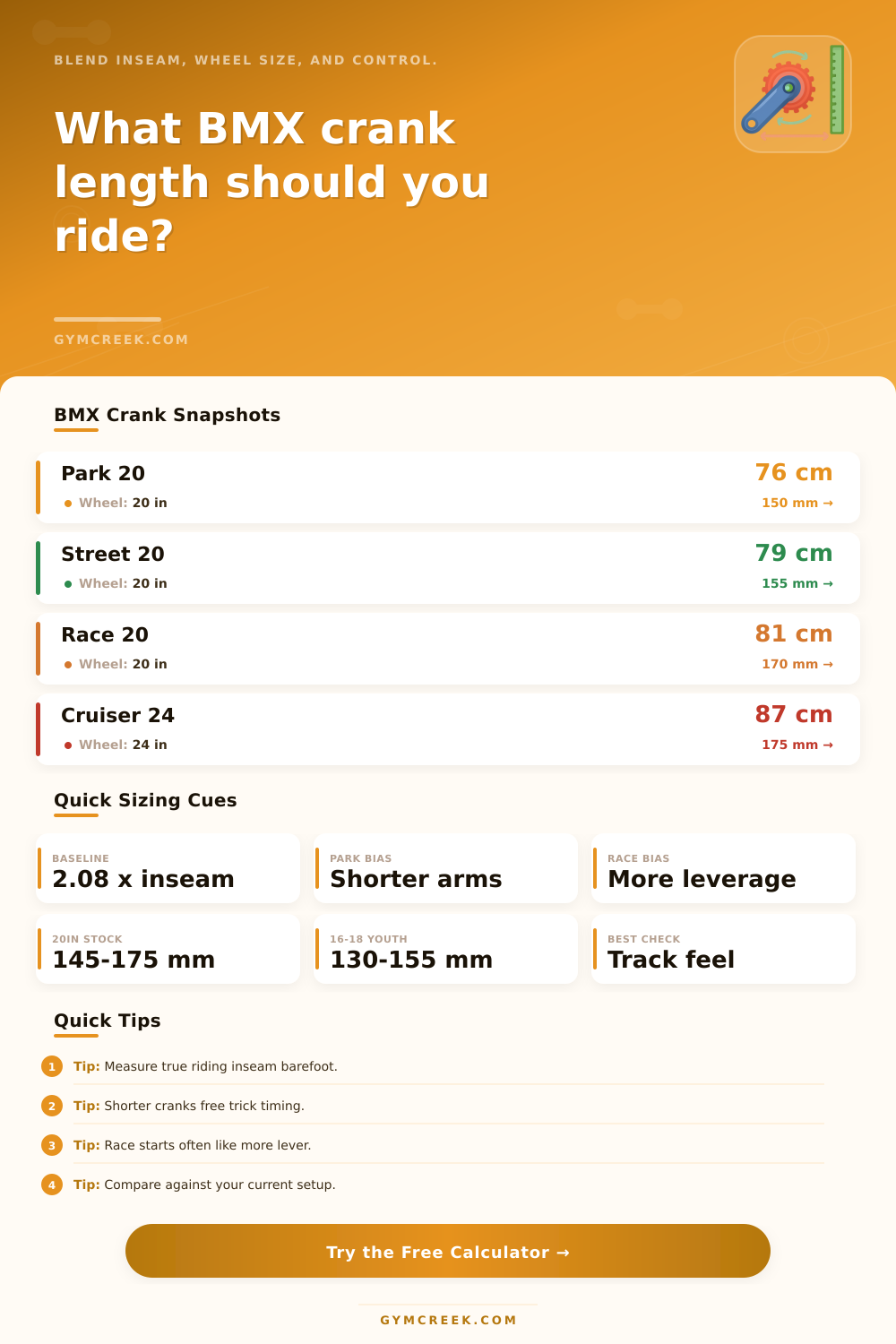
These presets cover youth, park, street, race, dirt, flatland, and cruiser situations so you can compare leverage and trick-room tradeoffs without filling every field from scratch.
BMX Fit Inputs
BMX crank recommendation
Enter rider details to estimate a practical BMX crank length.
BMX Metrics Grid
Reference Tables
| Riding inseam | Raw baseline | Usual stock | Read |
|---|---|---|---|
| 56-62 cm | 116-129 mm | 130-140 mm | Mini and junior starts short |
| 63-69 cm | 131-144 mm | 140-145 mm | 18 inch and small 20 inch riders |
| 70-76 cm | 146-158 mm | 145-155 mm | Park and youth race overlap |
| 77-83 cm | 160-173 mm | 155-165 mm | Most adult 20 inch builds live here |
| 84-90 cm | 175-187 mm | 165-175 mm | Taller riders still get capped by BMX stock |
| Discipline | Bias | Main reason | Typical call |
|---|---|---|---|
| Park | -5 mm | Faster spin and bike movement | Slight trim |
| Street | -7.5 mm | Tech room around ledges and spins | Shorter is common |
| Race | +7.5 mm | Starts and hard pumping reward lever | Longer drive |
| Dirt | 0 mm | Neutral mix of speed and control | Stay near base |
| Flatland | -12.5 mm | Tight spin work favors the shortest feel | Shortest first |
| Cruiser | +2.5 mm | Bigger bike and seated drive | Mild increase |
| Wheel size | Allowed band | Common sizes | Notes |
|---|---|---|---|
| 16 inch | 130-145 mm | 130, 135, 140 | Mini bikes top out quickly |
| 18 inch | 135-155 mm | 140, 145, 150 | Junior race and street crossover |
| 20 inch | 145-175 mm | 145 to 170 | Main freestyle and race market |
| 22 inch | 155-180 mm | 160 to 175 | Larger BMX frames accept more arm |
| 24 inch | 160-180 mm | 165 to 180 | Cruiser leverage shows up fast |
| Context | Shorter cue | Longer cue | Why |
|---|---|---|---|
| Cadence | 95+ rpm | Below 78 rpm | Fast spin shortens the pedal circle |
| Priority | Spin room | Drive out of turns | Control and leverage trade off directly |
| Pedal feel | Quick spinner | Heavy stomp | Pedal pressure shifts size tolerance |
| Current crank | Knees too tucked | Need more launch | Your present setup is a reality check |
BMX Setup Tips
Crank length is the measurement from the center of the bottom bracket to the center of the pedal spindle. For BMX riders, crank length is important because it determine in what way the riders leg are moved relative to the bicycle. If the crank length is too long, the rider may struggle to plant there feet into the bicycle during spins.
However, if the length is too short, the rider may not be able to produce enough power from their bike at the start of a ride. Thus, finding a correct length for the crank is essential for both efficient riding and performing trick. In determining the appropriate length for the crank lengths on their BMX bike, a person must consider a variety of factors.
How to Choose the Right Crank Length for Your BMX
One of the primary factors to consider is the inseam of the BMX rider. A persons inseam is the distance from there floor to their crotch, and this should be measured while barefoot. A persons inseam will dictate the length of the crank that they can use; the shorter the inseam, the shorter the crank length that the person should use.
Another factor to consider is the height of the person. A persons height will indicate the length of they’re legs in relation to their torso. Individuals with long legs may benefit from using longer crank length relative to individuals with shorter legs.
An additional factor to consider in selecting the length of the crank for BMX bikes is the type of BMX riding that the individual will perform. BMX park riders may prefer shorter crank lengths to allow their legs to move at a faster rate. Street riders will also benefit from the use of shorter crank lengths to provide more space for their feet to move while performing tricks.
BMX race riders may prefer longer crank lengths to allow them to accelerate at the start of the race, or to traverse over berms at a BMX competition. Dirt jump BMX riders may require some balance between the length of their crank that they use and the amount of power that they can provide with each movement of their legs. Flatland BMX riders may utilize the shortest possible crank lengths to allow their BMX bikes to spin at a high rate, similar to a gyroscope.
Finally, cruiser BMX bikes have longer crank lengths due to the fact that cruiser bikes have a larger wheel size. In addition to the factors listed above, another consideration in the purchasing of BMX bikes is the cadence and control of the BMX rider. Cadence is the speed at which a person pedals.
A person who pedals at high cadences of 95 rpm and beyond may find that shorter crank lengths provides for a smoother pedaling circle. Shorter cranks reduce dead spots in the pedal stroke. Individuals who prefer to have slower and more powerful pedal strokes may prefer longer cranks.
The process of determining the proper crank length for a BMX bicycle involves some mathematical calculations and the review of available equipment for the individual. The inseam of the rider can be doubled to determine an initial length for the cranks. From this initial length the preferred riding style and cadence can be considered to make adjustments to the length of the cranks.
Crank lengths come in specific sizes in most cases; lengths of 145 mm and 170 mm are common crank lengths. Wheel size should also be considered in that the size of the wheel can limit the length of the crank; for example, an individual who rides bikes with 20-inch wheels may desire to choose a shorter crank length than an individual who rides 24-inch bikes. There are benefits to each length of crank, but it is important for the individual to test various crank lengths while riding; benefits to longer or shorter cranks may not be easily seen while in the shop.
For example, an individual who switches from 160 mm cranks to 150 mm cranks may find that they have an advantage in performing no-footers because their legs are no longer hitting the frame of the bike. A racer who adjusts from 150 mm cranks to 175 mm cranks may find that they can produce more power at the start of a sprint but lose some of their spin speed at the end of the sprint. Common mistakes that can be made with crank length include using the same length as those of mountain bikes; BMX bikes require different dimension for the cranks because BMX biking places an emphasis on maneuverability.
Another mistake is in the choice of pedals; bikes with wider pedals will allow for more “room” for each individuals legs. Crank length can also be affected by the frame of the bike; bikes with different frame geometries will allow for different feelings in regard to the crank length. Finally, any chosen crank length should of been ridden for at least one week to ensure that the length does not cause knee discomfort for the individual or make it difficult for the individual to spin the bike at comfortable rates.
An individual should of checked the bikes size too. Its important to avoid making errors that could cause discomfort. Actually, many people dont realise how much the crank length can affect how they ride.
Youll need to take your time to find the right one. There is alot of different options out there. The modern bike setup can be complex.
If you want to ride better, you should of checked your inseam first. It is a very important part of the process.