Blood Flow Restriction Pressure Calculator
Estimate BFR cuff pressure from measured LOP/AOP or a conservative screening model, then compare working ranges for supervised arm or leg training.
📌Presets
Each preset loads a realistic supervised BFR scenario. Use measured LOP/AOP when available; estimates are only planning aids.
⚙Calculator
BFR pressure snapshot
Enter cuff, limb, and screening details to calculate.
📊Fitness Metrics
📑Reference Tables
| Context | Upper limb | Lower limb | Use note |
|---|---|---|---|
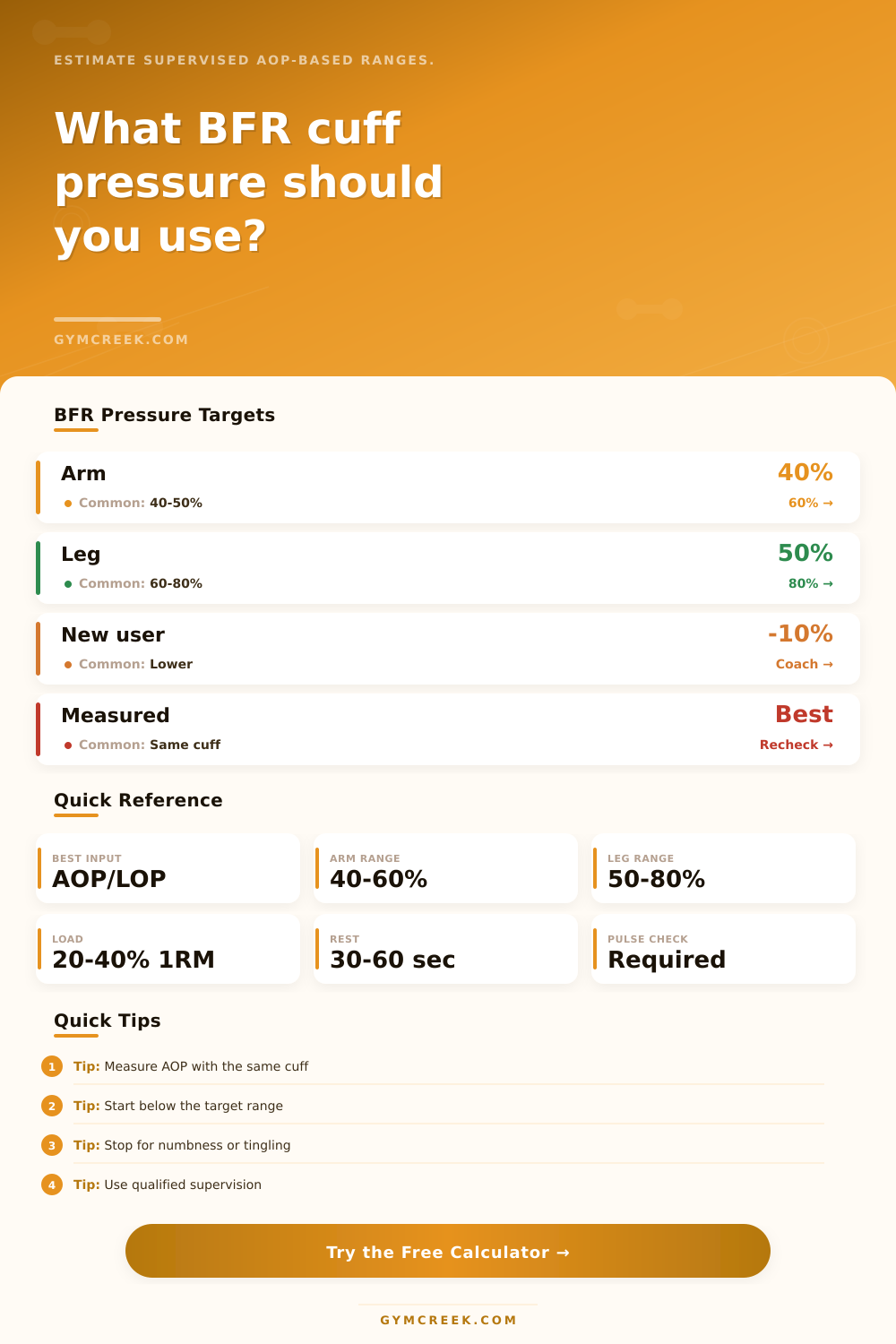
| First session | 40% LOP | 50% LOP | Learn feel |
| Rehab strength | 45-50% | 55-65% | Conservative |
| Hypertrophy | 50-60% | 60-80% | Low load |
| Aerobic | 40-50% | 50-60% | Easy pace |
| Cuff width | Typical size | Pressure effect | Action |
|---|---|---|---|
| Narrow | 5 cm | Needs more | Measure LOP |
| Medium | 10-12 cm | Moderate | Same cuff |
| Wide | 17-18 cm | Needs less | Avoid guessing |
| Elastic | Varies | Less precise | Use caution |
| Metric | Common value | Why it matters | Check |
|---|---|---|---|
| AOP/LOP | 100% | Occlusion base | Doppler best |
| BFR load | 20-40% 1RM | Low stress | No failure |
| Rest | 30-60 sec | Protocol dose | Monitor feel |
| Reperfusion | 3 min | Tissue break | Deflate cuff |
| Stop sign | Meaning | Response | Next step |
|---|---|---|---|
| Numbness | Nerve stress | Deflate | Assess |
| No pulse | Too much | Stop | Recheck AOP |
| Dizziness | System stress | Stop | Medical help |
| Sharp pain | Unsafe feel | Stop | Review plan |
💡Tips
Most folks treat blood flow restriction training like a gamble with their blood flow. Wrap a band around their arm or leg and hope for the best. Hope they don’t cut off circulation. They wildly guess at how tight is too tight. Well, that completely neglects the biology.
Blood flow restriction rely on partial blockage of venous return while still allowing arterial inflow. It creates a metabolic stress signal which fool your body into believing you’re lifting weight heavier than what you actualy are. If you have a measured occlusion pressure, the calculator above run the math for you and saves you from having to guess solely based off limb size.
How to Do BFR Safely
Without getting this baseline right, there’s no guarantee the stimulus will hit muscle fibers without also strangeling the nerves. That brings us to our core metric: Limb Occlusion Pressure, or LOP. This is the exact measure of how much pressure it takes to shut off all blood flow in that particular limb at any given time.
Because people vary in size, shape, muscle mass, and even what they had for breakfast that day everyone’s LOP will be unique. The same millimeter of mercury will mean vastly different things when measured with a narrow versus a wide cuff; the wider the cuff, the more the force are distributed. Without a Doppler device available to you, the calculator also gives you an option to enter your limb measurements and cuff width which it uses to account for this variation.
But remember, estimates remain exactly that, estimates. While they can serve as a starting point to plan around, don’t think of them as prescriptions for safe travel. Think of them as conservative lower bounds, don’t use them as a target, but always as a floor.
In this space, it’s less about how hard you push it and more about experience. Beginners should begin far below the recommended range to get used to what it feels like as blood flow is restricted. It will feel odd; expect some heaviness or tingling in the limb (normal up to a degree). If it becomes too painful or numbing, then stop immediately; there’s no glory in grinding through nerve compression.
As the tool lays out in its reference tables, the safe percentages vary greatly based off goal: Muscle growth training can be done much higher than rehab work. Don’t try to rush the adaptation, even veterans need to honor the physiology here. Pressure setting is also directly related to load management. With BFR, users can develops muscle strength with just a few reps at twenty to forty percent of their one-rep max. That’s revolutionary for those looking to preserve tissue quality while avoiding joint stress, think older adult or injured athletes.
But it’s useless unless the cuff traps metabolites in an area that’s also receiving adequate blood flow (oxygen). If the pressure is too low, it is uncomfortable; if it is too high, there is no blood flow and a risk of injury. The sweet spot is both personal and narrow.
Interestingly, safety has a lot to do with resting. BFR calls for short rest periods, typically 30-60 seconds between sets, whereas typical hypertrophy routines may allow longer rests between sets. By maintaining an acidic metabolite environment during the set and providing only slight opportunity for removal through blood flow, you create a signal for muscle growth without allowing too much waste product build-up. Repeat for several sets and then fully deflate and let your limb flush out. It’ll be intense but brief, signaling the end of the workout.
BFR is not for everyone. People with vascular diseases, a history of clots, or uncontrolled high blood pressure should of not undergo screening. For anyone else, pre-screen checks are a must: pulse and sensitivity. If you’re feeling lightheaded or dizzy, stop immediately; your body will tell you when it’s being pushed.
While the tool has a safety status indicator based on what you input, nothing beats qualified supervision. A trained expert can watch your tissue response in real-time. They can adjust pressure to match and read the subtle signs that numbers don’t always pick up.
Technology enables standardization. What used to be an art now has metrics. Fixed pressure becomes individualized metrics. More consistency, less risk. Optimal isn’t always maximum. Impair return but don’t block entry. That’s a big difference.
Begin low, measure frequently and feel first rather then spreadsheet first. It’s not what the gauge says, it’s what the muscle feels. Respect the biology and let the results come to you.