Block Pull Deadlift Calculator
Compare pulls from blocks with floor deadlifts, estimate range-of-motion reduction, adjust for reps and RPE, and flag how much the setup biases lockout strength.
📌Block Pull Presets
Presets load realistic deadlift scenarios and immediately recalculate ROM, overload, and fatigue-adjusted strength.
⚙Calculator
Block pull snapshot
Enter your floor pull, block pull, height, reps, and RPE to compare the setup.
📊Metrics Grid
📑Reference Tables
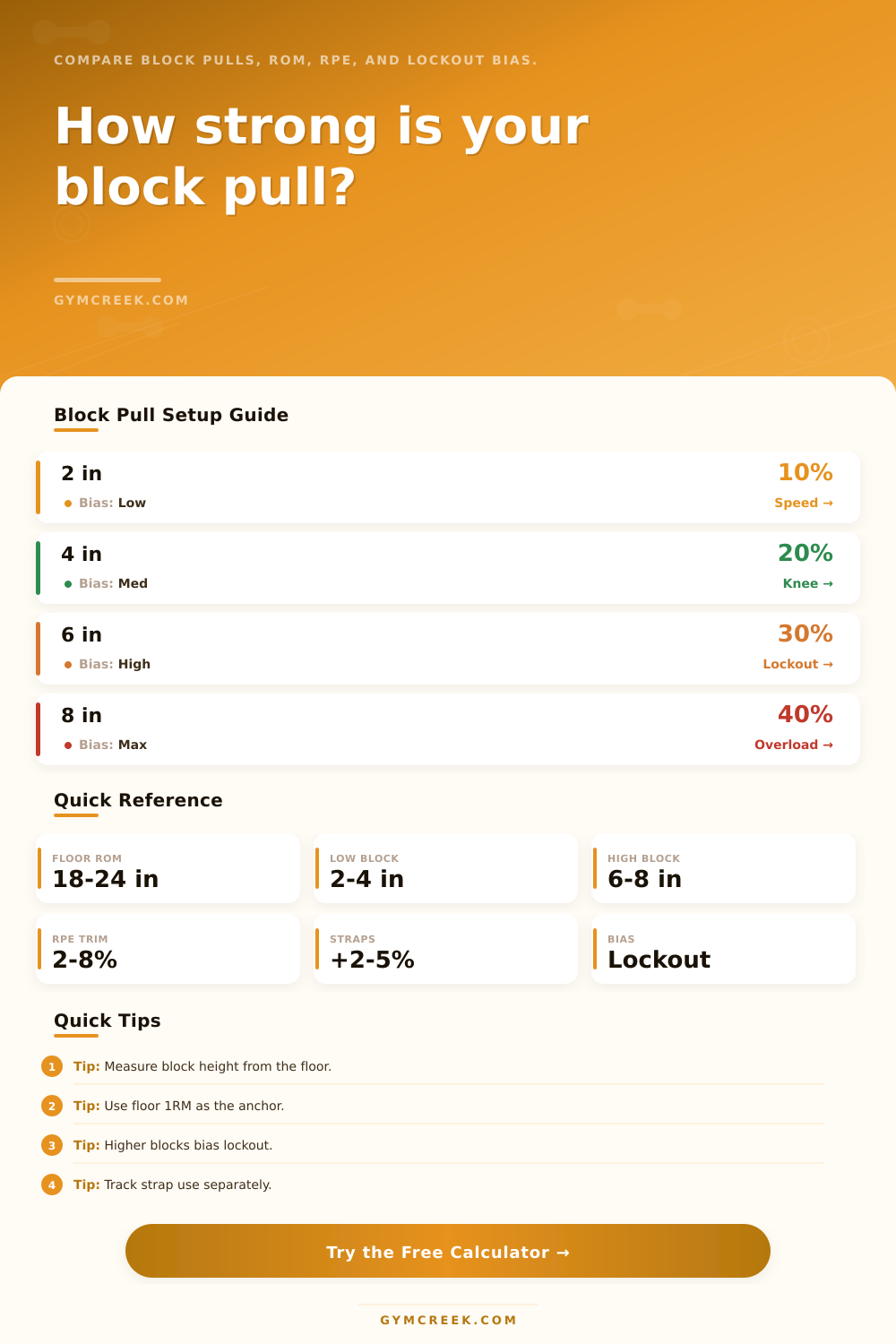
| Block height | Typical ROM cut | Main emphasis | Floor carryover |
|---|---|---|---|
| 1-2 in | 5-12% | Speed from low position | High |
| 3-4 in | 13-24% | Mid-shin to below knee | Moderate-high |
| 5-6 in | 25-34% | Knee-area transition | Moderate |
| 7-10 in | 35-50% | Lockout overload | Specific |
| Block pull vs floor 1RM | Reading | Likely limiter | Programming note |
|---|---|---|---|
| Under 100% | No overload | Setup, confidence, or fatigue | Lower height or reduce RPE |
| 100-110% | Useful overload | Balanced pull | Good for strength practice |
| 111-122% | Heavy lockout bias | Top-end strength | Use sparingly near heavy weeks |
| Over 122% | Very specific overload | Mostly shortened ROM | Track separately from floor pulls |
| Grip option | Comparison effect | Best use | Watch point |
|---|---|---|---|
| No straps | Cleanest comparison | Grip plus lockout testing | Grip can cap posterior chain |
| Mixed grip | Slight assist | Heavy singles and triples | Keep shoulders square |
| Hook grip | Competition-specific | Raw pullers using hook | Thumb tolerance matters |
| Straps | Highest assist | Overload and back strength | Do not blend with raw maxes |
| RPE | Reps in reserve | Adjustment | Interpretation |
|---|---|---|---|
| 10 | 0 | Max effort | Best test signal |
| 9 | 1 | About 3% | Strong heavy set |
| 8 | 2 | About 6% | Good training set |
| 7 | 3 | About 9% | Technique or volume work |
💡Tips
There’s a certain sort of satisfaction that comes from getting more weight off ground from blocks compared to straight from floor. Your deadlift has suddeny made you feel stronger overnight, except you’ve just taken the toughest portion of lift out of it. This is where the block pull deadlift calculator come in. It’ll show you exactly how much you’re cutting into your range of motion. It will also show if this added weight match improved lockout strength or if you’re simply using block as a convenient shortcut.
Block pulls are all about context. There’s a huge difference between pulling from eight inches and pulling from two inches off the ground. An eight-inch raise is a different type of training stimulus then a two-inch raise which barely alters path of bar. While the latter is a helpful tool for getting past initial inertia or speed work, an eight-inch raise transform the deadlift into more of a high-pull variation focused on top end of movement.
How to Use the Block Pull Calculator
Use our deadlift pull calculator. Simply enter your floor one-rep max and block height and calculator will do math for you. It will tell you how much range of motion you’ve eliminated as a percentage. Why does this matter? It’s easy to remove twenty percent of the lift. But when you start eliminating forty percent of the lift, it change the nature of exercise entirely.
The bottom line is that you need to be real honest about how tired you are and what kind of grip you’re using. With straps, your posterior chain do most of the work. Your forearms don’t give out until after that. You’ll get away with heavier weights, but unless you want to compare those numbers directly to your raw floor maxes, you have a false sense of total strength. That’s where tool comes into play. It takes your rate of perceived exertion and adjusts output depending on pull style (straps, mixed grip or barehanded). A set done at an RPE of eight will leave you with two reps in reserve. That impacts estimated one-rep max versus an all-out test done at RPE ten.
Block pulls = floor max plus X pounds, Most lifters assume they should of being pulling significantly more weight off the blocks as compared to their floor max. Not necessarily so. It’s quite common to see a five percent increase in block pull over floor max. Thirty percent and you’re probably cheating with straps or starting with very high blocks. In other words, you’re not truly testing yourself at your full-body strength. These ratios will explain themselves if you look at reference tables on the page. They’ll tell you the reasonable amount of overload to expect based off your choice of block height. That way you won’t confuse a shortened range of motion with increased strength.
Blocks change how the hip hinge work. Blocks alter mechanics of the hip hinge. When using lower blocks, the bar stay near the shin. That keeps the torso more vertical, like in floor deadlift. When you use higher blocks, the hips can rise higher sooner. That makes it more about upper back and glutes. That’s why we ask where you want to set them on the calculator. If you’re attempting to correct a weak lockout, high blocks make sense. If you’re training to be stronger for a competition, lower is safer. The tool will flag an aggressive set-up that won’t have good transfer for strength.
Finally, consider effect of neural fatigue. Are you pulling blocks after deadlifts and squats? Your nervous system is fried so it won’t work as well. The calculator accounts for session fatigue. It knows that, when a lifter’s fatigued, they’ll underperform, even at a smaller ROM. That way you know if a lower result indicate a true strength deficit or simply a sign of exhaustion.
The block pull isn’t a substitute; it’s an accessory movement. Done properly, it stress certain weakness found at the top end of the pull and draws attention to them. However, it doesn’t replace the grunt work involved with pulling from the bottom all the way through. While looking good on the blocks might make you look like a stud, the floor will always expose you as to whether or not that’s true. Keeping your expectations realistic with the calculator ensures you’re tracking your progress accuratly and that your block pulls is indeed beneficial to you. The numbers don’t lie, they’ll show you the way.