Bikram Yoga Calorie Calculator
Estimate calories burned, class intensity, METs, and sweat loss from your body stats, class format, heat level, effort, and breaks.
📌Presets
Presets load realistic hot-room yoga scenarios and auto-calculate so you can compare class styles quickly.
⚙Calculator
Bikram yoga session snapshot
Enter class details to estimate calorie burn and sweat loss.
📊Class Metrics
📑Reference Tables
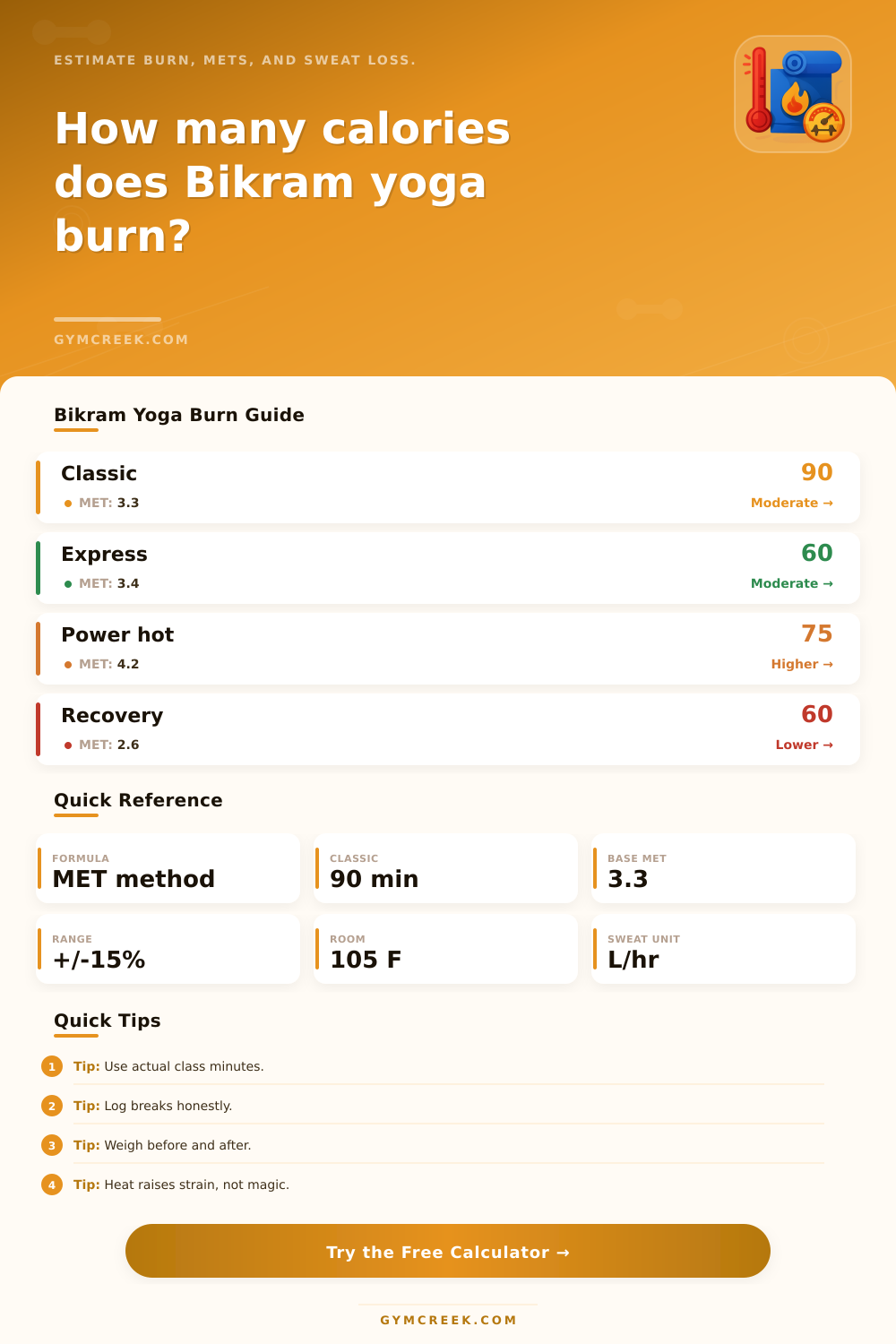
| Class format | Base MET | Typical minutes | Calculation note |
|---|---|---|---|
| Classic Bikram 26+2 | 3.3 | 90 | Steady isometric work |
| Express hot yoga | 3.4 | 45-60 | Less total time |
| Power hot yoga | 4.2 | 60-75 | More transitions |
| Recovery heat pace | 2.6 | 45-75 | Lower effort |
| Modifier | Low | Middle | High |
|---|---|---|---|
| Effort RPE | 4-5 | 6-7 | 8-10 |
| Completion | 60% | 80% | 95%+ |
| Breaks | 20+ min | 8-15 min | 0-5 min |
| Heat strain | Mild | Standard | Very humid |
| Sweat rate | L/hr | Meaning | Use |
|---|---|---|---|
| Low | <0.5 | Light loss | Track trend |
| Moderate | 0.5-1.0 | Common | Replace fluid |
| High | 1.0-1.5 | Heavy loss | Plan ahead |
| Very high | 1.5+ | High strain | Use caution |
| Example | Weight | Class | Burn range |
|---|---|---|---|
| Smaller yogi | 125 lb | 90 min | 260-350 |
| Average yogi | 155 lb | 90 min | 330-440 |
| Larger yogi | 205 lb | 90 min | 435-585 |
| Power hot | 175 lb | 75 min | 390-525 |
💡Tips
Bikram yoga involve performing yoga in a room that is maintained at a high temperature of around 105 degree. The high temperature within the yoga studio produce a sensation of high exertion in those performing the yoga exercise. However, this sensation of high exertion isnt necessarily correlated with high caloric expenditure.
In fact, individuals often feel tired after Bikram yoga class as a result of the way in which the body respond to such high temperature in the yoga studio. Additionally, individuals may feel as if they burned a large number of calorie during there Bikram yoga class. However, the weight loss that individuals experience after their Bikram yoga classes is actualy due to the loss of water from the body.
How Bikram Yoga Affects Calories and Water Weight
Thus, body water loss should of been distinguished from body fat loss. In order to calculate the number of calories that is burned during a session of Bikram yoga, several different piece of information are required. One of the pieces of information that is required is the body weight of the individual performing the class.
The body weight of the individual are correlated with the number of calories that are burned during the class. Individuals with higher body weight will burn more calories than individuals with lower body weights. This calculation involve the use of MET values; MET values are a measurement of the amount of oxygen that the body consumes during a particular activity compared to the amount of oxygen that the body consumes when it is at rest.
Different form of hot yoga include different types of physical movements; thus, the type of hot yoga that is performed will impact the number of calories that are burned. For instance, Bikram yoga classes include the same movements during a class while power hot yoga classes involve more dynamic movement. Therefore, if an individual take breaks during their Bikram yoga class, their active time will decrease; thus, the number of calories that are burned will decrease.
Effort is a subjective measurement of the physical exertion of an activity; however, effort can be quantified through the Rate of Perceived Exertion. Thus, two individuals who perform the same pose during Bikram yoga for the same length of time may exhibit difference in the effort that they expend during those poses. The higher the Rate of Perceived Exertion that is used for an activity, the more muscle fiber that are recruited to perform the activity.
Therefore, recruiting more muscle fibers require the body to expend more energy. Additionally, the rate at which the instructor performs poses during class will also impact the number of calories that are burned; the higher rate will place more strain on the cardiovascular system of the individual as the body must pump more blood to the skin in order to cool the body and more blood to the muscles to perform the poses. Thus, Bikram yoga classes are more intense than other classes that use less exertion of poses in the same length of time.
The amount of sweat that is lost during a session of Bikram yoga can be tracked. To calculate the rate at which an individual is losing body fluid due to sweating, the instructor can measure the body weight of the individual before and after performing the class. Additionally, the amount of water that the individual consumes should also be added to the calculation.
Some individuals are high-volume sweaters; they lose a large amount of fluid from their bodies during their Bikram yoga class. Other individuals are low-volume sweaters; they lose a small amount of fluid from their bodies during their class. Thus, individuals who lose a large amount of fluid from their bodies during a class will need to follow a rehydration plan after the class so that they dont feel fatigue or brain fog after the class session.
Another important measure of calories is an individual’s Basal Metabolic Rate. An individual’s Basal Metabolic Rate is the amount of energy that the body uses while at rest. By comparing the amount of calories that are burned during a session of Bikram yoga to the Basal Metabolic Rate of the individual, it is possible to determine the overall impact of the class upon the individual’s body.
By understanding the relationship between the body weight of an individual, the effort that is required to complete the poses in a class, the heat of the yoga studio, and the impact of these factors upon the body, it is possible for an individual to understand how Bikram yoga can impact their body. Thus, an understanding of the way in which Bikram yoga can impact the body allow an individual to move beyond guessing about the impact of the class on their body to understanding the data behind that impact.