Bike Saddle Size Calculator
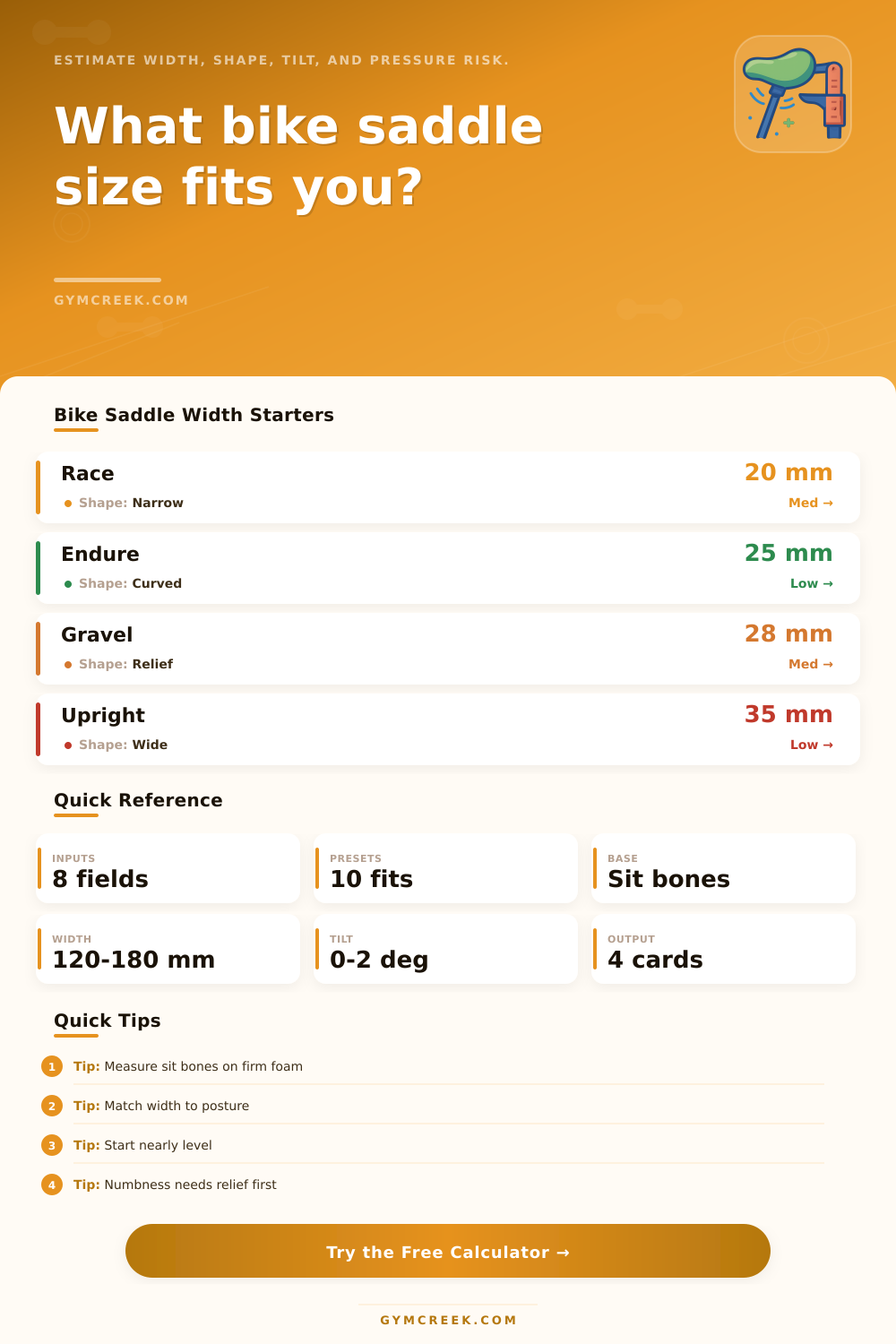
Estimate a practical bicycle saddle width and shape from sit bone width, riding style, bike type, flexibility, pelvic rotation, ride duration, padding preference, and pressure-relief needs.
📌Saddle Fit Presets
Presets fill realistic saddle-fit profiles and calculate immediately. Use them to compare posture, pressure-relief, and duration changes.
⚙Calculator Inputs
Recommended saddle fit
Your result will appear here after calculation.
📊Fit Metrics
📘Reference Tables
| Sit Bones | Race | Endurance | Upright |
|---|---|---|---|
| 90-100 mm | 120-130 mm | 125-135 mm | 135-145 mm |
| 101-110 mm | 130-140 mm | 135-145 mm | 145-155 mm |
| 111-120 mm | 140-150 mm | 145-155 mm | 155-165 mm |
| 121-130 mm | 150-160 mm | 155-165 mm | 165-175 mm |
| Shape | Best For | Pressure Cue | Setup Cue |
|---|---|---|---|
| Flat narrow | Low torso road | Needs relief if numb | Level to slight nose down |
| Slight curve | Endurance road | Stable sit-bone load | Level first |
| Short nose | Aero or aggressive | Front relief matters | Check reach and setback |
| Wide rear | Upright and touring | Rear support first | Avoid nose-up tilt |
| Ride Position | Setback | Tilt | Watch |
|---|---|---|---|
| Endurance road | Neutral rails | 0 to -1 deg | Hand pressure |
| Race road | Slight rear | 0 to -1.5 deg | Sliding forward |
| Tri or TT | Forward | -1 to -2 deg | Nose pressure |
| Commuter | Neutral | 0 deg | Rear edge pressure |
| Preset | Sit Bone | Posture | Likely Width |
|---|---|---|---|
| Road Endurance | 115 mm | Neutral | 142-150 mm |
| Road Race | 108 mm | Forward | 132-140 mm |
| Gravel Long | 118 mm | Neutral | 148-158 mm |
| Commuter | 125 mm | Upright | 165-175 mm |
💡Fitting Tips
Finding an correct saddle requires that you understand your sit bone width and your riding posture. A saddle that feel comfortable when a saddle matches your anatomy and a saddle matches your posture will feel uncomfortable when a saddle dont match your anatomy or a saddle does not match your posture. There are various factor to consider to find the perfect saddle for your anatomy, and there are also various factors to consider to find the perfect saddle for your posture.
The first of these factors is your sit bone width. This is the first measurement to be consider when purchasing a saddle, and most saddle fitters will begin their evaluations of you with your sit bone width. Individuals with a wider pelvic opening may require a saddle with a wider platform.
Find the Right Bike Saddle
However, the width of the platform will also depend upon the way that you typically ride your bicycle. If you typically ride in an aggressive road position with your weight shift forward, a narrower saddle platform may be appropriate for you. If, however, you typically ride in an upright commuter position, your weight will be more focused on the rear of your saddle, requiring a wider saddle platform to better distribute that weight.
Using the calculator available on this page, you can enter your sit bone width and your riding style to determine the recommended width for your saddle. The calculator will make the calculations for you without the necessity of performing the calculations yourself. The flexibility of your body is another significant factor in the comfort that you experience from your saddle.
Individuals with limited flexibility in their hamstrings or pelvis may roll their pelvis backward when they are riding their bicycles. This may place excessive pressure upon the soft tissue located behind your sit bones. In contrast, individuals with better flexibility may be able to better rotate their pelvis in a forward direction, allowing their weight to shift onto the nose of their saddle.
This factor will impact the type of saddle that you need and the type of relief feature that that saddle should have. For instance, individuals who can spend significant amount of time in an aero position for long distances may find that a saddle with a short nose and a cutout in the middle of the saddle may be more appropriate than the endurance type of saddle. The duration for which you will be riding your bicycle and your preference for the type of padding within the saddle are two factors that interact with each other.
For instance, saddles with plush padding may feel great for the first 20 minutes of riding, but they may begin to compress over the length of a long ride. Saddles with firm padding will maintain their shape over time but may be uncomfortable for the individual with the wrong saddle width or tilt. The calculator considers the length of your ride when it make its recommendations.
If your ride is for around 3 hours, your saddle should provide support over long distances, while shorter commutes may not require the same level of support. The calculator also weighs the relief need that you can provide for your saddle. This tool can assist you if your saddle already creates numbness or pressure on the perineum.
The rotation of your pelvis while on your bicycle is another variable that may impact the way that you feel from your saddle. If you tend to maintain a neutral orientation of your pelvis while on your bicycle, a level saddle with a modest setback may be appropriate for your body. Alternatively, if your pelvis rolls forward onto the nose of your saddle, your saddle may have a shorter nose or an alternative tilt to your saddle.
The tool considers this variable when it asks for your pelvic rotation while on your bicycle. Many individuals will make a mistake with their purchase of a bicycle saddle by changing too many variable at once. For instance, an individual may purchase a saddle with a wider platform than there body requires.
Then they may tilt that saddle downward. Then they may shift the saddle forward. By shifting so many elements at once, an individual cannot determine which change made the individual feel better on their bicycle.
Try to shift only one variable at a time, and ride distances of varying lengths will help you to find the perfect balance in your saddle. Begin with the width that the calculator suggests for you. The saddle should remain nearly level.
Finally, after riding for at least one hour, evaluate the stability of the rear of your saddle. At this stage, adjust the tilt or setback of your saddle by small increment only. The tables referenced on this page can help you determine the width of saddles according to your posture and sit bone width.
While these tables will not replace the need to test saddles on your bicycle, they will provide you with a range of saddle size to order according to your specifications. Your body will provide you with information that you cannot get from the packaging of the saddle. Your goal is to find the saddle that works best for you.
However, the goal is not to find the perfect saddle the first time, your goal is to narrow your options to provide you with useful information during your test ride on each of these products.