Biceps Triceps Ratio Calculator
Compare arm circumference balance, curl strength, triceps extension strength, and left-right symmetry with one practical arm development score.
📌Presets
Presets load realistic arm profiles and immediately recalculate the size, strength, and symmetry balance.
⚙Calculator
Arm ratio snapshot
Enter arm size and strength values to calculate the balance profile.
📊Arm Metrics Grid
📑Reference Tables
| Size Ratio | Category | Meaning | Next Focus |
|---|---|---|---|
| Under 0.58 | Triceps heavy | Back-arm dominant | Curl volume |
| 0.58-0.64 | Triceps lean | Common for pressers | Biceps detail |
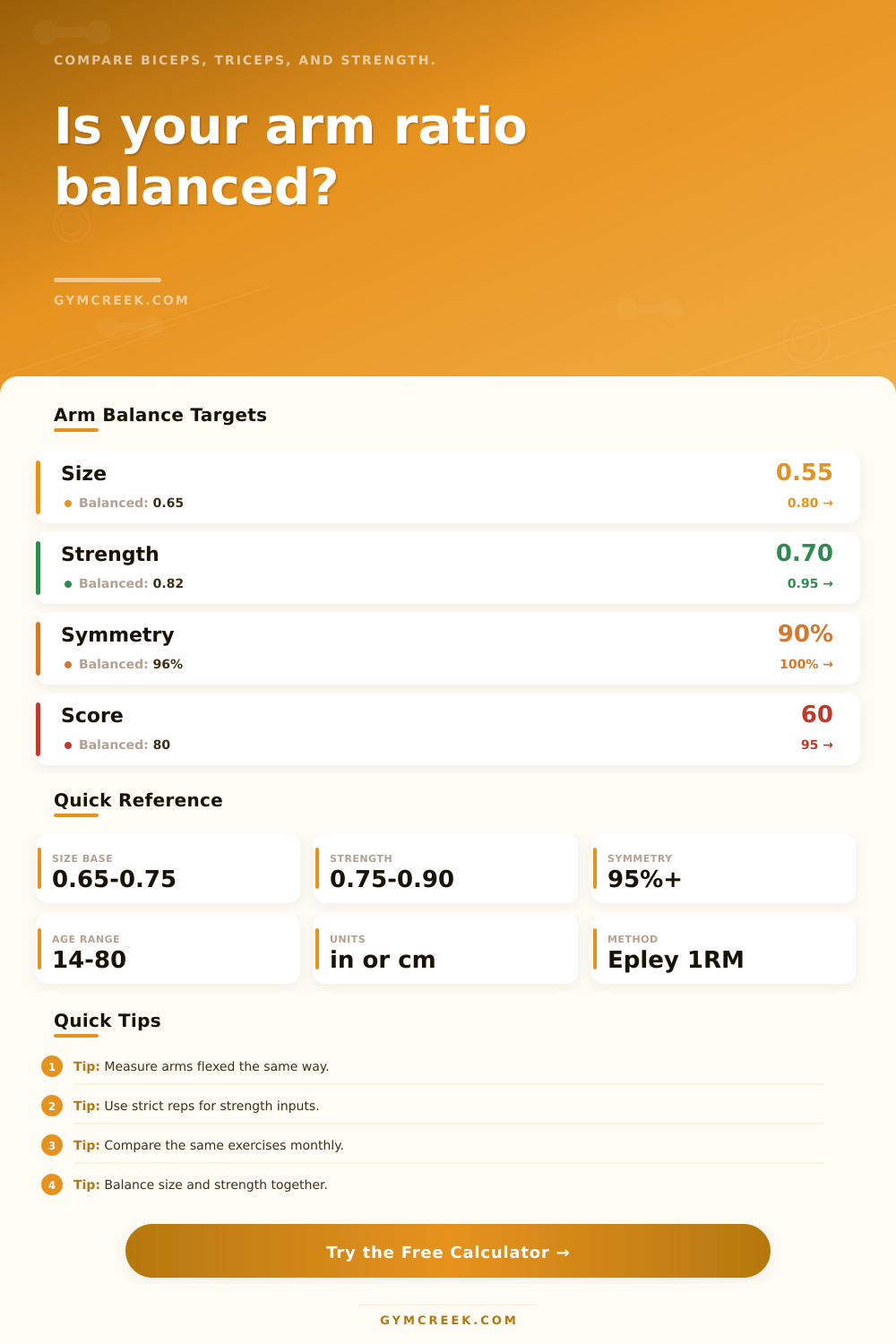
| 0.65-0.75 | Balanced | Useful arm split | Maintain both |
| 0.76-0.84 | Biceps high | Front-arm bias | Extension work |
| Over 0.84 | Curl dominant | Likely triceps lag | Triceps strength |
| Strength Ratio | Category | Meaning | Check |
|---|---|---|---|
| Under 0.70 | Triceps strong | Push bias likely | Curl strictness |
| 0.70-0.78 | Low normal | Good pressing base | Elbow comfort |
| 0.79-0.90 | Balanced | Solid arm force | Same tempo |
| 0.91-1.00 | Biceps high | Curl strength leads | Extension form |
| Over 1.00 | Mismatch | Likely triceps lag | Exercise choice |
| Scenario | Size Ratio | Strength Ratio | Pattern |
|---|---|---|---|
| New lifter | 0.62-0.76 | 0.70-0.92 | Variable |
| Press athlete | 0.56-0.68 | 0.65-0.80 | Triceps lead |
| Arm specialist | 0.68-0.82 | 0.82-0.98 | Biceps lead |
| Balanced hypertrophy | 0.65-0.75 | 0.78-0.90 | Best match |
| Symmetry block | Any | Any | Side gap focus |
| Formula | Variables | Output | Use |
|---|---|---|---|
| Size ratio | Biceps, triceps | Thickness ratio | Arm balance |
| Epley 1RM | Load, reps | Est strength | Fair sets |
| Symmetry index | Left, right | Side match | Lag check |
| Composite score | Ratios, symmetry | 0-100 score | Priority |
💡Tips
When you look at yourself in the mirror, there’s a good chance you’ll see your biceps before anything else. When flexed and caught in the right lighting under a t-shirt, they pop out front. So it makes sense why you’d obsess over this peak; many workout programs is full of different curls. But here’s something you should know: Your triceps make up approximately two-thirds of your upper arm mass. In other words, they’re doing the majority of the work for shape and size. If you ignore ’em, you create an imbalance that hammer curls won’t correct.
Let’s discuss why arm symmetry are important. What exactly are we measuring? After you input strength numbers and measurements, the calculator does all of the math for you. There’s no need to guess anymore if you’re doing things right, or skewing things one way or another. It will measure the thicknesses of your triceps and biceps and show you a size ratio.
Why Arm Balance Is Important
For most people with balanced lifts, their triceps are going to be a little bigger than their biceps because that is how the body is built. So if you see your number leaning on the higher side, it means you might be doing too many flexion exercises instead of extension work. Finally, it takes into account left-right symmetry (a factor many don’t think about until an injury makes them).
Most people has small discrepancies between their arms. This is typically harmless. But large discrepancies can show up as joint pain or poor posture later. Catching that drift over time helps you address imbalances before they becomes problems.
But size isn’t everything. Sometimes we see a thick pair of triceps despite weak lockout power. This may be because the person lacks consistent rep ranges and exercise selection. Strict form is vital compared to being able to lift a lot of weight using sloppy form.
There are data points in those reference tables that group various profiles. An athlete who spends most of his time on presses will display lagging biceps and strong triceps, whereas a bodybuilder on the hunt for peak will invert that dynamic. As long as you know which way your focus leans, neither is necessarily “wrong.” It becomes problematic when you go through the motions, training blindly to see if one muscle group are overshadowing another.
The accurate measuring part requires a bit of care. You really should maintain constant elbow angle and tension each time you take a reading, otherwise shifting where you place the tape can change your results entirely. Failing to do this will produce what we call noise, not a helpful trend line. It’s quite simple to mistake measurement error for actualy progress.
Maintaining some type of log with these measurements will help distinguish between genuine gains and daily fluctuation due to muscle fullness or water retention. Now let’s be clear: training for balance doesn’t equal splitting your volume in half “just because.” It means adjusting to your weaknesses. So if your strength ratio indicates a dominant set of triceps, then it would of made sense to increase dedicated bicep volume. Or if your arms are flat but have decent numbers, maybe check your pressing form and see if that could explain why the back of your arm isn’t responding?
You want balanced, functional aesthetics, ones that serve both performance and look. But a lot of times arms aren’t about their appearance in the mirror, but rather how they perform under load. Having balanced development promote healthier shoulders and enables heavier compound lifts while avoiding elbow-bottlenecking. Perfect symmetry isn’t necessary to be both attractive and strong.
It’s only necessary that you know where your blind spots are and steer clear of them in training. This slight shift in perspective alters your approach to each workout, turning random exercises into purposeful steps toward a stronger body. The mirror will still lie occasionally, but with this real data you’re grounded on what really matters.