🏋 Bench Press Percentile Calculator
Find out how your bench press compares to the general population. Enter your lift details below.
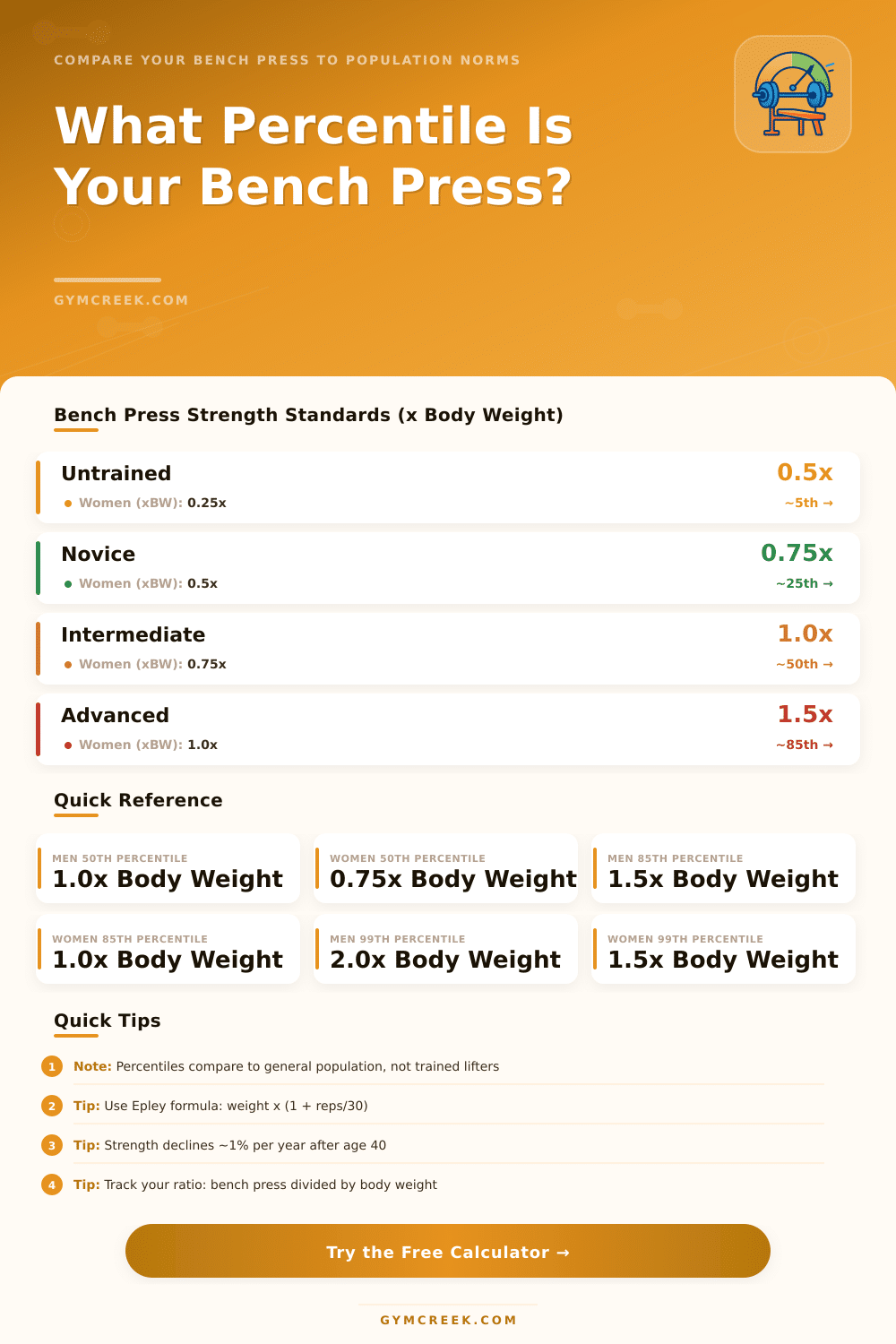
| Level | Men (xBW) | Women (xBW) | Men @ 180 lb | Women @ 150 lb | Approx. Percentile |
|---|
| Age Group | Men Avg Ratio | Women Avg Ratio | Adjustment Factor | Note |
|---|---|---|---|---|
| 18-29 | 1.00× BW | 0.65× BW | 1.00 (Baseline) | Peak strength years |
| 30-39 | 0.97× BW | 0.63× BW | 0.97 | Minimal decline |
| 40-49 | 0.88× BW | 0.57× BW | 0.88 | ~1% per year decline |
| 50-59 | 0.78× BW | 0.51× BW | 0.78 | Hormonal changes |
| 60+ | 0.68× BW | 0.44× BW | 0.68 | Sarcopenia factor |
The bench press is one of the most popular exercise used to gauge an individual’s upper body strength. From the most rudimentary home gyms to the most elite powerlifting competition, the bench press is one of the most well-known exercises in all of physical fitness. Yet, there is no easy way of determining if an individual’s bench press strength is impress compared to others. This is why knowing how an individual compare to others is of great value, which is why bench press percentile calculator have become increasingly popular among strength athlete of all levels.
Percentiles allow an individual to compare there lifting capability to other individuals from thousands of measurement of different ages, genders, and weights. Rather than measuring an individual’s strength in how much weight they can lift, the percentile provides an insight into how that strength relative to others in the general population.
What Makes the Bench Press Such a Popular Strength Benchmark?
The bench press is target specific to the chest, shoulders, and triceps. Additionally, it also engages the core and upper back muscle to stabilize the body during the exercise. Due to the benefits that it provide for muscle mass and strength, the bench press is an exercise that is commonly found in gyms of any kind around the world.
However, not all individuals has the same strength in their bench press performances. One of the factor that can play the greatest role in the strength difference among individuals is the body weight of those individuals. The strength standard for males is higher than females due to the strength and muscle mass that males naturaly have compared to females. Additionally, the age of individuals can play a role in their strength; the younger individuals tend to have more strength than the elderly, though this decline is gradual after the age of 40 if the individual maintain their strength and powerlifting routines.
Furthermore, the body weight of the individual can play a significant role in their strength. An individual that weighs 150 pound and can bench press 225 pounds has significantly different strength compared to an individual that weighs 250 pounds and can perform the same bench press number.
To account for these difference, there is a standard for strength comparisons that has become more and more popular among lifters. For instance, benching one’s bodyweight is considered an average strength for men while benching 1.5 times one’s body weight is considered to be advanced strength. The same standard exist for females, though with lower numbers.
Understanding these strength benchmarks allows individuals to better understand how they compare to others with similar physical characteristic. Most individuals may find themselves lacking in strength relative to others with whom they compare themselves. However, the majority of the population is untrained and does not have the same level of strength as those individuals who regular lift weights.
Furthermore, researchers have perform studies on the strength of individuals of all ages, genders, and physical characteristics to formulate a more accurate understanding of human strength. Data collected from untrained individuals, recreational athletes, and professional powerlifters show the strengths of each of these groups individually.
Individuals of all ages have different level of strength. While it is often thought that an individual’s strength decline after the age of 40, data shows that this decline is gradual after the age of 40 for those that continue to incorporate weight lifting and strength training into their programs regularly. An individual’s testosterone levels decline with time which can have an impact on their ability to gain the strength to build muscle. However, continued training can even out the differences in strength between the elderly and younger individuals.
The difference in strength between men and women can be attributed to the physical differences in their bodies. Men tend to have significantly more muscle mass and higher level of testosterone than women which allow them to exhibit greater strength. Women tend to have more strength in their lower bodies than their upper body.
An individual’s experience with weight lifting can also have an impact on their strength. An individual that has trained with weights for five years will typically have more strength in their bench press performance than an individual that has just start to lift weights. Furthermore, the strongest gains in strength is made in the first two years of lift training.
Context always matters more than raw numbers. For an individual that can bench press 315 pounds, their strength is impressive if they weigh 280 pounds and have trained for 15 years. However, for an individual that can bench press 185 pounds yet weighs 145 pounds and is 5’4” in height, their strength is impressive as they have trained for only 18 month.
With the rise of social media and fitness influencer, individuals often show off their physical strength and muscle mass with highlight reels. However, most of these highlight reels do not account for the amount of time and effort that it take to gain such impressive physical strength. An individual may feel compelled to pursue a number strength that may not be suitable for their body type or physical characteristics. A percentile calculator allows an individual to better understand there physical strength without succumbing to the unrealistic numbers perpetuated by others online.

An understanding of physical strength and the percentiles that relate to those strengths can allow an individual to:
Develop a program for improving their bench press strength
Track their relative strength to determine when to compete in strength competitions or when to focus on improving there technique
Set goals according to how strong they wish to be in relation to others in there age, gender, and physical characteristics
Gain a sense of accomplishment in view of the numerous benefits provided to those that incorporate strength training into their programs.
Yet, the bench press is but one component of the overall fitness of an individual. While it can show the strength of an individual’s pushing muscle, it is only one of many aspect that need to be developed to create well-rounded and physically fit individuals. The best measure of strength of an individual is relative to the other lifter in the same age, gender, height, and physical characteristics groups.
No matter where you stand in terms of the strength and experience that you possess in your physical body, it is essential to understand where you stand in comparison to others in your demographic. Using the calculator above, you can find out where you stand in comparison to others of your age and gender. Recognizing your physical strength relative to others will give you the confidence and knowledge to define your body and your capability. Most importantly, understanding your strength relative to your peers will fuel your dedication and commitment to further develop your physical strength.
As with anything, individual difference will play a role in your physical strength. However, the most important factor in your physical strength journey is your dedication to consistently improving your capabilities in time. The journey to find your physical strength provides benefit that go beyond the capability of any single lift.