Belt Squat Conversion Calculator
Estimate belt squat effective resistance, back squat carryover, bodyweight-relative loading, and rep-adjusted strength from one setup.
📌Presets
Presets load common belt squat setups with realistic machine ratios, transfer targets, depth, stance, reps, and RPE.
⚙Calculator
Belt squat conversion snapshot
Enter your setup details to estimate equivalent squat loading.
📊Fitness Metrics Comparison
📑Reference Tables
| Machine Style | Typical Ratio | Why It Changes | Best Use |
|---|---|---|---|
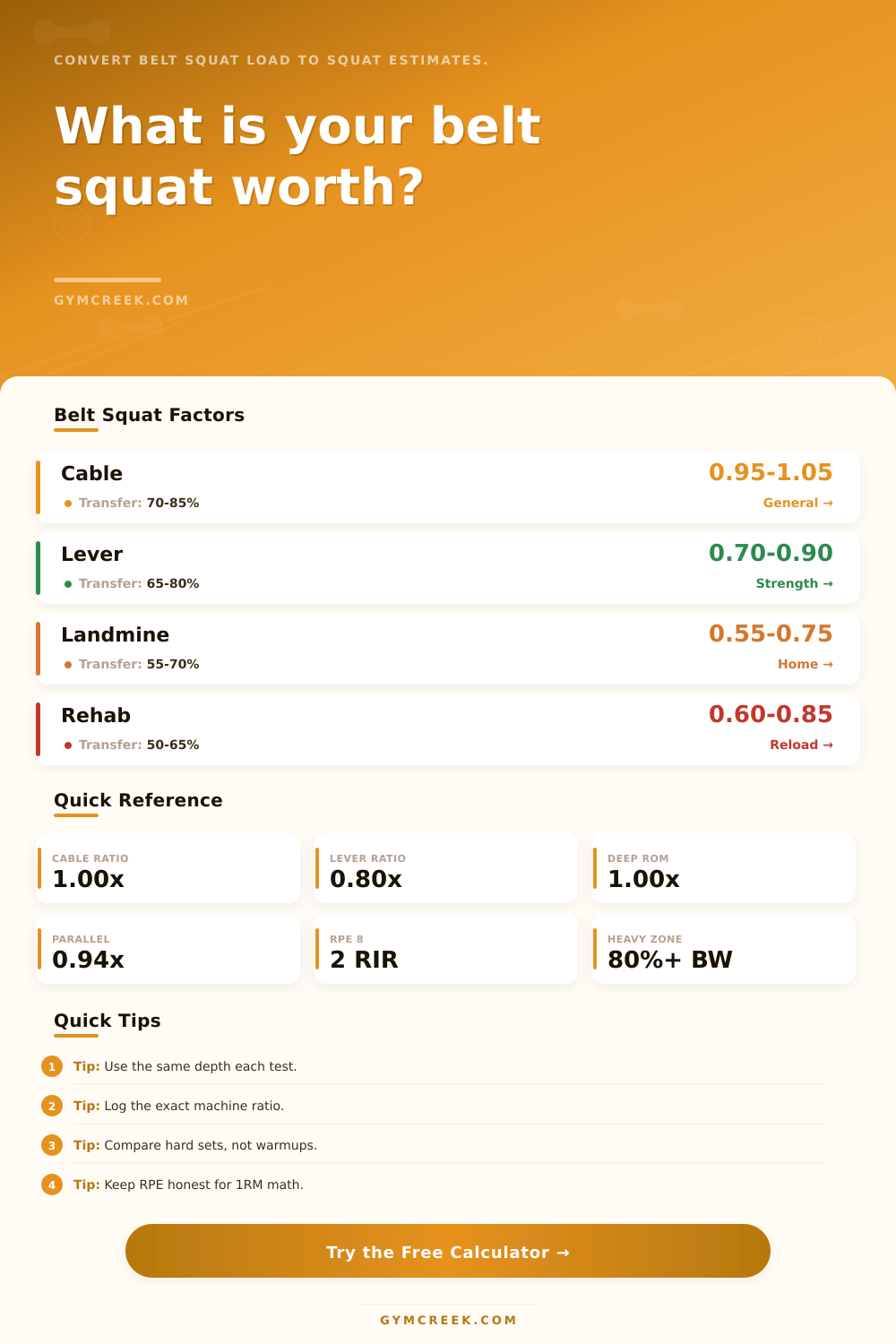
| Cable tower | 0.95-1.05x | Near vertical pull | General conversion |
| Lever arm | 0.70-0.90x | Arc and leverage | Strength blocks |
| Pit-style unit | 0.85-1.00x | Guided carriage | Heavy lower work |
| Landmine setup | 0.55-0.75x | Angled bar path | Home training |
| Transfer Setting | Factor | Use When | Interpretation |
|---|---|---|---|
| High skill match | 84% | Same depth and bracing | Closest estimate |
| Strength carryover | 78% | Back squat is trained | Conservative strong |
| Accessory work | 72% | Belt squat is extra volume | Hypertrophy view |
| Rehab reload | 64% | Axial load is limited | Deload estimate |
| Relative Load | Zone | Typical Feel | Training Note |
|---|---|---|---|
| Under 40% BW | Light | Warmup or reload | Technique work |
| 40-70% BW | Moderate | Volume sets | Hypertrophy base |
| 70-100% BW | Heavy | Hard work sets | Strength support |
| 100%+ BW | Very heavy | Low-rep overload | Use stable setup |
| Formula | Variables | Purpose | Output |
|---|---|---|---|
| Effective load | (Load + carriage) x ratio x ROM x stance | Machine resistance | Belt load |
| Back estimate | Effective x transfer | Carryover view | Back squat |
| Belt target | Back / transfer / factors | Reverse planning | Plate load |
| Epley 1RM | Load x (1 + reps / 30) | Rep adjustment | Est. max |
💡Tips
The belt squat is for you if you have lower back pain and want to lift a lot of weight. Without a bar across the spine, you can keep your spine straight and still feel like hips are moving while the quads get worked. However, knowing how this exercise compare to a standard back squat is essential. Just looking at the number doesn’t tell the full story.
The mechanics differ. The lever arm changes mechanical advantage, the cable angle changes resistance, and machine’s geometry matters. Convert these variables into a format that makes your training log useful. Let’s run the math with the calculator. But here’s why it make sense to understand what goes into the calculator so you can set up your workout programming to match.
Why the belt squat is good for you
First, determine if you’re using cable towers or lever machine. Cable towers are easy. Because the load path is almost vertical, there is a near one-to-one relationship between force on your hips and weight of the plates. Lever machines is not as straightforward. Because they have a pivot point, the arc of a lever arm alters the mechanical advantage, making the lift feel lighter or heavier at different points in movement. Adjusting for this leverage ensures that you don’t confuse a lighter effective load for something heavier. This is the difference between moving weight vs. You are building strength.
The numbers change with stance and depth. Most people think that depth should be parallel (but the deeper you go), the more work you do on each rep. To adjust for this, the tool has a factor for range of motion. If you go deeper into your squat, you’ll do more work against gravity (even if you keep weight the same). It will raise the intensity. Stance also affects the distribution of effort, shifting it toward your glutes vs your quads. Narrow stances drives your knees forward, requiring more quad use and altering the perceived heaviness of the set. Those small details can mean the difference between matching the feeling of a back squat or cheating yourself to an easier route.
The connection between theory and reality is called transfer. When you put on a 30-pound weight on a belt squat, that doesn’t translate directly into putting 30 pounds on the bar. Belt squats isolate different muscles than back squats, your balance, bracing technique, and core strength all play a part in back squats, but machine isolates those qualities away. Transfer factors take these into account. It use transfer percentages to estimate what your belt load would look like if you were bearing it axially.
If you squat at the same depth and brace perfectly on both exercises, that’s considered a high skill match. Otherwise, it’s lower because the accessory work doesn’t have the same systemic stress as the compound lift. That’s why it’s a difference in demand, rather than a flaw in the machine. We’re trying to learn how much strength transfers over so we can accurately plan out our main lifts.
To benchmark for the long term, use relative intensity rather than focusing on exact weights to measure your load in relation to your body weight. You can then compare honestly over time with various machines and track yourself as a percentage of body weight. If you lift 90 percent of your bodyweight using a belt squat, you’re showing some serious strength, no matter what the actualy number is. It means you’ve developed some lower-body power without solely depending on heavy weight on your spine. That’s an important perspective when avoiding ego lifting. Maybe you’ll be moving more total tonnage on a machine, but relative difficulty will tell the story of your progress.
Another wrinkle is rep-adjusted strength estimation. This takes into account how many reps you do, along with rate of perceived exertion, to estimate your one-rep max for the given setup. That lets you periodize your workouts without having to test true maximums as frequently. It lets you know when a set was legitimately hard vs. It was just long. It lets you change next time’s load according to actual effort instead of arbitrary increments.
For most people, their setup won’t be exact. But they can use the reference table on the page to quickly see what typical ratios are for different set-ups. This way, if your machine feels unusually light, then this will tell you whether it’s time to change form or your expectations.
In conclusion, the belt squat is an excellent rehab and volume device. And when you turn that output into back squats, you have a full picture of where your lower body is developing. You no longer guess how strong you are; instead, you know exactly what to program. No longer does the number feel like vanity, but rather measurable progress. You won’t wonder why your quads aren’t getting bigger or why your back doesn’t get sore anymore. Your training log will finaly come together.