Belly Dancing Calorie Calculator
Estimate calories burned in belly dance drills, choreographed routines, drum solos, traveling combinations, veil work, cane work, and social dance sessions using body weight, duration, rest ratio, and adjusted MET logic.
📌Presets
Each preset loads a realistic belly dance profile and recalculates from shimmy intensity, traveling steps, prop demand, routine density, drill share, and rest time.
⚙Calculator
Belly dance calorie snapshot
Enter session structure and dance demand to estimate calories.
📊Fitness Metrics
🧮Formula Cards
Calories per minute = MET x 3.5 x body weight in kg / 200. The calculator applies it to routine time, drill time, remaining dance time, and rest separately.
Base belly dance MET is adjusted by shimmy intensity, traveling step demand, prop work, and layering complexity to reflect the session load.
Work time is split into full routine run-throughs, isolation drills, and mixed dance practice so sustained dancing and technical blocks can burn differently.
Mifflin-St Jeor estimates BMR from age, size, and gender, then activity level estimates TDEE so the dance session can be compared to daily energy use.
📑Reference Tables
| Session Type | Easy | Steady | Hard |
|---|---|---|---|
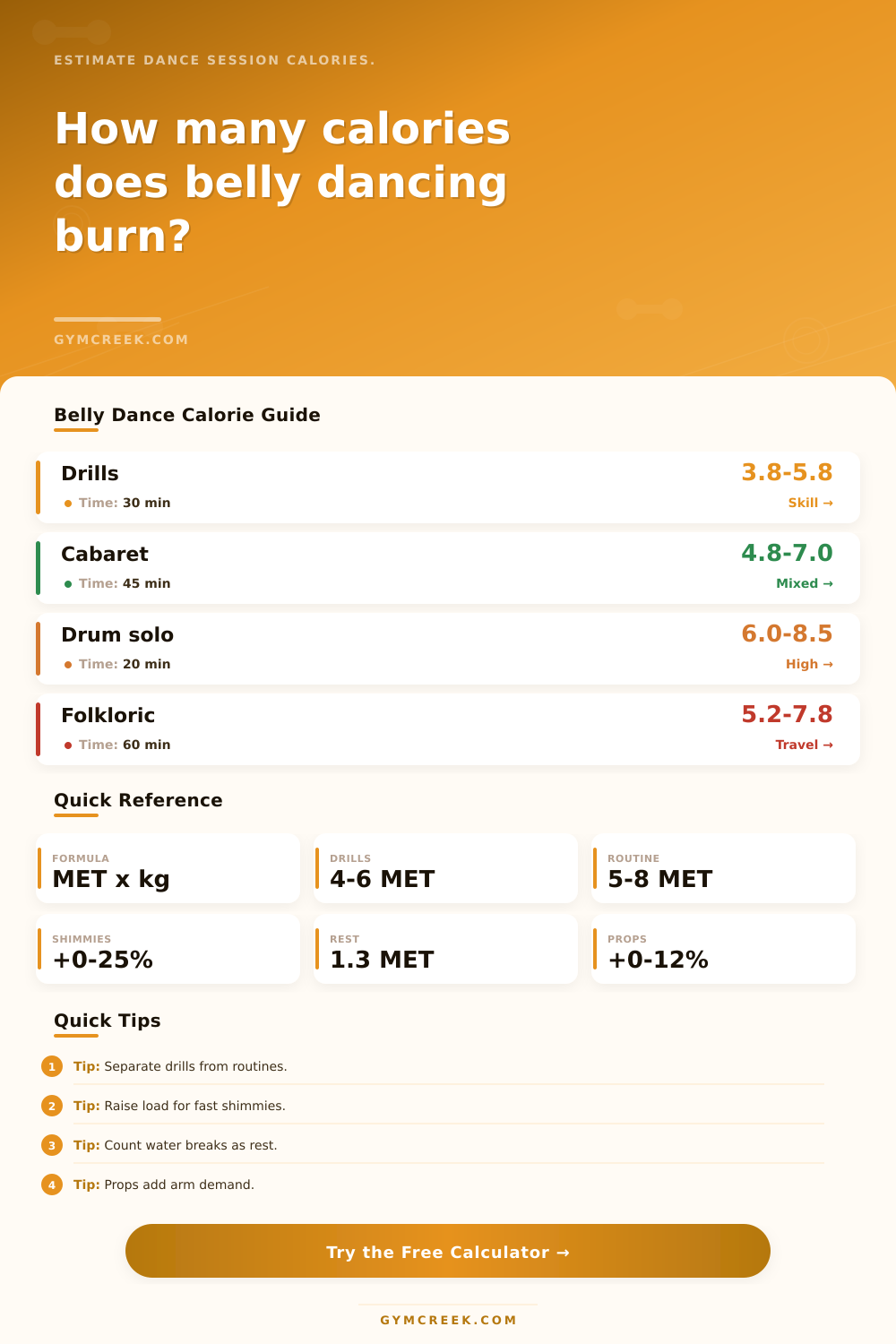
| Technique drills | 3.2 MET | 4.2 MET | 5.8 MET |
| Cabaret routine | 4.1 MET | 5.6 MET | 7.2 MET |
| Drum solo | 5.0 MET | 6.8 MET | 8.8 MET |
| Folkloric travel | 4.8 MET | 6.2 MET | 8.0 MET |
| Veil flow | 3.6 MET | 4.9 MET | 6.4 MET |
| Shimmy Demand | Modifier | Typical Block | Meaning |
|---|---|---|---|
| Minimal | 0.94x | Warm-up | Low impact |
| Light accents | 1.00x | Combos | Mixed use |
| Steady | 1.08x | Technique | Core demand |
| Fast layered | 1.18x | Drum solo | High demand |
| Sustained | 1.28x | Intervals | Peak load |
| Prop or Veil | Add-On | Arm Demand | Best Use |
|---|---|---|---|
| No prop | 0% | Normal | Class drills |
| Finger cymbals | 4% | Light | Rhythm work |
| Veil or cane | 7% | Moderate | Routine work |
| Sword balance | 10% | High | Control drills |
| Continuous prop | 12% | High | Performance |
| Formula | Variables | Output | When Used |
|---|---|---|---|
| MET kcal | MET, kg, min | Calories | Main burn |
| Routine split | Work, share | Run time | Choreo |
| Drill split | Work, share | Drill kcal | Isolations |
| Rest kcal | Rest MET, min | Break burn | Pauses |
| TDEE share | kcal, TDEE | Percent | Daily view |
💡Tips
In a belly dance class, you start with slow intro piece and then switch into some type of fast paced music. Your body is moving slowly (except for your hips) and then suddenly, you are keeping up with the tempo. Maybe at the end of the class, you feel awesome. However, did you realize how many calories you burned?
If you asked most bellydancers, they would estimate the exercise was extremely mild or super heavy. In reality, it’s somewhere in-between. It is based off time, intensity, and activity level.
How Many Calories Do You Burn in Belly Dance?
You might be trying to figure out how your body function or aiming for certain fitness result. Either way, knowing the variance makes a world of difference. It also takes out guessing about how many calories you burn; the calculator on the page does that for you. It tells the difference between the time when you’re sitting down and resting versus the time when you’re up moving around dancing.
You don’t really dance for all sixty minutes in a real class, there’s time while you listen to instructor talk, while you pause the music to fix it, while you sip your water. All those breaks decrease the average number of calories you’re burning. If you don’t account for them, you’ll overestimate the number of calories you burned. With the tool, you can adjusts how much rest time you get, which results in a more honest estimate.
What is important isn’t the movement but how much it moves. The harder you move (intensity), the greater the burn. Are you moving slowly with a hip drop instead of shimmying quickly? That’s burning fewer calories then. Shimmying quickly means working all those big muscles: glutes, lower back, core. How hard do you shake? What we know about exercise and calories burned depend on how hard you work those muscles.
Using big muscle group, like those in your legs and feet used for stepping, will increases effort. Turns and complex footwork typical of folkloric styles raise the bar further by adding extra effort over the more static exercise drills. It’s these small differences that make dance an effective fitness practice alongside other activity.
This doesn’t account for props, which do affect the physical effort required. A veil, a cane, or balancing a sword all add resistance that require constant tension. That means more work in the upper body. Your shoulders and arms works more to keep you upright and balanced. Overall calorie burn go up. As the chart on the page shows, each prop also adds to the baseline exertion required.
You won’t notice props burning more calories right away, but over time they adds up. Think of it like wearing light hand-weights when dancing versus no hand-weights at all.
The amount of body weight goes into formula. Each additional pound increases the energy required to move around and therefore scales the metabolic cost up or down. Also, the calculator compares how much energy your session burns compared to all the energy you expend during a day. This is given as a percentage that puts things in perspective. That forty five minutes of a hard rehearsal may be a fraction of what you can spends during a day.
If you are hoping that a dance class will substitute for a trip to the gym, this is a reality check. It doesn’t lessen the value of taking a dance class but it brings expectations in line with how your body works.
Belly dance is a cardio workout that requires both endurance and technical precision. While the numbers gives you a framework to follow, the proof comes from how your muscles feel. A good rule of thumb is that if your core feels tired and you’re breathing hard then chances are you fall on the high side of things. Pay attention to your body’s cues for when it says ‘the work was real,’ and use the estimated values as a guide for your post-workout recovery and food intake.
You do feel good after class. That means something; now you know what it could of cost you to be there.