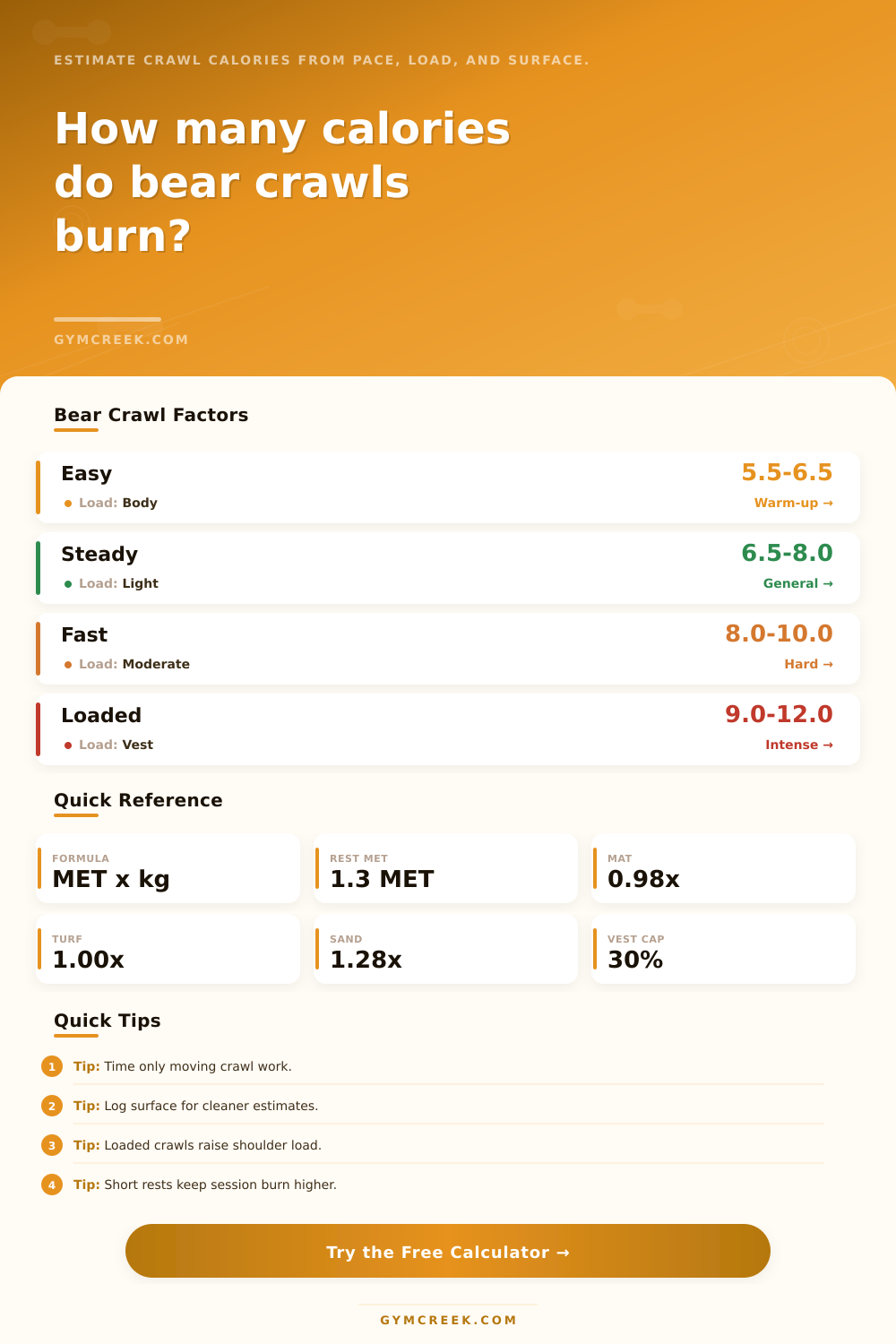
Bear Crawl Calorie Calculator
Estimate calories from bear crawl distance, work time, direction, bodyweight, surface, vest load, sets, rest, and shoulder or core demand.
📌Presets
Each preset fills a distinct crawl setup and recalculates the estimated session burn.
⚙Calculator
Bear crawl calorie snapshot
Enter your crawl setup to estimate active and rest-inclusive calories.
📊Session Metrics
📑Reference Tables
| Pace band | Speed | Base MET | Typical feel |
|---|---|---|---|
| Controlled | Under 8 m/min | 5.5 | Skill practice |
| Steady | 8-16 m/min | 6.5-8.0 | Repeatable work |
| Fast | 16-28 m/min | 8.0-9.5 | Conditioning pace |
| Sprint | Over 28 m/min | 10.0+ | High effort |
| Direction | Factor | Load emphasis | Calculator note |
|---|---|---|---|
| Forward | 1.00 | Balanced | Baseline crawl |
| Backward | 1.08 | Core control | More coordination |
| Lateral | 1.10 | Shoulders | Side-to-side tension |
| Mixed | 1.12 | Whole trunk | Direction changes |
| Light drag | 1.18 | Brace and hips | Added resistance |
| Surface | Factor | Example | Why it changes burn |
|---|---|---|---|
| Rubber mat | 0.98 | Gym floor | Smoother traction |
| Indoor turf | 1.00 | Sled lane | Baseline grip |
| Grass | 1.08 | Field | Uneven contact |
| Sand | 1.28 | Beach area | Soft surface drag |
| Slight uphill | 1.18 | Ramp or hill | More vertical work |
| Formula step | Calculation | Purpose | Output |
|---|---|---|---|
| Base pace MET | Speed band | Sets intensity | 5.5-10.5 MET |
| Adjustment | Factors multiply | Direction and surface | Adjusted MET |
| Active calories | MET x 3.5 x kg / 200 | Moving work | Calories/min |
| Rest calories | 1.3 MET equation | Session total | Extra calories |
💡Tips
Bear crawls is seen by most as a calorie-burning activity. In reality, however, bear crawls are more about building structural integrity.
Think about it: It’s hard to crawl without fighting gravity, friction and slouching over. Your core, hip and shoulder system has to work together in one direction to make this happen. When they does, your energy expenditure goes way up. If not, crawling will be a struggle to pull yourself along the ground.
How to Do Bear Crawls
Why does that matter? It informs what your training should look like in terms of intensity and volume. After that, input your own configuration into the calculator (above). It will do the math for you. You won’t have to guess if the extra weight of a vest add more stress, or if it just moves that stress to your lower back.
Because friction alters the equation, factor in the surface on which you’ll be crawling. Gym floors is made of rubber mats, slick and helpful for speed but typically at the expense of stability. Even though the distance may be small, your muscles must work overtime to catch tiny slips. This adds to how much energy you need.
Now try crawling over sand. The floor give way beneath your knees and hands. Your body must labor to stay put. The resistance changes and the burn change with it.
The other thing that most trainers miss is loaded vest. Yes, adding weight does mean you’ll burn more calories in less time, but it also adds compression to your shoulder joints and makes you brace your core to support addition weight. There’s a point at which the vest impairs your form more different than it assists with conditioning.
To account for that, the vest caps how much weight you can add. There isn’t some endless level at which you keep dialing up weights and your calorie burn go to infinity. Your body won’t let that happen. You’re looking for a weight that’s challenging enough while still letting you have your butt clenched and your spine locked into place.
The directionality is key to the exercise experience, both in terms of effect and focus. Crawling forward serves as baseline, providing an even split across the body’s load. Crawling backward require more use of your core and body awareness (you can’t visually check out what you’re doing). Crawling laterally shifts the focus to lateral muscles in the trunk and shoulders (not often worked in conventional routines). Mixing directions keeps the brain working: you have to pay attention to spatial cues as well as fatigue from movement. The calculator takes all this direction into account for the metabolic equivalent calculation.
Movement coordination equals calories. Equally important to the work are rests in-between. Don’t rest so long that your heart rate slows down, because then you miss the point of metabolic conditioning entirely. But don’t rest too short either or you’ll get sloppy with form (and hurt yourself). You’re trying to maintain high enough intensity to push it hard. You should of not go so hard that fatigue leads to sloppy form instead of quality work.
In this case the tool has a set of presets for you to see what happens to overall calorie output for the session depending on the rest period. Your body continues burning calories even when you stand up and catch your breath to recover and remove lactate from the system…so it’s interesting to see how many calories you actualy expend simply recovering.
But at its root, the bear crawl is an exercise in efficiency. It’s about moving your body from point A to B across a resistant surface with minimal wasted motion. Each inch is a win for coordination.
Calorie tracking helps you understand how much energy you use, but time is the real measure. How long can you go before your hands lose their grip or your hips sag? This is how far you’ve come.
Go easy, concentrate on connecting your core and your hands, and allow difficulty to rise gradualy. Your body will thank you with a burning sensation.