BCAA to Leucine Calculator
Convert BCAA grams, label ratio, servings, product concentration, body weight, and meal leucine into a practical leucine threshold snapshot.
📌BCAA/Leucine Presets
Presets load realistic label setups and calculate immediately. Edit any field to match your product.
⚙Calculator Inputs
Leucine snapshot
Enter your label numbers to convert BCAA dose into leucine, isoleucine, and valine.
📊Metrics Grid
📑Reference Tables
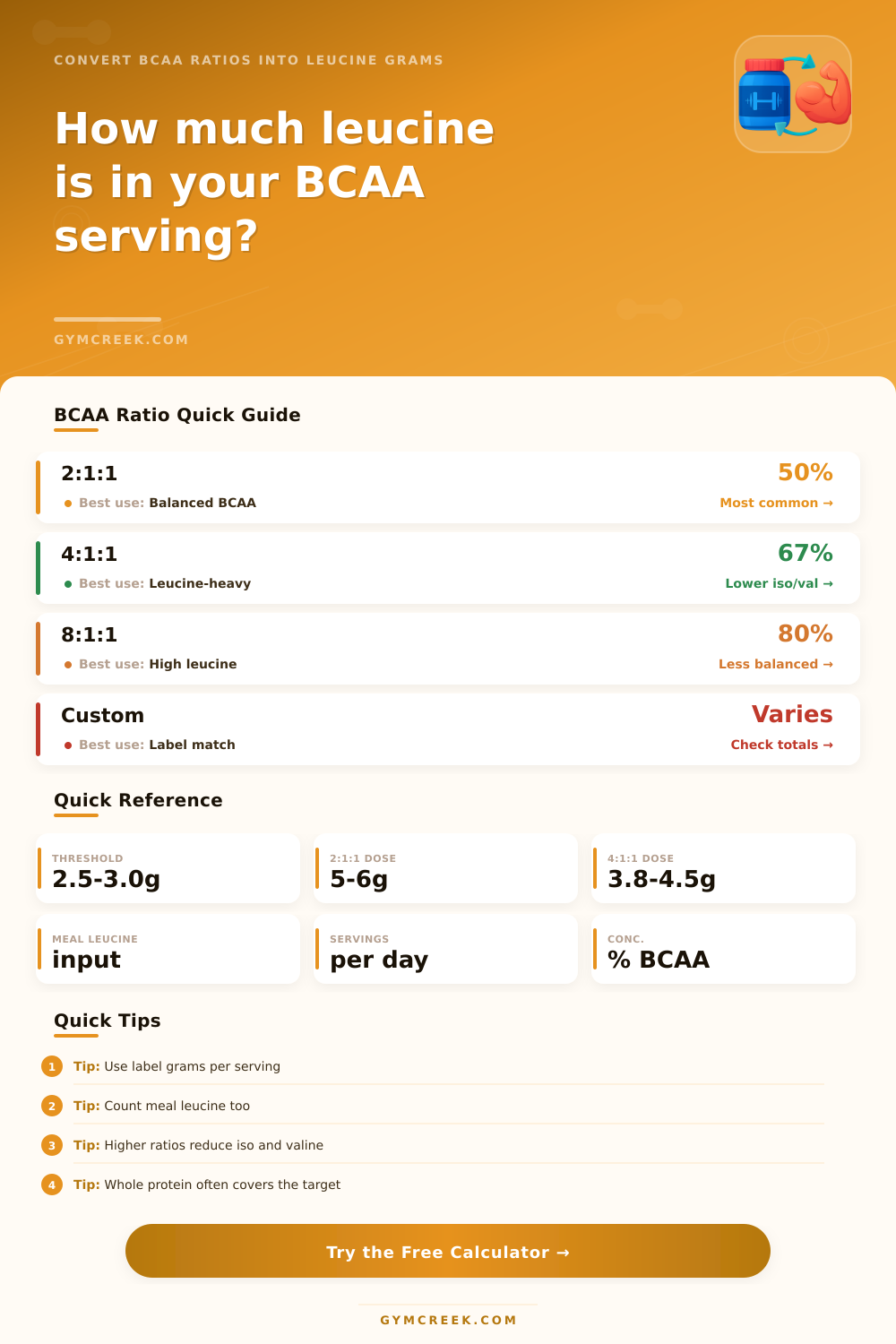
| Ratio | Leucine share | Isoleucine share | Valine share |
|---|---|---|---|
| 2:1:1 | 50.0% | 25.0% | 25.0% |
| 4:1:1 | 66.7% | 16.7% | 16.7% |
| 8:1:1 | 80.0% | 10.0% | 10.0% |
| Custom | L / total | I / total | V / total |
| Goal | Target used | What it means | Practical note |
|---|---|---|---|
| Maintenance | 2.5 g | Basic meal trigger estimate | Food protein often covers it |
| Muscle gain | 3.0 g | Higher lifting target | Useful when meal protein is low |
| Cut or recomp | 3.0 g | Protein quality support | Prioritize total protein first |
| Higher threshold | 3.2 g | Conservative context | Use clinician advice if needed |
| Product | BCAA serving | Leucine | Servings for 3 g |
|---|---|---|---|
| 2:1:1 powder | 5 g | 2.5 g | 1.2 |
| 2:1:1 powder | 6 g | 3.0 g | 1.0 |
| 4:1:1 powder | 4.5 g | 3.0 g | 1.0 |
| Drink mix 50% | 8 g | 2.0 g | 1.5 |
| Step | Formula | Input | Output |
|---|---|---|---|
| Active BCAA | BCAA g x concentration | Label serving | Usable BCAA grams |
| Amino split | Active BCAA x part / total | Ratio | Leu/Iso/Val grams |
| Coverage | (Meal + supplement) / target | Goal threshold | Percent covered |
| Servings | (Target - meal) / leucine per serving | Meal leucine | Servings needed |
💡Tips
When a person take a BCAA supplement, they often want to increase the amount of leucine in there body. The leucine content on BCAA supplements is not measured on the label, though; instead, the total weight of BCAAs and the ratio of BCAAs is listed. In order to determine how many gram of leucine the supplement contains, a person must perform a mathematical conversion from these two value.
However, this can be difficult for a person while they are shopping for supplement. To remove the guesswork in this process, a BCAA calculator can determine the number of gram of leucine that a person will receive from a supplement. All a person must do is enter the total grams of BCAAs that the brand produce, the ratio of BCAAs in that brand’s supplement, and the concentration of the BCAA supplement.
How to Use the BCAA Calculator
The BCAA calculator will then tell a person the amount of leucine, isoleucine, and valine in the supplement, as well as the amount of leucine that the meal that the person eat contains. This number represents the total number of grams of leucine that the body will receive. This measurement of total leucine is important for the body, as leucine cannot work alone.
Research show that a person needs at least 2.5 grams of leucine and up to 3 gram of leucine per meal in order to maximize muscle protein synthesis. Therefore, if the meal that a person eats contain leucine, they will require less leucine from a BCAA supplement. By using the BCAA calculator, a person can determine how many scoops of BCAA supplement are necessary to reach the recommended amount of leucine for that meal.
The BCAA calculator prevents a person from purchasing too much scoops of BCAA supplements from their favorite brand. The ratio on a BCAA supplement can change the distribution of grams of BCAAs. For instance, a 2:1:1 ratio indicates the grams of BCAAs distributed among the amino acids leucine, isoleucine, and valine.
However, a 4:1:1 ratio or an 8:1:1 ratio will contain more grams of BCAAs going into the leucine category. Therefore, a higher ratio indicates more leucine and less isoleucine and valine than a lower ratio. A person can see this on a BCAA calculator to allow a person to select a supplement with the correct ratio of BCAAs to meet their bodily need.
Body weight is another factor in the determination of how much leucine the body need. A person’s body weight can be entered into the BCAA calculator. Based off this information, the BCAA calculator can indicate if a person’s total leucine intake is becoming very highly.
This BCAA calculator is a tool that provide information to a person, but it isnt a replacement for medical advice. The amount of leucine that is in a person’s meal is also a critical factor in using the BCAA calculator. A person may think that a BCAA supplement will add more leucine to the body, but many meal that contain proteins like chicken, eggs, or whey protein contain leucine as well.
Therefore, if the meal contains a high amount of leucine, the BCAA calculator will show that fewer gram of BCAA supplement are necessary. This information is critical for a person who wants to improve their health and eat more healthyly foods rather than focus on BCAA supplements. Concentration is important for BCAA supplements that contain additional ingredient like carbohydrates and flavoring.
A person must enter the percentage of the BCAA supplement that is actualy BCAAs into the BCAA calculator. If a person use a lower percentage, the BCAA calculator will correctly calculate how many grams of leucine are in the BCAA supplement. Otherwise, they may overestimate the amount of leucine in that supplement.
Overall, the BCAA calculator is a simple tool that allow a person to take the information on the label of their BCAA supplement and convert it into grams of leucine. From here, the person can compare the amount of leucine in their meal to the grams of leucine that the BCAA supplement will add to their system. Based on this comparison, the person can decide if they need to take BCAA supplements to aid in their health.
This decision will be based off the mathematical calculation of the BCAA supplement calculator, not the persuasive language used by the supplement manufacturer.