Battle Rope Calorie Calculator
Estimate calories burned from battle rope length, diameter, wave style, work and rest intervals, rounds, cadence, body weight, and slam intensity.
📌Presets
Each preset loads a realistic battle rope setup, including rope dimensions, interval timing, and cadence.
⚙Calculator
Battle rope calorie snapshot
Enter rope dimensions, intervals, cadence, and body weight to estimate session calories.
📊Fitness Metrics
🧮MET Logic
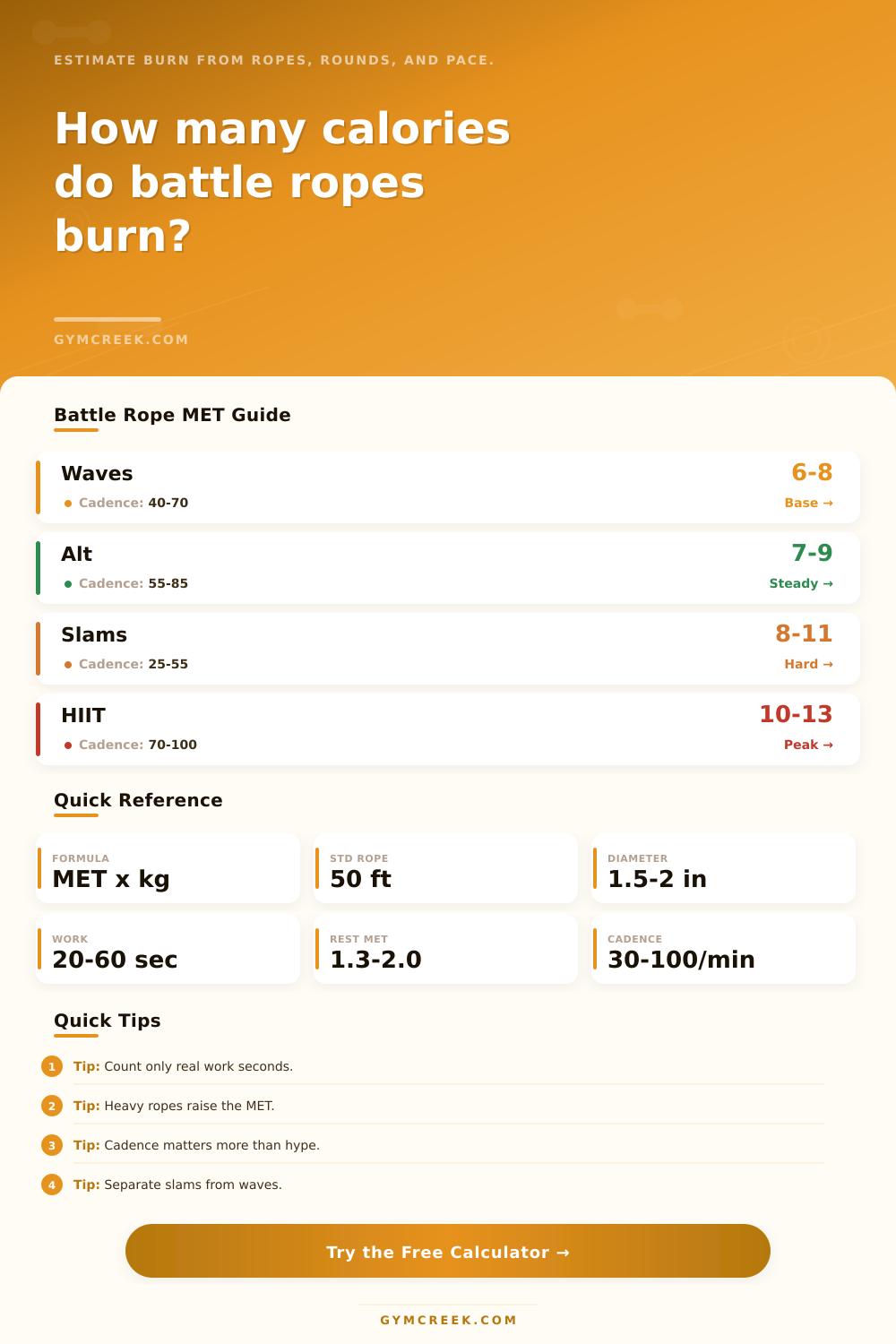
Calories per minute = MET x 3.5 x body weight in kg / 200. This drives the active work estimate.
Length and diameter adjust the base MET because thicker, longer ropes require more force to move cleanly.
Higher waves per minute increase the adjusted MET, while slower technique sets lower the final estimate.
Rest uses a low recovery MET, and hard interval styles add a small EPOC estimate after the session.
📑Reference Tables
| Wave Style | Base MET | Cadence | Best Use |
|---|---|---|---|
| Double waves | 6.8 MET | 40-70/min | Technique base |
| Alternating waves | 7.8 MET | 55-85/min | Conditioning |
| Power slams | 9.5 MET | 25-55/min | Power output |
| Outside circles | 8.2 MET | 35-65/min | Shoulder load |
| Jumping jack waves | 10.2 MET | 45-80/min | Full-body work |
| Rope Setup | Diameter | Length | Modifier |
|---|---|---|---|
| Light gym rope | 1.5 in | 30 ft | 0.90-0.98x |
| Standard rope | 1.5 in | 50 ft | 1.00x |
| Heavy rope | 2.0 in | 50 ft | 1.15-1.25x |
| Long heavy rope | 2.0 in | 60 ft | 1.25-1.35x |
| Interval Setup | Work | Rest | Training Load |
|---|---|---|---|
| Skill rounds | 20 sec | 40 sec | Low |
| Base intervals | 40 sec | 20 sec | Moderate |
| Tabata ropes | 20 sec | 10 sec | High |
| Long density | 60 sec | 30 sec | Very high |
| Formula | Variables | Output | Used For |
|---|---|---|---|
| MET kcal | MET, kg, min | Calories | Work burn |
| Rest kcal | Rest MET, kg | Calories | Breaks |
| Duty cycle | Work, rest | Percent | Density |
| Mifflin BMR | kg, cm, age | Baseline | Daily share |
💡Tips
Sometimes battle ropes are seen as punishment. Finish your weights. Go over to anchor point. Wave those ropes around till your lungs burn.
The idea is that if it makes you sweat, it must be working. But there’s an inefficiency in flailing with no direction. You spent ten minutes on the ropes. That could of been five minutes. You’re moving air, not mass.
Measure Your Battle Rope Workout
To truly understand what this movement costs you, you’ve got to go deeper than just the clock. Understand the physiology of what you’re doing and the physics of what you’re doing.
After entering your interval structure, rope dimensions and bodyweight into the calculator above, it will do the math for you. No more guesswork about how difficult a light rope session might be compared to a heavy one.
Many folks think if they wave a rope around for five minutes, they’ve done five minutes of high-intensity work. They haven’t. There is very few seconds during any given rope session in which you are actually burning energy. When the rope goes slack, when you pause to readjust your grip, that’s not conditioning; thats recovery time. And since the energy burn stops when the tension breaks, this is important. Only account for the seconds when the rope is really battling back.
The other part is the type of rope used. For example, consider a thirty-foot thin rope. That’s a technical tool. It goes quickly, with little resistance. You’re practicing your coordination and speed.
Now take that same length of a two-inch diameter rope, and the dynamic change completely. There’s far more mass to be pushed along, stopped and started again. That’s where the MET values differ. On the page, they have a nice table for reference. It shows how the length and diameter modifiers increases the base metabolic equivalent. More mass means more force required to accelerate and decelerate.
Suddenly, what was just a cardio workout becomes a mix of cardio and strength endurance. You’re no longer simply running in place, you’re picking up a dead weight over and over. That alters need for recovery.
The thing everyone overlooks? Cadence. The slower and more perfectly formed your wave, the less it’ll burn. But if the wave is frantic and sloppy, you will get gassed sooner. You can’t keep up a frantic pace. Thirty seconds in and you’re done. The sweet spot is high-cadence but controlled. That’s what keeps the heart pumping and your body burning without peaking the lactic acid too soon. A higher cadence mean a higher caloric burn per second.
The goal of the cadence isn’t to move faster, just to maintain tension throughout. Drop the cadence and you’ll also drop the burn.
This is the afterburn effect. That’s because interval structure drives this. You can achieve quality reps by performing short bursts of work and then resting longer than usual. For pure endurance, perform longer work intervals and keep the rest short. But you’ll likely lose some power output.
The calculator separates rest calories from work calories. That provides a realistic depiction of the total cost of that session. And it includes a tiny estimate for something called excess post-exercise oxygen consumption, aka, the extra energy your body uses as it recovers.
Yes, this afterburn is real. But it’s frequently overstated in fitness marketing. Don’t count on it to do heavy lifting. The work needs to earn the result.
The whole calculation then relies on body weight. You burn more calories when you move a greater amount of mass (i.e., a heavier person burning more calories than a lighter one, moving the same rope). That’s a fact of biology, not some moral judgement. The tool assumes that and applies standard metabolic formulas to calculate it.
Then it takes into account what kind of activity you typically do in order to put things into context. For someone who sits most of the time outside of the gym, a rope session will have a greater relative effect different than it would for someone who runs marathons on weekends. This shifts the meaning of the data.
Rope sessions are better when they’re structured, not improvised. Choose a style, a duration, and a rest period before you start. Stay committed. Your discipline show up on the numbers.
Want to shed fat? Volume matters more than hero sets. Want strength? Lower cadence; focus on slam intensity. The tool gives you that. It makes your fuzzy intentions clear. And it shows you exactly what happens when you change a single variable.
That is worth more then just the sweat. Don’t guess how hard you’re working. Measure what’s really making a difference.
The things you control are rope size, cadence, and work to rest ratio. Use them wisely.
You’ll feel a burn, that’s real. But you can act on the burn you measure. It is not just the ache in your shoulders. Use the data to decide what to do during your next set. The rope doesn’t lie. Don’t let your planning do so either.