Basal Metabolic Rate Calculator
Estimate resting calories, total daily energy burn, and a practical target range using body stats, activity, and goal settings.
📌Presets
Each preset loads a realistic profile, selects a formula strategy, and recalculates the BMR estimate immediately.
⚙Calculator
BMR estimate
Enter your stats and calculate your resting energy needs.
📊Fitness Metrics
📑Reference Tables
| Formula | Core inputs | Strength | Best use |
|---|---|---|---|
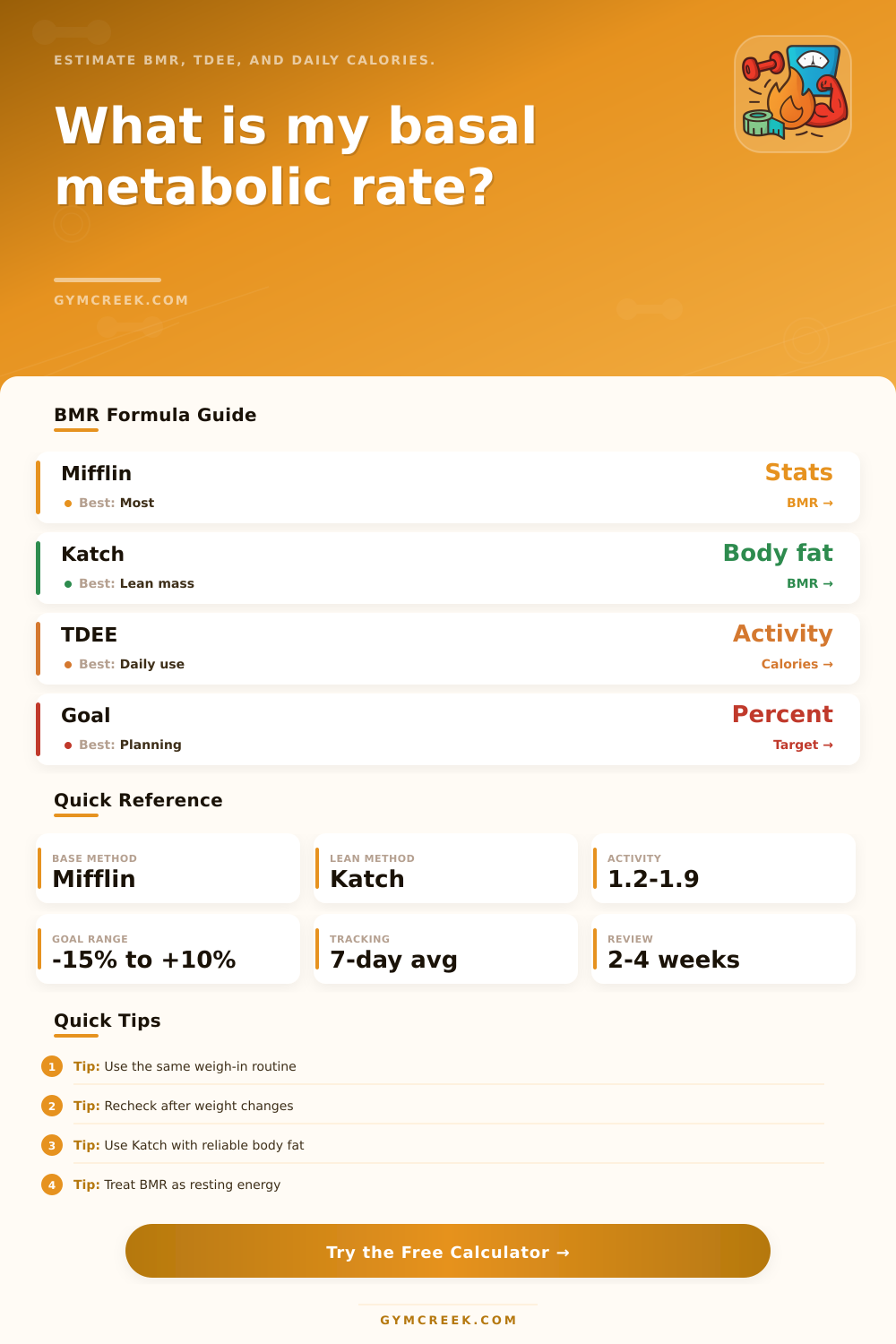
| Mifflin-St Jeor | Sex, age, weight, height | General estimate | Most adults |
| Katch-McArdle | Lean body mass | Body composition | Known body fat |
| Average mode | Both formulas | Smoother estimate | Uncertain body fat |
| TDEE layer | BMR x activity | Daily burn | Planning intake |
| Activity level | Factor | Typical steps | Training cue |
|---|---|---|---|
| Sedentary | 1.2 | Under 5k | Little exercise |
| Lightly active | 1.375 | 5k-8k | 1-3 days |
| Moderate | 1.55 | 8k-12k | 3-5 days |
| Very active | 1.725 | 12k-16k | Hard training |
| Extra active | 1.9 | 16k+ | Daily labor |
| Goal | Adjustment | Scale pace | Use case |
|---|---|---|---|
| Fat loss | -15% | Faster loss | Short phase |
| Slow cut | -10% | Steady loss | Most cuts |
| Recomp | -5% | Slow change | Lifting focus |
| Maintain | 0% | Stable | Baseline |
| Lean gain | +5% | Slow gain | Muscle gain |
| BMR per kg | Range | Meaning | Check |
|---|---|---|---|
| Lower | 18-21 | Smaller burn | Review inputs |
| Typical | 21-25 | Common range | Track trend |
| Higher | 25-29 | More lean mass | Check activity |
| Very high | 29+ | Large output | Verify stats |
💡Tips
How many calories do you burn sleeping? How about when you’re sitting around at home? If you don’t already know your basal metabolic rate (BMR), then odds are good you have a more accurate idea of your height and weight. Yet your BMR is the baseline for everything else you decide to eat. It’s your bodys invisible energy cost, how much your body burn simply to maintain your heartbeat. Most of us guess because we’ve heard some vague “rules of thumb” in headlines and articles; that never holds up very well against forces of reality. Knowing your BMR change the equation from guessing to planning.
To help with that, this calculator will do math for you as soon as you enter your own statistics (you don’t have to worry about fumbling around trying to find unknown formulas or make mistakes with coefficients). And it also leaves it up to you where that estimate come from, so you can pick an option that matches whatever data you believe.
How to Use the BMR Calculator
For example, the Mifflin-St Jeor formula uses your gender, age, height and weight as its basis because it makes some basic assumptions about your overall body composition based off these facts. For most folks who aren’t meticulously tracking their body fat percentage, thats fine; it’ll provide a good-enough estimate.
If you are aware of your lean mass, though, the Katch-McArdle method remove all of these assumptions regarding your body fat and just estimates your energy needs based on amount of muscle tissue present. Why? This is because muscle require more calories to maintain at rest than fat tissue. So if you’re rather heavily muscled, you might run into issues using a generic formula here and accidently eating too little. That’s where it gets interesting.
Basal metabolic rate are strictly energy used for survival (no commuting to work, no walking to the kitchen, no thinking about your lunch). So you have to layer in activity on top of that baseline figure in order to understand how much food you should of being eating. And that’s exactly what the reference table on the page show: it uses your training frequency and daily step count to determine your activity multiplier.
If you commute to work then sit at a desk all day, yet still make it into the gym for an hour each evening, you’re probably only lightly active, not moderately so. This is the #1 reason why people stick to their plan yet don’t see results: They miscalculate this multiplier. Underestimate it and you slow the rate of change; Overestimate it and you stall progress. In practice, erring on the low side, with a slightly lower estimate, tends to be safer than going to high with an overly optimistic guess.
Second, determine how you’re going to proceed. Burning everything you eat maintains weight, but doesn’t alter body composition. To lose fat, create a slight calorie deficit. It’s safe and sustainable, it won’t cause your metabolism to slow down, and it is effective over time. Aggressive deficits of 15 percent are typically used only at higher initial weights, in very limited durations, or during phases where rapid progress are desired. Ten percent is generally manageable for most individuals, providing a gradual rate of loss that still protects mood and muscle mass. To build muscle, reverse this: increase calories to fuel new tissue without storing excess fat.
Whatever the target, the calculator converts this percent into numbers. It provides daily totals to help you visualize the shift instead of blindly trusting a vague idea. But tracking gives us the feedback loop we need to convert our estimate to fact. There’s no mathematical equation that will account for your unique mixture of metabolism, sleep patterns, and stress level. So while it may be tempting to get hung up on what the scale says one day, the real story lies in whether your progress align with where you want it to be over the course of a week.
Your body is constantly changing… Glycogen stores fluctuate, water retention varies, and yes, even digestion affect the scale on any given day. Regardless of your underlying body fat trend, each day will throw a different value at you. When you finally see some meaningful change on the scale, adjust your goals so that they reflect your new, lighter bodys changing energy requirements. It won’t seem like much, but it’ll matter if you’re serious about long term success. Think of this first number as a beginning rather than a final declaration and let your own results guide you accordingly. A good plan is a living, breathing plan.