Barre Workout Calories Burned Calculator
Estimate calories, active minutes, muscle endurance load, weekly burn, and intensity category from your class length, barre style, pulse work, equipment, experience, and weekly sessions.
Your barre calorie estimate
Enter your class details to estimate burn and muscular endurance load.
| Barre style | Base MET | Active share | Best fit |
|---|---|---|---|
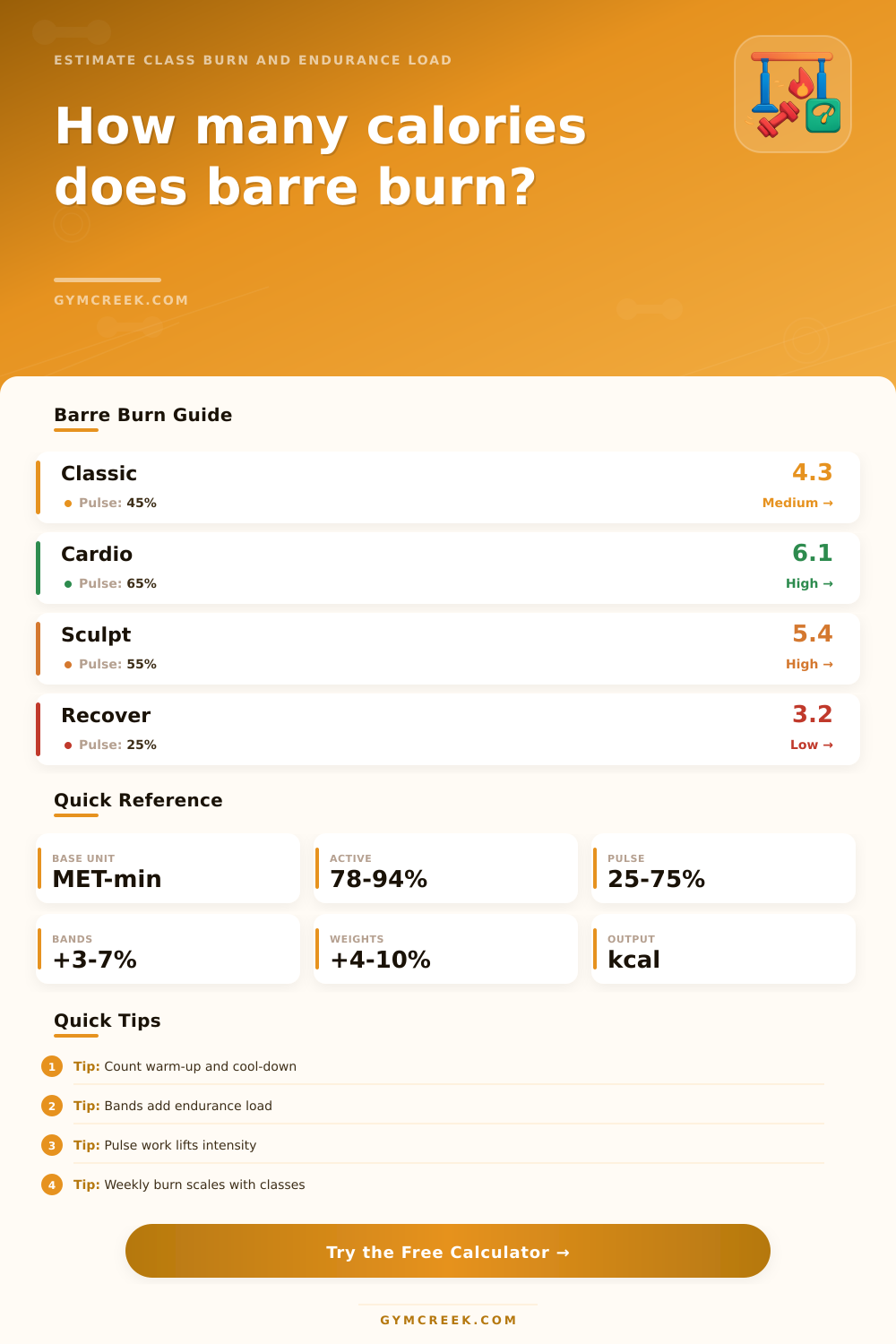
| Classic barre | 4.3 | 86% | Small ranges, holds, pulses, and steady standing work. |
| Cardio barre | 6.1 | 92% | Faster transitions, bigger arm patterns, and interval blocks. |
| Sculpt barre | 5.4 | 88% | Barre work mixed with strength circuits and equipment. |
| Pilates barre fusion | 4.7 | 84% | Core control, mat work, balance, and slower transitions. |
| Ballet technique barre | 3.8 | 82% | Form, turnout, balance, and controlled repetitions. |
| Power barre | 5.8 | 90% | Higher tempo blocks with added lower-body fatigue. |
| Gentle or recovery barre | 3.2 | 78% | Mobility, alignment, lighter holds, and slower pacing. |
| Athletic barre hybrid | 6.4 | 94% | Barre mixed with athletic conditioning or low-impact cardio. |
| Input choice | Multiplier | Active effect | Endurance effect |
|---|---|---|---|
| Low, technique focused | 0.88 | Less continuous work | Best for skill, balance, and low fatigue days. |
| Moderate, steady class | 1.00 | Baseline active share | Typical class demand for regular students. |
| Vigorous, sweaty class | 1.16 | More dense work | Raises calorie burn and local muscle fatigue. |
| Max effort intervals | 1.30 | Highest active share | Hardest rating for pulsing and cardio barre classes. |
| More isometric holds | 0.98 | Slightly lower movement | Higher time-under-tension load. |
| More pulsing reps | 1.05 | Slightly higher movement | Higher repetition endurance score. |
| Dynamic movement blocks | 1.10 | More transitions | Higher heart-rate and active-minute signal. |
| Factor | Calorie effect | Load effect | Calculator use |
|---|---|---|---|
| Bodyweight only | Baseline | Baseline | Use for classic classes without added resistance. |
| Light resistance band | +3% | +10% | Small calorie rise, clear endurance load rise. |
| Heavy resistance band | +7% | +20% | Higher local fatigue during abduction and arm blocks. |
| Light hand weights | +4% | +12% | Best for upper-body burn and shoulder endurance work. |
| Bands plus hand weights | +10% | +28% | Highest equipment effect in the calculator. |
| New or returning | +6% | +10% | Less efficient movement often feels more demanding. |
| Trained barre student | -3% | +5% | Better skill can lower cost while increasing work quality. |
| Instructor or advanced | -6% | +12% | Efficient movement with higher control and tension. |
| Output | Formula basis | Inputs used | Interpretation |
|---|---|---|---|
| Calories | MET x 3.5 x kg / 200 x minutes | Weight, style, intensity, ratio, equipment, experience | Standard exercise energy estimate for one class. |
| Active minutes | Class length x active share | Length, style, intensity, pulse ratio | Estimated minutes spent in meaningful work. |
| Muscle endurance load | Active min x MET x tension factors | Pulse, isometric, equipment, experience | Local muscular fatigue score for comparing classes. |
| Weekly burn | Class calories x weekly sessions | Calories and weekly frequency | Estimated weekly barre calorie burn. |
| Intensity category | Adjusted MET plus load score | MET, active minutes, load points | Labels the session as light, moderate, high, or very high. |
Barre classes requires energy from the body to perform the specific movement involved. Many people may feel heavy in there legs after a barre class due to the repetitive movements involved in barre classes. People want to know the energy cost of an barre class to track their training load for the week and to plan their days off to recover from the barre classes they attends.
Knowing the energy cost of barre classes allow people to understand why some classes may feel more draining than others. The energy cost of barre classes are determined by several different factors. One of the main factor is the weight of the individual who attend the barre classes.
How Much Energy Do You Use in a Barre Class?
A person who weigh more will use more energy than a person who weighs less to perform the same movement patterns. The length of the barre class is another determining factor as each class will have a warm up and cool-down portion. Additionally, the style of barre class will determine the intensity of that barre class.
Cardio barre classes will burn calories more differently than barre classes that focus on slow movements. The ratio of pulsing movements to isometric hold will impact the energy used in a barre class. Barre classes that use equipment will require more energy than barre classes that dont use no equipment.
Finally, the experience level of the individual in the barre class will influence how much energy they use. Beginners will use more energy than barre class enthusiast who have mastered the movements. This is because beginner movements are not nearly as efficient as advanced movement.
Additionally, the more experienced barre class attendees will use more energy due to local muscle fatigue. A barre class energy calculator will show several figure regarding the energy use of barre classes. The number of calories that can be burned in a barre class in a single session will be one figure.
The active minute that an individual will burn will be another figure. The muscle endurance load score will be represented in another figure as well. This figure can explain why an individual may feel sore in their muscle after attending a barre class.
The weekly burn and the weekly load in a barre class energy calculator will allow individuals to see how many barre class sessions they attends each week. Not all barre classes is the same. A barre class that uses heavy band for forty-five minutes will not be the same as a barre class that focuses on mobility for forty-five minutes.
These bars have different impact on the body, thus requiring different amount of fuel to return to normal. Individuals should pay attention to the ratio of pulsing movements to isometric holds during a barre class. Any barre class that incorporate long isometric holds will increase the time under tension that a muscle is active.
Increased time under tension can impact a person’s muscle endurance during a barre class, hence, increasing the soreness in those muscles. The main purpose of these figures within a barre class energy calculator is to permit individuals to compare the energy cost of barre classes over time. By utilizing the calculator, an individual can compare the energy cost of barre classes as long as their weight, the length of the class, and the type of barre class remain the same.
By keeping these factors the same, the only variable will be the frequency at which they attend barre classes, or the type of equipment use during those classes. The information from the barre class energy calculator will allow individuals to decide whether to increase the frequency at which they attend barre classes, or to increase the demanding nature of the barre class that they attend. These figures from a barre class energy calculator will allow individuals to make decision regarding their barre class goals.
These goals can be focused on gaining higher level of calorie burn during barre classes, or the individual can focus on utilizing controlled tension in their muscle during barre classes. Knowing the difference between these two goals will allow individuals to choose the type of barre class that best fit their needs at that particular time.