Barbell Row Calculator
Estimate barbell row 1RM, training max, bodyweight ratio, target load, tonnage, and technique-adjusted strength from a recent row set.
📌Presets
Presets load realistic row tests, body data, technique choices, and target reps so you can compare strict, Pendlay, and heavy accessory styles.
⚙Calculator
Barbell row estimate
Enter a recent barbell row set to estimate 1RM, ratio, and target loads.
📊Row Metrics
📋Training Loads
| Zone | Percent | Load | Typical reps | Use |
|---|---|---|---|---|
| Technique | 60% | --- | 8-12 | Positions |
📑Reference Tables
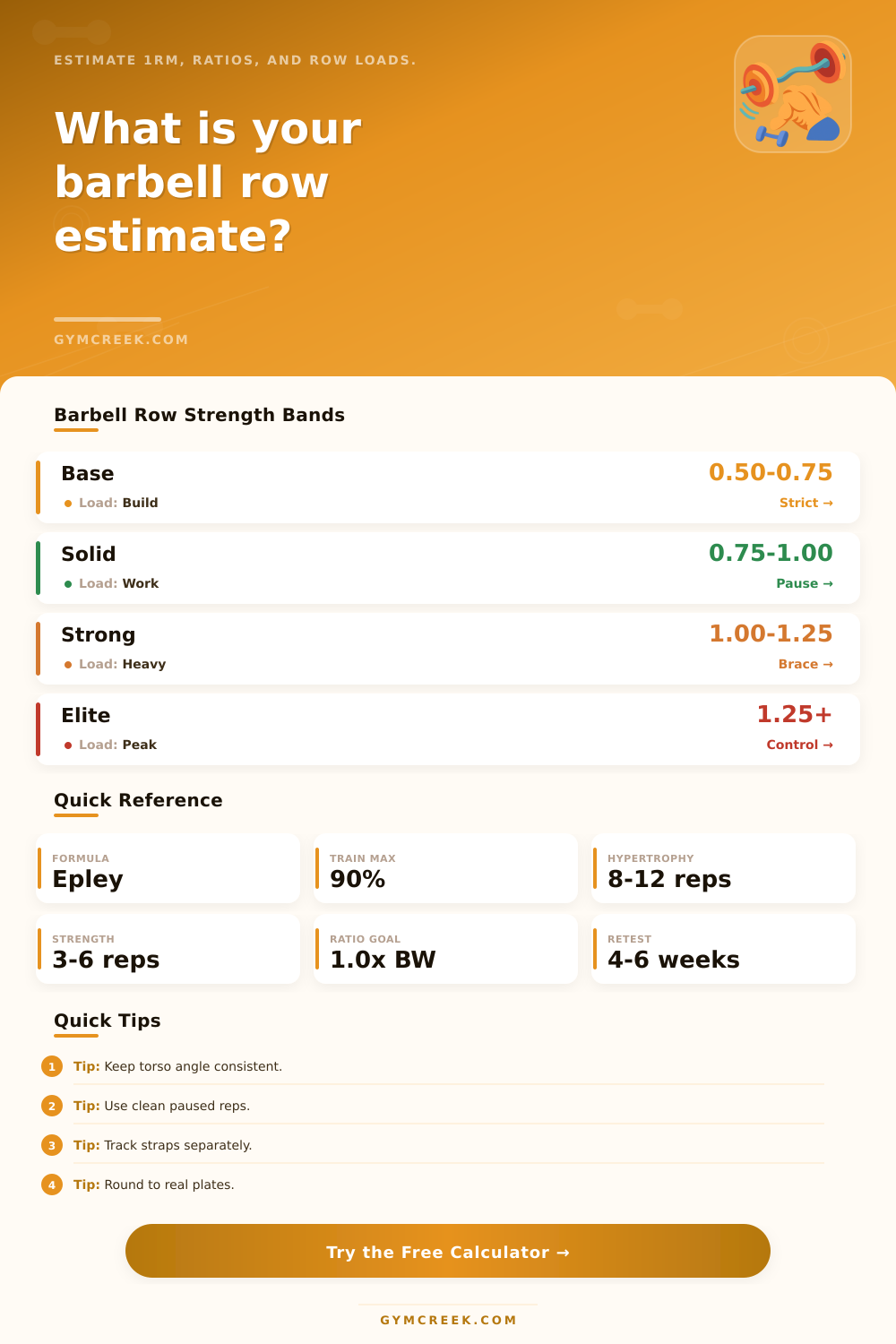
| Strength band | Adjusted ratio | Typical row | Training cue |
|---|---|---|---|
| Base | 0.50-0.75 x BW | Technique building | Own the torso angle |
| Solid | 0.75-1.00 x BW | Useful working strength | Add pauses and volume |
| Strong | 1.00-1.25 x BW | Advanced pull support | Keep reps honest |
| Elite | 1.25+ x BW | High row strength | Manage fatigue carefully |
| Row style | Best use | Load effect | Comparison note |
|---|---|---|---|
| Strict bent-over | Back strength | Baseline | Best repeatability |
| Pendlay row | Power from floor | Slightly lower | Dead stop each rep |
| Yates row | Lat emphasis | Often higher | More upright torso |
| Body-English row | Overload work | Highest load | Track separately |
| Formula | Use | Equation | Best range |
|---|---|---|---|
| Epley e1RM | Max estimate | Load x (1 + reps / 30) | 1-12 reps |
| Training max | Planning load | e1RM x percent | 85-92% |
| Target load | Rep goal | e1RM / (1 + reps / 30) | 3-15 reps |
| Mifflin BMR | Body context | Weight, height, age | Profile only |
| Input | Why it matters | Higher value means | Best practice |
|---|---|---|---|
| Torso angle | Leverage changes load | More strict demand | Film from the side |
| Range of motion | Back work quality | Better transfer | Touch same point |
| Grip support | Limits or boosts set | Different comparison | Log straps clearly |
| Fatigue | Daily performance | Lower estimate | Test after warm-up |
💡Tips
The barbell row is an exercise that falls somewhere in the middle of other barbell exercises. The barbell row exercise has an effect upon the way that the back muscles holds weight. Despite the fact that many people perform the barbell row as an accessory exercise to there training routine, the barbell row provides information about the strength of a person.
A person can perform a sloppily set of barbell rows or a strict set of barbell rows, each type of performance will have an effect upon the posture of that person and there ability to lock out in a deadlift exercise. The barbell row exercise also provides information about the leverage that are created during the exercise. For example, an adjustment in the angle of a persons torso, the grip that they use, or the range of motion that they create will alter the amount of load that that individual can handle.
How to Measure Your Barbell Row Strength
A person may lift the same load with the barbell but be performing at a differents intensity with that barbell row exercise. Most estimates for the strength of a person in the barbell row exercise begins with a recent set performed by that individual. The load that is lifted, the number of repetitions performed with that load, and the number of repetitions that an individual has left in their reserve can all be entered into the Epley formula for estimating the one repetition maximum that an individual can create with barbell rows.
This calculation only provides an estimate of the one repetition maximum strength of that individual and does not account for the quality of the sets performed with the barbell. For example, an individuals barbell row with a rounded back is not equivalent to the same exercise performed with a braced back. A number of adjustments can be made to the barbell row exercise that alter the difficulty of the exercise.
For instance, adjusting the angle of the torso that is performed with the exercise will change the demand upon the lower and hamstring muscles of an individual versus there upper back muscles. Additionally, the range of motion and the grip that an individual uses can also alter the difficulty of the set. The calculator provided calculates the various elements of this exercise so that an individual dont have to manually calculate each variable.
The bodyweight ratio for an individual that can perform barbell rows that weigh as much as the body weight of that individual indicates that they are in a solid physical position relative to there body frame. If an individuals bodyweight ratio is below there bodyweight, those individuals may need to focus more on there technique within the barbell row exercise. Conversely, an individual whose bodyweight ratio is above there body weight has likely performed the exercise regularly over time.
While the bodyweight ratio does not dictate the type of training program that an individual is to utilize, it does provide information as to whether or not the load that they are performing is appropriate to there body size. The training maximum for an individual is the number that most people use within there training program to increase the strength in that exercise. Most training programs does not use the true one repetition maximum of an individual in relation to barbell rows.
Instead, a percentage of the adjusted maximum can be used to create training sets for that individual. For instance, percentage values between 85 and 90 percent of the training maximum are typically used in strength training programs while higher percentages are used forhypertrophy training programs. The calculator will provide both the raw estimate and the training maximum to allow for comparison between the two values.
Session tonnage is another value that can be tracked with the barbell row exercise. Session tonnage is calculated by multiplying the load performed by the repetition counts and the number of sets performed. Two different training sessions will have the same tonnage yet utilize different sets of repetitions.
For instance, one session may include heavy triples while another may include sets of twelve. By tracking the tonnage performed with the barbell row exercise, an individual can track there increasing strength. Additionally, tonnage can also help to reveal if an individual is under-loading there training in comparison to previous training months.
Deadlift balance is an optional field within the calculator that can be used after an individual has performed the exercise for several months. The barbell row and the deadlift utilize similar muscles within the body. The strength gains from each exercise may not be the same, however.
For instance, an individual may find that there barbell row strength is lower than there deadlift strength. Their barbell row strength that is much lower than there deadlift strength indicates a potential weakness in there upper back strength. In contrast, if there row and deadlift strength are similar, they may be experiencing fatigue in there lower back muscles.
There are a few mistakes with the barbell row exercise that may occur that will lead to inaccurate determinations of the strength that an individual can develop. For example, one mistake is to perform barbell rows after performing heavy deadlift sets for that individual. An individual that performs this mistake will find there barbell row to have a maximum strength that does not truly represent there back strength.
Another mistake is to utilize straps for every set of barbell rows. This will prevent the individual from gaining strength in there grip. The third mistake is to attempt to increase the load performed with barbell row sets by increasing the angle of the torso.
This turns the barbell row exercise into a shrug movement for that individual. Each of these mistakes will make it more difficult for an individual to compare there barbell row strength over time. The tables within this calculator indicate the relative strength of individuals within a given range of ratio counts.
These tables are not a means of labelling an individual as a beginner or an elite weightlifter. Instead, the tables allow individuals to understand what strength is required for different types of training. For instance, base ratios require strict repetitions to develop back strength.
Individuals with solid ratios can utilize pauses between sets while performing barbell rows. Elite ratios require careful management of fatigue levels during performance of the set. Training is rarely a straight line for any individual.
For instance, an individual may find that there barbell row strength is light during one month due to good sleeping habits but find that there strength is lower during another period of time due to stress or poor nutrition. While the calculator cannot determine the strength of an individual each day, it does provide the baseline from which that individual can determine whether or not a bad row day is temporary or persistent. The different techniques for performing barbell rows will relate to the goals that an individual trains with.
For instance, powerlifters may use a higher angle of the torso than individuals that focus upon strict barbell row techniques because there goals focus upon the development of the upper back muscles. An individual that trains with strict techniques for barbell rows may use a torso angle that is close to parallel to the floor as it will help in the performance of a deadlift. Each of these techniques is valid with a specific goal for that individual.
The calculator provided helps to indicate the strength of an individuals back as well as the training maximum for that individual.