Barbell Curl Calculator
Estimate a strict barbell curl 1RM, bodyweight ratio, strength category, and practical training loads from curl load, reps, bodyweight, strictness, bar type, and tempo.
📌Presets
Use a recent curl set where the bar, torso motion, elbow travel, and tempo match how you want to compare your strength.
⚙Calculator
Barbell curl strength snapshot
Enter curl load, reps, bodyweight, strictness, bar type, and tempo.
📊Curl Metrics
📑Reference Tables
| Category | Male strict 1RM | Female strict 1RM | Meaning |
|---|---|---|---|
| Beginner | Below 0.25 x BW | Below 0.15 x BW | Learning controlled curl mechanics |
| Novice | 0.25 to 0.45 x BW | 0.15 to 0.28 x BW | Regular curls with clean reps |
| Intermediate | 0.45 to 0.65 x BW | 0.28 to 0.42 x BW | Noticeable arm strength base |
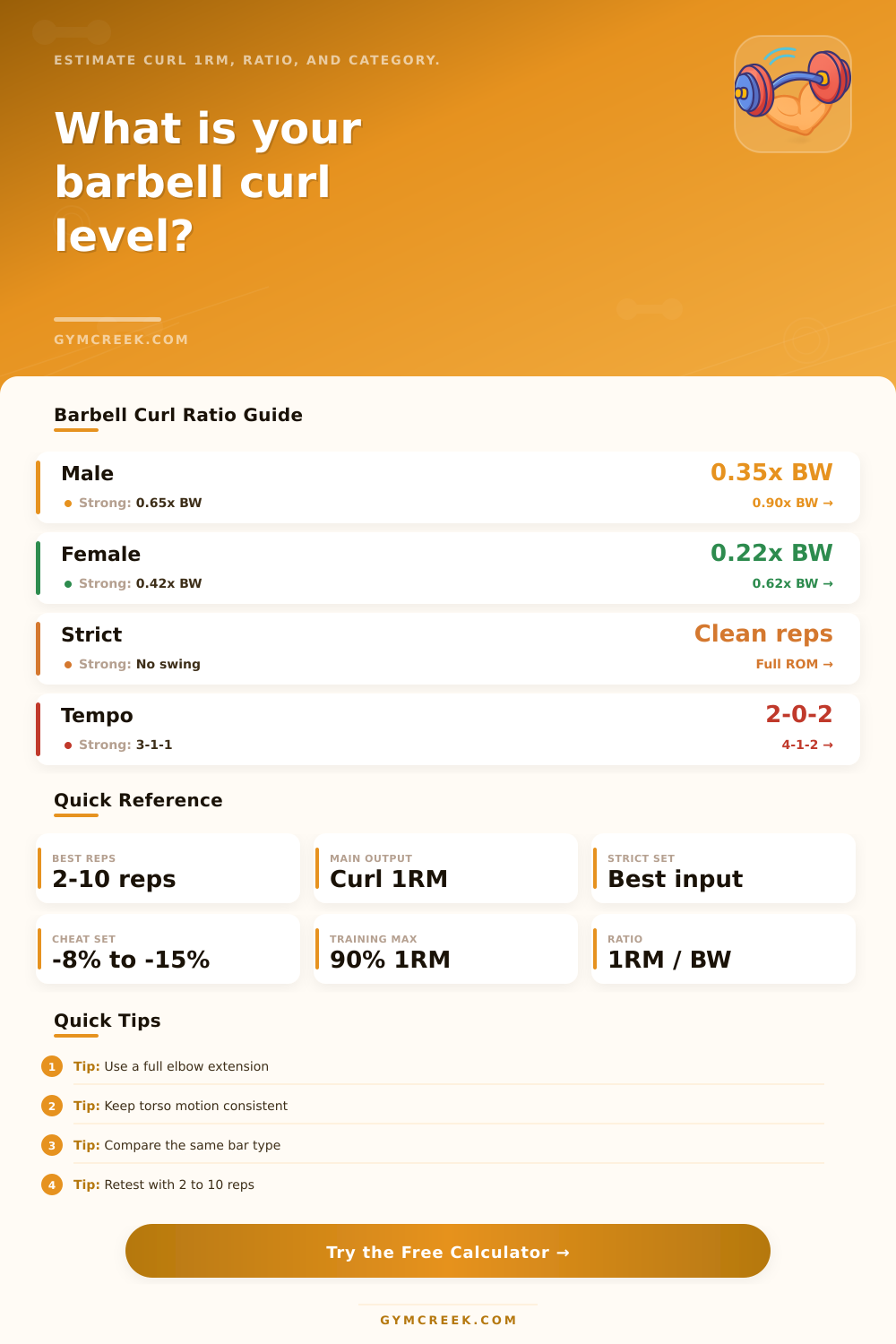
| Advanced | 0.65 to 0.90 x BW | 0.42 to 0.62 x BW | Strong strict curl for bodyweight |
| Elite | Above 0.90 x BW | Above 0.62 x BW | Rare strict curl strength |
| Input | Factor | What it does | Use |
|---|---|---|---|
| Wall strict | 1.02 | Credits very strict testing | Best for standards comparison |
| Strict standing | 1.00 | Baseline estimate | Normal strict curl |
| Small body English | 0.94 | Removes mild torso help | Gym top sets |
| Loose or cheat curl | 0.85 to 0.91 | Converts to strict equivalent | Training reference only |
| Slow tempo | 1.03 to 1.07 | Recognizes harder rep speed | Controlled hypertrophy sets |
| Bar type | Factor | Why it changes | Compare as |
|---|---|---|---|
| Straight barbell | 1.00 | Standard long-bar curl | Baseline |
| EZ-curl bar | 0.98 | Often wrist-friendly, slightly different line | Near baseline |
| Fixed curl bar | 0.99 | Usually shorter and easier to control | Gym estimate |
| Thick axle bar | 1.03 | Grip demand can cap load | Grip-adjusted |
| Preacher setup | 1.06 | Less hip help, different leverage | Strict proxy |
| Formula | Equation | Best reps | Role |
|---|---|---|---|
| Epley | Weight x (1 + reps / 30) | 2 to 10 | Main anchor |
| Brzycki | Weight x 36 / (37 - reps) | 2 to 8 | Conservative check |
| Lombardi | Weight x reps ^ 0.10 | 5 to 12 | Higher-rep balance |
| O'Conner | Weight x (1 + .025 x reps) | 3 to 10 | Moderate curve |
💡Tips
The barbell curl is an simple exercise to perform in the gym. The barbell curl, however, can provide information regarding how an individual train their body and how their biceps develops in response to the weights that they lift. While many peoples consider the barbell curl as an exercise to perform later in a workout routine, the barbell curl can actualy serve as a diagnostic tool for a lifter.
One set of barbell curls can provide information regarding whether or not an individual’s bicep are developing at the same rate as the remainder of their body, or whether an individual’s form with the barbell is changing or whether their lifting numbers is realistic relative to their body development. A calculator allow an individual to take the information from one set of barbell curls and transform that information into an estimated one-rep max for that individual, a bodyweight ratio, and a strength category. Each of these factor can provide additional information to an individual regarding their performance with the barbell curl.
Check Your Bicep Strength with Barbell Curls
Bodyweight can be one of the factors that is use to calculate the strength of an individual’s bicep relative to their bodyweight. An individual who can lift 120 pounds with their bicep who weighs 200 pounds is likely to have less relative strength than an individual whose bicep strength are the same but whose bodyweight is 140 pounds. Other factors that the calculator must account for include the type of bar that is use in the barbell curl, the style of barbell curl that is performed and the sex of the individual performing those barbell curls.
Each of which can impact the strength indicated by that individual. The age of the individual is another factor that can impact the strength of an individual’s bicep relative to other individuals whose ages is different than the age of the individual being calculated. The results that the calculator generate include a determination of each individual’s estimated one-rep max for the barbell curl, the strength of the individual’s biceps when compared to their bodyweight relative to other individuals of similar ages, and the training loads that the individual should use in performing barbell curl exercises that match the individual’s specific training goal.
Additionally, the calculator is useful not just in the calculation of the individual’s strength in relation to other individuals who perform the same exercise, but also in the adjustment of those calculations for different training context for the individual. For instance, an individual who return to training after a break in that training does not require the same percentage of training loads as an individual who is undergoing dedicated strength training. Conversely, percentages can be lowered if an individual is experiencing a deload or re-entry period for those muscle.
Finally, while the calculator can be useful in calculating the strength of an individual’s bicep with minimal variables, there are a variety of external variables that impact the performance of an individual in the barbell curl exercise… Variables that the calculator cannot account for. Variables to consider in this calculation may include the level of sleep that the individual get, the level of stress that the individual places upon themselves, the total number of training hours that the individual performs each week, the health of those individuals elbows or wrists, and the frequency with which that individual train those muscles.
In order to accurately reflect the strength of an individual’s biceps relative to their body, the individual should perform the barbell curls under similar conditions each time that they use the calculator. Each of these factors will ensure that the individual can produce reliable results from the calculator. Additionally, the individual should record their sets during a period when they feel strong and freshly in their performance of barbell curls, recording a set after a back workout, for instance, may impact the strength of their biceps that is reflected in the calculator results.
Finally, performing between two and ten controlled repetition of the barbell curl is recommended for individuals aiming to use the calculator to reflect on the performance of their bicep strength. The primary purpose of a barbell curl strength calculator, therefore, is not to provide an individual with a number that can reflect their strength, but rather to provide an individual with a reference point for their training. Should an individual discover that their bodyweight ratio increase over time, for instance, that indicates that their training is having the desired effect upon their body.
Should that ratio remain the same over time, though, the calculator provide that individual with a signal that their training program may need to be altered. Thus, by utilizing the calculator, an individual can remove the guesswork from their training program regarding the number of repetitions that they should perform or the amount of weight that they should lift during their barbell curl training.