Banana Carb Calculator
Estimate total carbs, fiber, net carbs, sugar, starch, resistant-starch shift, and serving fit from banana size, peeled weight, ripeness, prep form, and carb target.
📌Banana Carb Presets
Presets use peeled edible banana weight. Ripeness changes the sugar, starch, and resistant-starch split, while total carbohydrate is driven mostly by grams.
⚙Calculator Inputs
Banana carb snapshot
Enter banana grams, ripeness, prep form, and target to estimate your serving.
📊Banana Carb Metrics
📑Reference Tables
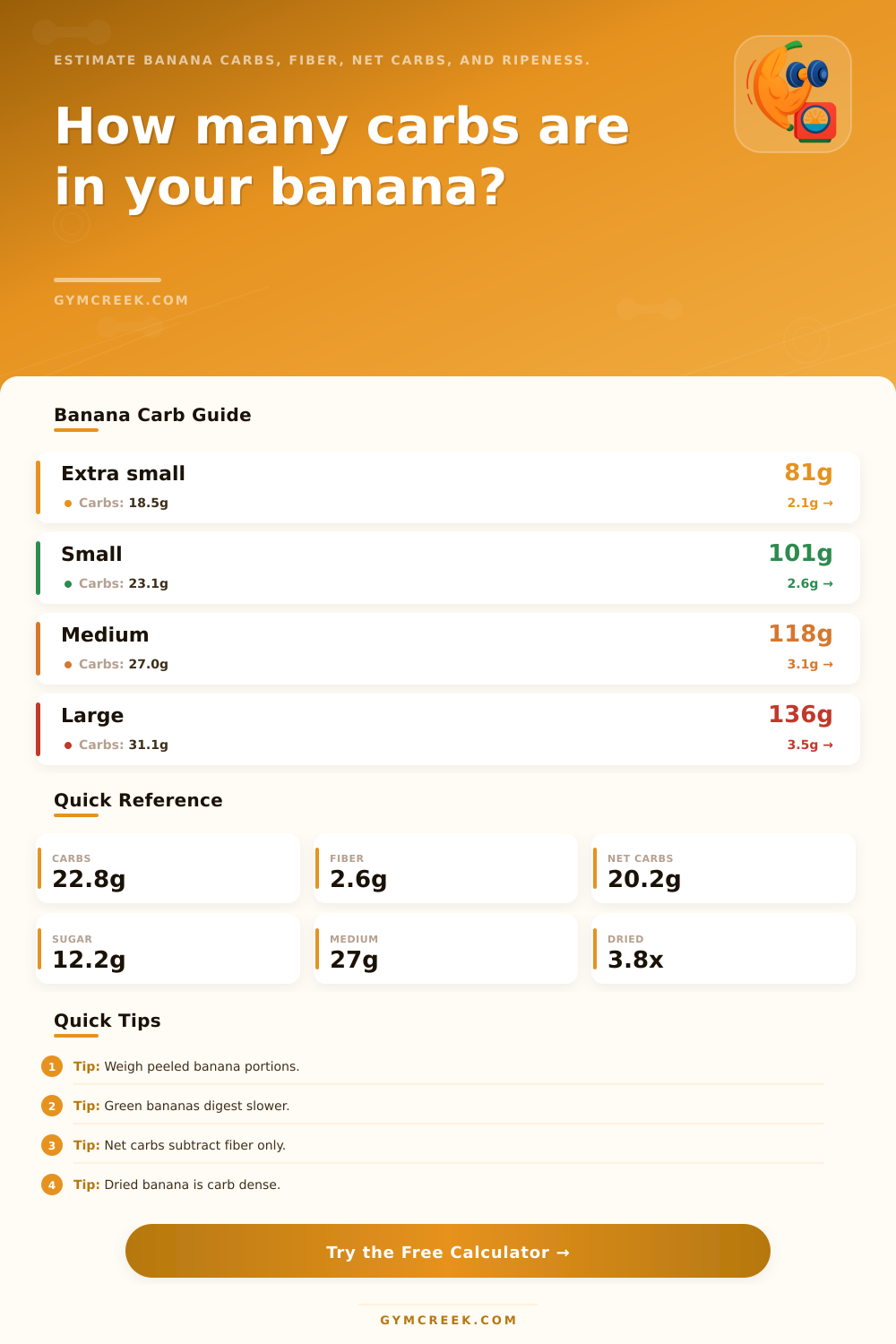
| Banana Size | Edible Weight | Total Carbs | Net Carbs |
|---|---|---|---|
| Extra small | 81 g | 18.5 g | 16.4 g |
| Small | 101 g | 23.1 g | 20.5 g |
| Medium | 118 g | 27.0 g | 23.9 g |
| Large | 136 g | 31.1 g | 27.6 g |
| Extra large | 152 g | 34.7 g | 30.8 g |
| Ripeness | Sugar Share | Resistant Starch | Calculator Use |
|---|---|---|---|
| Green or firm | Lower | Highest | Slower carb split |
| Yellow | Moderate | Moderate | Balanced estimate |
| Speckled ripe | Higher | Lower | Faster snack carbs |
| Very ripe | Highest | Lowest | Baking and quick fuel |
| Prep Form | Carb Factor | Best Entry | Accuracy Note |
|---|---|---|---|
| Raw fresh | 1.00 | Peeled grams | Best baseline |
| Frozen | 1.00 | Frozen grams | Same banana mass |
| Mashed | 1.00 | Mash grams | Weigh before mixing |
| Baked | 1.03 | Cooked portion | Small water loss |
| Dried chips | 3.80 | Chip grams | Carb dense |
| Context | Common Target | Banana Fit | Watch Point |
|---|---|---|---|
| General snack | 15-30 g carbs | Half to medium | Count add-ins |
| Pre-workout | 25-45 g carbs | Medium to large | Ripeness matters |
| Post-workout | 30-60 g carbs | Large or paired | Add protein separately |
| Recipe mash | By gram weight | Custom entry | Repeat the scale method |
💡Tips
It is a banana. That’s most folks’ attitude toward that fruit. It’s a single nutritional unit, something you pick up from the bunch, peel, and expect to provide roughly equal amount of energy regardless of how yellow its skin has turned, how many spots has appeared, or if it’s already all mushy. This misconception throws off your carb count.
Even though the banana doesn’t really get much bigger as it ripens, it change in what it’s made of. As starch converts to sugar, rate at which that carb hits your blood stream is greatly changed. Knowing this are far better than simply memorizing the label’s number. This helps you avoid guessing which stage of ripeness or weight will deliver energy slow to your system and which will deliver it quickly.
Why Bananas Change as They Ripen
This matters when timing is important, such as deciding if you need sugars immediately one hour before a long run. Or am I looking for slow-burning energy, such as when managing blood sugar spikes during the rest of the day?).
The calculator above do all the work once you input your stage of ripeness and peeled weight. For example, it will show you how ripeness shifts the internal ratio between net carbs and total carbs, which lets you visualize the tradeoff.
The other familiar hurdle is weighing the fruit (kitchen scales are cheap, yet most people eyeball their portions). Instead of weighing things, most of us eye-ball our servings based off size. For example, a large banana might weigh over one hundred thirty grams, while a small one weigh about eighty grams. This is a big difference that equals almost fifteen grams of carbohydrates.
This matters if you’re on a tight macro-count for either metabolic health or athletic performance goals. That’s like sneaking an additional piece of toast into your dish without knowing it. Size accounts for nearly all of the carbohydrate content, as you can see from the reference table on the page. Instead of trusting the default “medium” preset, plug in grams. This lets you enter actual amount you measured instead of guessing with an arbitrary setting.
This is just one more level of complication that few people consider: How did you prepare it? Concentrated fuel. That’s what dried banana chips are. When you remove the water from something, it make the carbs more concentrated. Because they’re so dense, a little piece can has almost four times as much carbohydrate by weight compared to fresh fruit. This adjustment is built into the calculator so if you eat a little bit here and there (in the dried form) you don’t accidently overdo it.
Likewise, freezing or baking doesn’t make that big a difference in the number of carbs, although it will influence how full you feel. However, the same amount of carbs can be a problem or a benefit depending on the context. Ripe bananas is helpful in a post-workout meal where we’re looking to rapidly refill our glycogen stores. In contrast, a less-ripe banana could provide a steadier source of energy and fiber as part of casual afternoon snack.
With this tool, you’ll define a carb target based on your own context, then determine how far the banana take you toward that target. It helps us avoid one of the most common mistakes: combining a big banana with other carb-heavy add-ins (such as honey or oats) without accounting for total carb content.
Consider the banana as something whose characteristics are not fixed, but instead are things that change. How it’s prepared, the temperature at which it’s eaten, and the time elapsed since it was picked all affect its nutritional make-up. When you know exactly how much you’re eating and account for the banana’s ripeness factor, you have a solid data point where previously you would of had an educated guess. Knowing what’s on the other side of the peeling gives you power: the ability to dial-in your own nutrition plan according to the effort you intend to use.