Banana Calorie Calculator
Estimate banana calories, carbs, fiber, potassium, recipe add-ins, and workout fuel from size, count, grams, ripeness, prep style, and activity context.
📌Banana Presets
Presets use peeled edible weight because banana peel size varies. Adjust grams after weighing for the tightest estimate.
⚙Calculator Inputs
Banana nutrition snapshot
Enter a banana size, count, grams, ripeness, and context to estimate your serving.
📊Banana Metrics Grid
📑Reference Tables
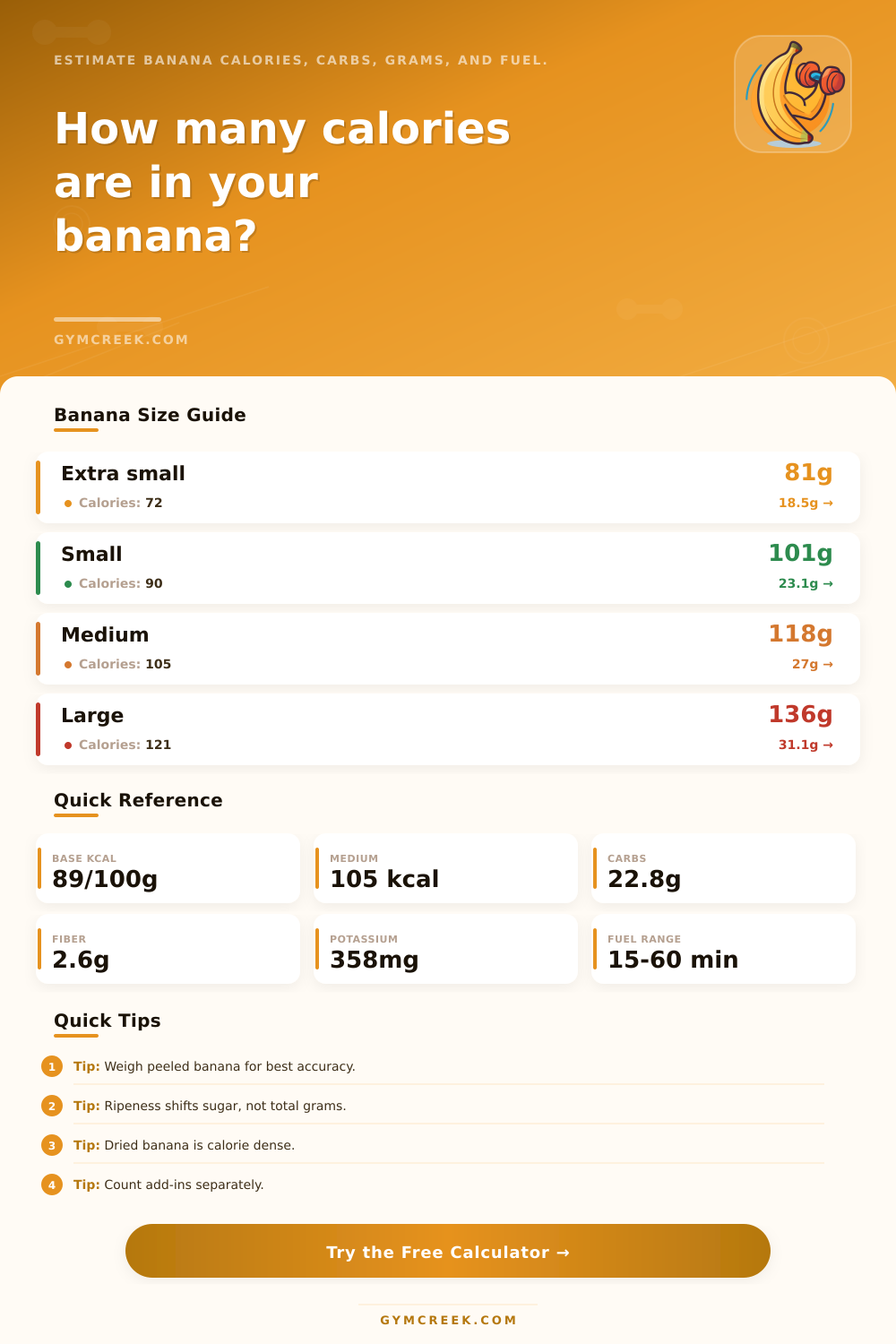
| Banana Size | Edible Weight | Calories | Carbs |
|---|---|---|---|
| Extra small | 81 g | 72 kcal | 18.5 g |
| Small | 101 g | 90 kcal | 23.1 g |
| Medium | 118 g | 105 kcal | 27.0 g |
| Large | 136 g | 121 kcal | 31.1 g |
| Extra large | 152 g | 135 kcal | 34.7 g |
| Ripeness | Best Use | Sugar Feel | Calculator Note |
|---|---|---|---|
| Green or firm | Longer snack | Lower | More resistant starch |
| Yellow | Everyday snack | Moderate | Balanced texture |
| Speckled ripe | Pre-workout | Higher | Sweeter taste |
| Very ripe | Baking | Highest | Fastest sweetness |
| Prep Form | Kcal Factor | When To Use | Accuracy Note |
|---|---|---|---|
| Raw fresh | 1.00 | Snack logs | Use edible grams |
| Frozen | 1.00 | Smoothies | Same banana mass |
| Mashed | 1.00 | Baking cups | Weigh before mixing |
| Baked | 1.02 | Warm topping | Water loss is small |
| Dried chips | 3.90 | Trail snack | Very calorie dense |
| Context | Practical Target | Banana Fit | What To Watch |
|---|---|---|---|
| Pre-lift | Quick carbs | Medium or large | Add protein later |
| Run fuel | 30-60 min | One medium | Test tolerance |
| Kid snack | Small portion | Half to small | Cut for age |
| Recipe | Repeatable grams | Weighed mash | Count all add-ins |
💡Tips
You might have been taught growing up that bananas are great fuel because of their potassium. It doesn’t give enough detail to guide your energy management, nor does it provide anything useful if you aim to reach certain macronutrient goals. A banana do not stay the same. What is in a banana depends on three things: Ripeness, Size, and Preparation Method.
When you start considering these factors, a hazy snack becomes a sharp tool in your dietary toolkit. Most of us make mistake of relying on visual estimates of banana size when figuring out their calorie content. A small banana can have nearly half the calories of an extra-large one, but they both look roughly equivalent in the supermarket unless you compare them side-by-side. But they both look roughly equivalent in the supermarket unless you compare them side-by-side. With our banana calculator, you no longer need to fumble through figuring out the coefficient and conversion factor, just input your desired size preset or exact weight and let the calculator do the work for you. This little change will significantly improve your ability to track accurately. When weighing your fruit, don’t forget to only weigh the edible part once peeled. The peel contributes dead weight and throws off your totals if you weigh it along with the rest.
How to Choose and Eat Bananas Correctly
Ripeness plays a subtler role. Most people think that bananas taste the way they do based on their color (green is hard and starchy), while yellow is soft and sweet. But it’s also due to whether or not the sugars has broken down into simpler forms.” When the banana is unripe, these complex starches haven’t turned into the sweet, simple sugars our bodies crave. That’s why an unripe (green) banana will feel firmer and starchy. A very ripe one have a lower glycemic impact because the simple sugars reach your blood stream quicker.
So if you’re having a banana pre-workout for some high-intensity lifting, a very ripe banana may be best. Whereas if it’s a slow-and-steady release throughout a long hike, a slightly less-ripe banana (a bit more of a green tint) has more starch that resists digestion, similar to fiber when digested by your body.
Another wrinkle comes into play here in terms of preparation method, even taking water out of the equation. Bananas make great dried banana chips, which are delicious and convenient for trail mix and snacking. That said, they’re super-calorie dense compared to fresh ones. By removing all that water, you end up with a lot higher energetic bang for your gram of food. A handful of dried chips can contain as many calories than two or three whole bananas. This is made clear in the table at the bottom of the page comparing raw vs. Dried fruit densities. You’ll notice it’s easy to eat too many calories when the food has a lot of energy but looks like a small amount.
The addition of any other ingredient transforms the snack completely. A plain banana will provide you with nothing but simple carbohydrates. For example, adding oats, Greek yogurt, or peanut butter creates a complete meal. This version contains both fat and protein. These additions change the way your body uses the energy provided by the banana and also slow down the rate at which it’s digested. You can include these common add-ins into the calculator so they aren’t missed when totalling up your day. I found that people regularly forget the half cup of milk and don’t include the tablespoon of honey they added to their banana; thus they consistently underestimate what they’re eating.
All things considered, though, the banana has proven itself to be one of the most versatile pantry items there is, though it’s important to pay attention to those details. Not every gram matter; don’t get obsessive about it all. But understanding the impact of preparation and size on the final product will help you make better decisions when using bananas whether you’re making a loaf of bread for the family table or fueling up before an early-morning run.
Because then it becomes more than just a standard snack. It becomes a planned part of your healthy plan.