Ballroom Dancing Calorie Calculator
Estimate ballroom dance calories from style, tempo, song count, average song length, social or practice mode, competition rounds, frame effort, posture load, rest ratio, body weight, and adjusted MET values.
📌Presets
Each preset loads a realistic ballroom session and recalculates from song volume, tempo, mode, rest, partner hold, footwork demand, and frame effort.
⚙Calculator
Ballroom calorie snapshot
Choose a dance style, mode, tempo, and song count to estimate session calories.
📊Fitness Metrics
🧮Formula Cards
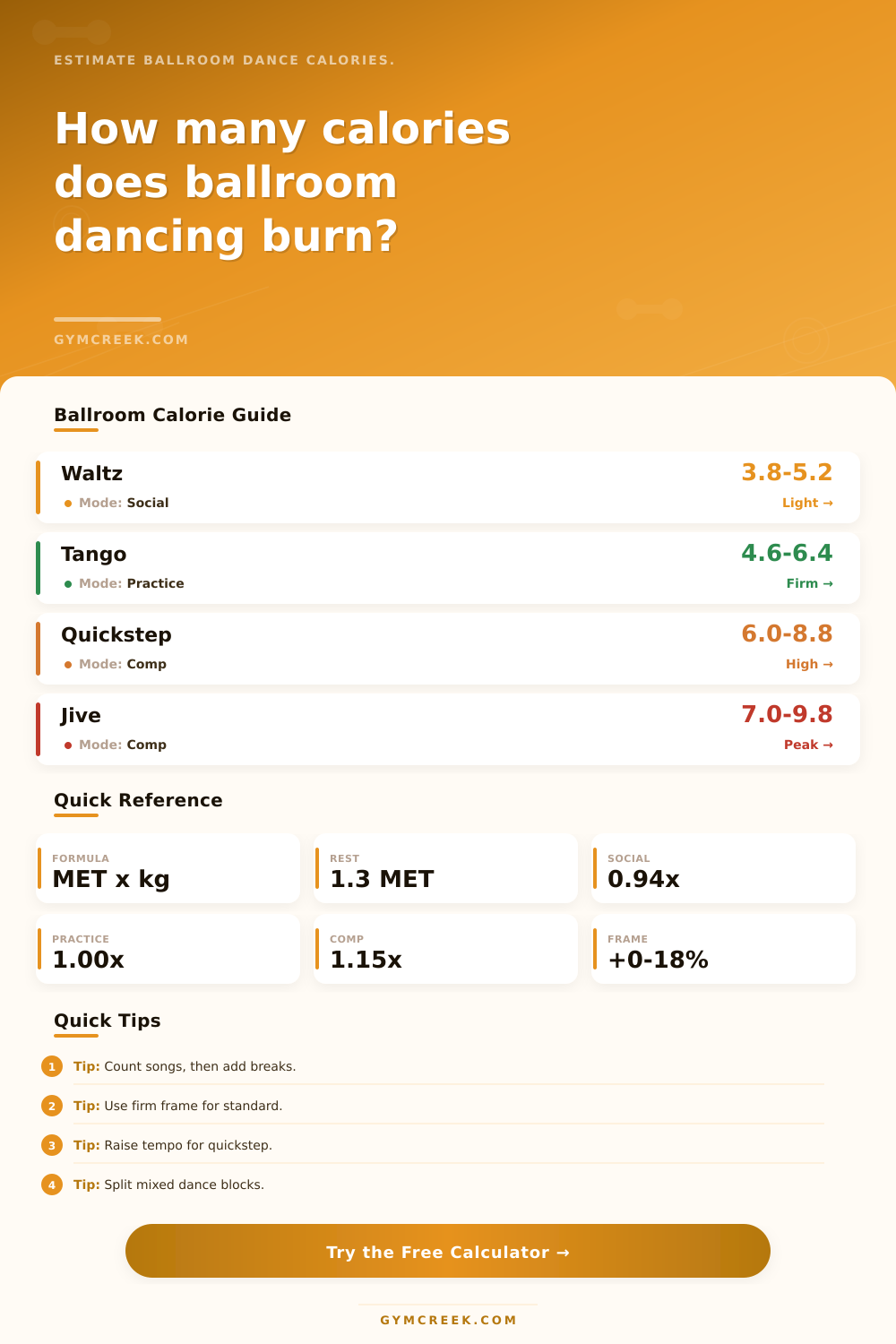
Calories per minute = MET x 3.5 x body weight in kg / 200. The calculator applies it to song dancing, drill time, and rest separately.
Base style MET is adjusted by tempo, mode, frame effort, partner connection, and footwork demand to reflect actual ballroom workload.
Music time equals song count multiplied by average song length. Extra drill minutes are added as active time before rest ratio is applied.
Mifflin-St Jeor estimates BMR from age, size, and gender, then usual activity level estimates TDEE for a daily energy comparison.
📑Reference Tables
| Dance Style | Base MET | Typical Tempo | Load Driver |
|---|---|---|---|
| Waltz | 3.8 | Moderate | Rise and fall |
| Tango | 4.9 | Firm | Posture tone |
| Foxtrot | 4.2 | Smooth | Continuous glide |
| Quickstep | 6.6 | Fast | Travel speed |
| Viennese waltz | 6.0 | Fast | Turns |
| Jive | 7.2 | Fast | Bounce action |
| Mode | Modifier | Rest Pattern | Best Use |
|---|---|---|---|
| Social | 0.94x | Frequent | Dance party |
| Lesson | 0.90x | Instruction | Learning |
| Practice | 1.00x | Planned | Rehearsal |
| Showcase | 1.08x | Run-throughs | Routine |
| Competition | 1.15x | Round sets | Peak pace |
| Tempo | Modifier | Example | Effect |
|---|---|---|---|
| Slow learning | 0.86x | Counts | Lower burn |
| Moderate | 1.00x | Practice | Baseline |
| Brisk social | 1.08x | Party | Higher pace |
| Fast practice | 1.18x | Rounds | Hard effort |
| Competition | 1.28x | Finals | Peak effort |
| Formula | Variables | Output | When Used |
|---|---|---|---|
| MET kcal | MET, kg, min | Calories | Main burn |
| Song time | Count, length | Minutes | Dance tracks |
| Rest ratio | Active, rest % | Total min | Breaks |
| Frame load | Frame, hold | Adj MET | Posture |
| TDEE share | kcal, TDEE | Percent | Daily view |
💡Tips
Ballroom dance can be glamorous. There is nothing more elegant than dancing but it is also physically demanding. So when you walk into a ballroom dance studio, thinking you’re in for some romantic waltzing or a fun social cha cha cha, you’ll come out feeling as though you’ve just run a sprint. Knowing what calorie burn occurs will help you value the work-out your body receives and aid meal planning and recovery (whether you’re training for a competition or maintaining your fitness).
We all know that it’s about time spent dancing, right? Calories burned depends solely on time danced, or do they? Well, yes and no. While time spent dancing is important, so is the intensity with which you’re holding your frame. Holding a standard ballroom frame involve keeping constant muscle engagement to keep good connection and posture with your partner. If you have more relaxed hold, your body will burn fewer calories than if you’re holding a competitive, firm stance with high-held arms and a braced core.
Factors That Affect Calorie Burn
After plugging in your effort level and style, the calculator takes care of the rest, saving you from having to guess at how much this additional tension drains your energy.
The last point is all about tempo. A gliding foxtrot at a slow pace can be a restful experience where your muscles has a chance to recover between movements. When dancing a fast quickstep or even a jive, it is full on. Your heart pumps and your feet moves as quickly as possible, leaving little space for recovery. Remember if you count tracks then fast dancing will burn more calories in two minutes than slow instructive drilling does in five. And the disparity can be stark.
An hour of dancing may seem like an eternity. But if you sit out half of it or listen to instruction for half of it, number of calories burned is far less than what total time suggests.
One other important variable is your body weight. Because we’re moving more mass against gravity, heavier people burns more calories doing the same thing. That’s why being able to input an accurate weight matters when you want a realistic estimate of what happened. There’s no judgement involved; there’s only physics. And this formula accounts for that fact so the results won’t be some kind of generic average, they’ll be based on where you are. Which means if you’re lighter, you’ll have burned fewer calories…normal! Don’t worry. It doesn’t mean the workout wasn’t as good. It simply means the numbers don’t look the same.
Next, think about what kind of session it is. For example, is it a practice round or competition round? Or is it more like social dancing where there’s lots of conversation in between songs, pausing during dances, etc? Competition rounds can be an entirely different beast than practice ones; you’re probably doing really intense steps over and over again at maximum speed with very little rest in-between. Because of this, the tool takes into account the type of session you’re having and adjusts your metabolic equivalent based off some modifiers. So, you may find that a social dance has a moderate burn whereas the rehearsal for that competition pushes things way up. Knowing this will help keep your expectations of how hard you’re working in check.
The interaction between partners as well as the footwork demands is changing these outcomes. Larger patterns tend to use more energy as you cover more ground on the floor than staying contained in a small square. When a good partner is leading/following then there’s an additional component of continual response and adjustment. All of this is cumulative over time. While you may be unaware of using the additional energy at the time, you’ll see that reflected in your final tally.
Table on the page shows how each style and level of intensity relates to amount of energy spent.
So at the end of the day, ballroom dancing is a total body exercise that works your back, core and legs. It will help build your balance and coordination, and it will get your heart rate up. Putting a number to how many calories you are burning puts an added layer of awareness into your practice. You can feed your body properly and recognize the amount of physical demand it’s making on your muscles.
No matter if you’re competing, working out, or simply enjoying yourself while dancing, having these numbers helps you make the most of each movement as you go through your steps. Next time the music comes on, you’ll know just how much work you’re putting in.