Ballet Calorie Calculator
Estimate calories burned in ballet class, rehearsal, barre, center combinations, allegro jumps, pointe work, rest periods, and technique levels using adjusted MET logic.
📌Presets
Each preset loads a realistic ballet workload and recalculates calories from barre, center, jump, pointe, rest, and rehearsal density settings.
⚙Calculator
Ballet calorie snapshot
Enter class structure, pointe work, and rest ratio to estimate ballet calories.
📊Fitness Metrics
🧮Formula Cards
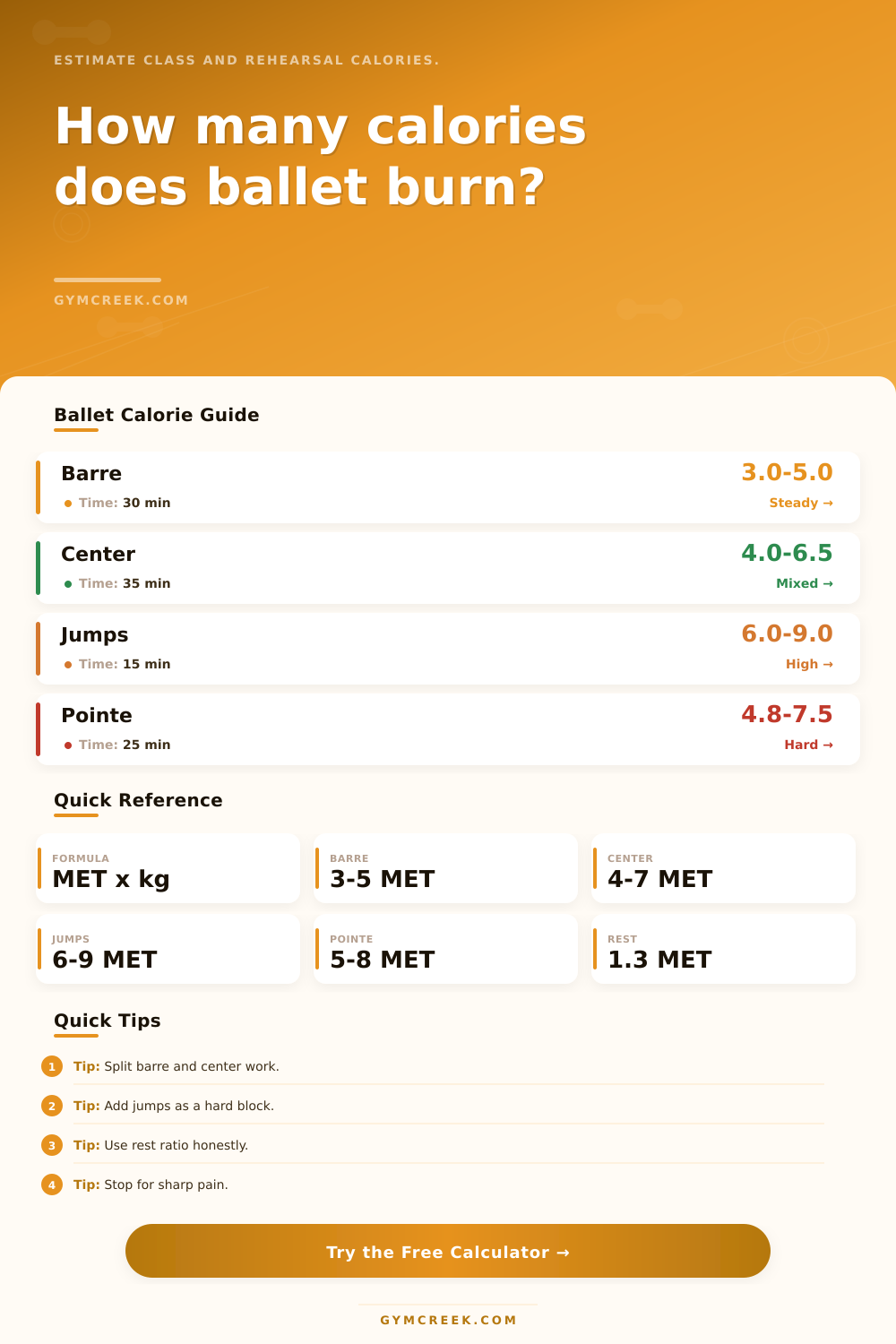
Calories per minute = MET x 3.5 x body weight in kg / 200. The calculator applies this to barre, center, jumps, pointe, and rest blocks.
The work portion is divided by your split percentages. If they do not equal 100, the calculator normalizes them before estimating each block.
Pointe minutes add a technique demand modifier, while combinations and repetitions increase the density factor for repeated starts and corrections.
Mifflin-St Jeor estimates BMR from age, size, and gender, then activity level estimates TDEE for comparing the ballet session with the day.
📑Reference Tables
| Ballet Block | Lower MET | Typical MET | Hard MET |
|---|---|---|---|
| Barre technique | 3.0 | 4.0 | 5.2 |
| Center practice | 4.0 | 5.2 | 6.8 |
| Turns and travel | 4.8 | 6.0 | 7.4 |
| Petit allegro | 5.8 | 7.2 | 8.6 |
| Grand allegro | 6.5 | 8.0 | 9.5 |
| Level | Modifier | Best Use | Load Note |
|---|---|---|---|
| Beginner | 0.90x | Basics | More pauses |
| Adult open | 1.00x | Class | Mixed work |
| Intermediate | 1.06x | Student | More travel |
| Advanced | 1.14x | Pre-pro | Fast phrases |
| Professional | 1.20x | Company | High volume |
| Pointe Setting | Minutes | Modifier | Use Case |
|---|---|---|---|
| No pointe | 0 | 1.00x | Flat shoes |
| Short segment | 10 to 25 | 1.04x | Class end |
| Half class | 30 to 60 | 1.08x | Mixed work |
| Full rehearsal | 60 to 150 | 1.12x | Variations |
| Formula | Variables | Output | When Used |
|---|---|---|---|
| MET kcal | MET, kg, min | Calories | Main burn |
| Split norm | Block % | Minutes | Class parts |
| Density | Combos, reps | Factor | Rehearsal |
| TDEE share | kcal, TDEE | Percent | Daily view |
💡Tips
From an external perspective, ballet appears effortless. However, a ninety minute class are no small task. The exercises requires energy and you’ll be sweating within minutes.
Learning about calorie expenditure will help you train more effectivey. What used to feel like a vague state of fatigue becomes measured into something real that you can control.
How Ballet Burns Calories
These estimates is based off what’s called the metabolic equivalent or MET which measures how intense an activity are relative to being seated. All you have to do is plug in information about yourself and the class (weight included). Coefficients is done for you by the calculator.
Each minute of each class isn’t created equally. Even though it may take just as long to go through that slower section than that faster section, fewer calories will be burned during the slower section. This matter for accuracy. You can customize based on the breakdown off the following: barre, center, and jumps
Barre involves rhythmic and steady movement. It usually have a low MET, as the emphasis is more on precision.
The center involve travel and balance. The caloric burn go up here.
Allegro involve quick jumps. These moves requires explosive power. Since they get your heart pumping quicker than slow arm movements, they burns lots of calories. The higher number of jump in your class, the greater the calorie burn. Fewer jumps mean less calorie burn. Many double tours or assemblés significantly increase energy cost.
It is also harder because small muscle in your feet and ankles work extra hard to stay steady while performing pointe work. While it doesn’t necessarily mean using more oxygen (thus burning more calories), the muscular demand are very high. We have a modifier for pointe work on the tool. It considers the added fatigue and focus demanded by shoes. They’re not about burning loads of calories; they’re about stability.
Rest Ratio. It is a key factor. During rehearsals you tend to stand around. Listen to the corrections. Wait for your turn. Catch your breath. You should of mark combinations. When using class time as total work, you’ll underestimate your burn. Adjust for this inactivity. This provide an accurate picture of how much waiting vs how much real work was done. It avoids the heartbreak of unrealistic expectations.
Then there’s your own bodyweight. You know how heavy you are. Your bodyweight change that bottom line. This is basic physics: the more you weigh, the more calories it cost to move around. Diet Culture isn’t involved here; this is straight up science. If two dancer do the exact same choreography and one of them weighs one-hundred pounds and the other weighs one-hundred and-fifty pounds, the lighter dancer will burn fewer calories. It simply requires less effort to move an object that has less mass through space against gravity.
In the reference table, the higher the intensity the greater METs change becomes. Because pro-dancers move faster and with more complex movements while resting less, they have a higher modifier value different than the beginner. The numbers are merely guidelines. These guidelines help you gauge how running through a ballet at full speed differs from a barre class. It’s not about how long you do something but about how hard and consistently you can do it. An hour of intense focus burns more then two hours sitting around waiting in class.
Treat the calculator as a starting point. Your body will tell you what it needs in terms of fuel. There are no absolutes here.
Remember, ballet is both a discipline and an art. It obeys the laws of energy exchange. Adjust accordingly. Move and move again. Allow the information to guide your training. Strength is the goal; calorie burn are secondary.