Balanced Diet Calculator
Estimate calorie needs, balanced macro ranges, protein targets, fiber, hydration, and a practical balance score from body stats, activity, goal, and training load.
📌Balanced Diet Presets
Presets load different body sizes, goals, activity multipliers, body-fat estimates, meals per day, and macro priorities so the outputs move realistically.
⚙Calculator Inputs
Balanced diet snapshot
Enter your stats to estimate calories, macro ranges, protein, fiber, hydration, and balance checks.
📊Fitness Nutrition Metrics
📑Reference Tables
| Macro | Reference range | Calculator use | Planning note |
|---|---|---|---|
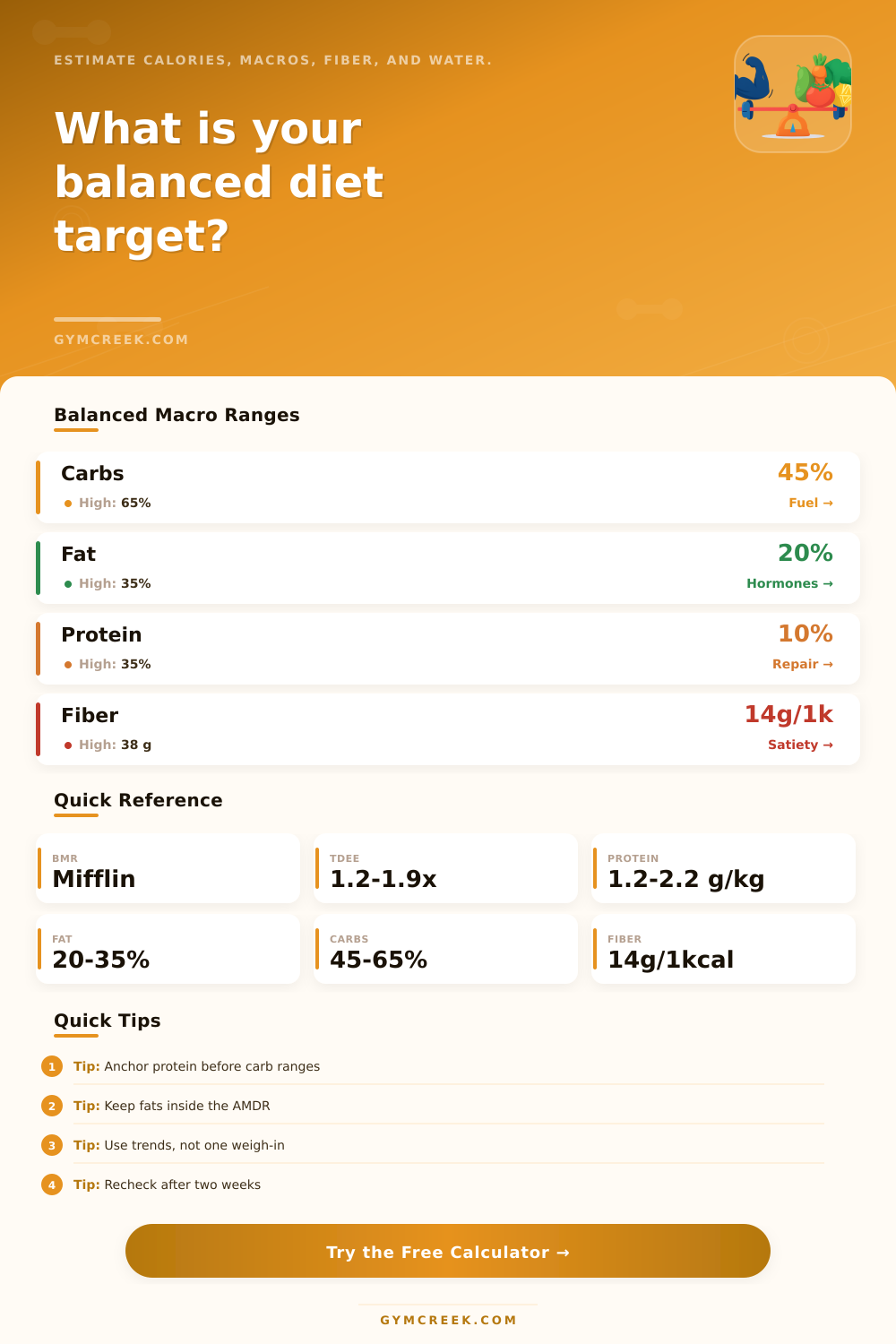
| Carbohydrate | 45 to 65 percent of calories | Low, middle, or high AMDR bias | Higher ranges fit frequent endurance or sport work |
| Fat | 20 to 35 percent of calories | Selected fat preference sets the middle target | Very low fat can crowd out essential intake |
| Protein | 10 to 35 percent of calories | Calculated from g/kg and checked against AMDR | Training and deficit goals raise the target |
| Fiber | 14 g per 1000 kcal | Rounded daily target with minimum options | Increase gradually if intake is currently low |
| Setting | Multiplier or change | Best fit | Result effect |
|---|---|---|---|
| Sedentary | 1.20 x BMR | Desk work, little planned exercise | Lowest TDEE estimate |
| Moderately active | 1.55 x BMR | Training 3 to 5 days weekly | Common active default |
| Steady fat loss | 18 percent deficit | Weight-loss phase with recovery guardrails | Lowers calories after TDEE |
| Lean gain | 8 percent surplus | Muscle gain with modest calorie push | Raises calories after TDEE |
| Profile | Protein factor | When it fits | Calculator note |
|---|---|---|---|
| Lower active minimum | 1.2 g/kg | Light activity or maintenance | Still checked against calorie share |
| Balanced baseline | 1.6 g/kg | General fitness and health goals | Default starting point |
| Higher protein | 1.8 g/kg | Fat loss, recomposition, frequent lifting | Supports satiety and recovery |
| Athlete protein | 2.2 g/kg | Hard training or lean gain phases | Used only within macro guardrails |
| Formula | Variables | Output | Why it is included |
|---|---|---|---|
| Mifflin-St Jeor | Weight, height, age, sex | BMR | Widely used resting calorie estimate |
| Katch-McArdle | Lean body mass | BMR context | Useful when body fat is known |
| TDEE | BMR x activity multiplier | Maintenance calories | Connects body stats to activity level |
| AMDR | Percent of calories | Macro ranges | Keeps protein, carbs, and fat balanced |
💡Tips
Use the protein target as the first anchor, then allow carbs and fats to move within the AMDR range around training, hunger, and preference.
Compare the calorie target with a two-week bodyweight trend before making large changes, especially during hard training blocks.
A balanced diet require specific nutritional targets. These nutritional targets are required to enable a person to balance the amount of protein, carbohydrates, and fats that they consumes in order to accomplish specific goal. While you may know alot about the importance of protein, such as protein aiding in muscle growth and providing a feeling of fullness after meal, you might not know how to apply that to your diet to create specific targets for protein intake.
A person must determine specific targets for protein, carbohydrates, and fats intake according to there body size and there activity level. If the targets for protein, carbohydrates, and fats intake are not balanced to the body size and activity level of the individual, they may not be sustainable for that person. The calculator will determine the amount of carbohydrates, fats, protein, and calories that a person should consume daily after inputting their body stats, activity level, and goal.
How to Find Your Daily Protein, Carbs and Fat Targets
A person’s age and sex will influence the calculation of their daily macros because these two variable will impact their resting metabolism. Body weight and body fat percentage will impact the calculation of the amount of energy that a person’s lean body mass burns daily. The height of a person will also have an impact on their macronutrient calculations because individuals with a taller frame will require more energy than those with a smaller body frame.
Each of these variable will create a baseline calculation for the number of macronutrients that a person should consume daily. A person’s activity level will also impact the calculation of their macronutrients, though many individuals may not accurately judge this input for themselves. A person’s activity level will impact the amount of calories that they burn daily due to there movements outside of exercise.
An individual’s activity level will also impact the number of calories that they burn due to the demands of there job. These variables will allow the calculator to estimate the number of calories that an individual burns daily. Based off the goal that an individual desires for themselves, the calculator will adjust the number of calories that is calculated from there activity level.
These adjustments to the calculated number of calories will be modest and not drastic because drastic adjustments to the number of calories that a person consumes can backfire over time. The target for protein intake will require special consideration from the individual using the calculator. The protein style that is chosen will range from low active minimum to the protein intake of an athlete.
Higher protein targets will assist individuals in recovering from exercise or sports activities and will aid in the control of appetite for individuals who are attempting to lose fat. However, higher protein targets will reduce the amount of calories that can be allotted to fats and carbohydrates. The target amount of protein will always remain within the accepted guidelines so as to ensure that the protein amount is not so high that the amounts of carbohydrates and fats becomes unrealistic.
The preferences for carbohydrates and fats can be set in the same way as the protein preferences. The amount of carbohydrates can be set to be low, medium, or high, as can the amount of fats that an individual consumes daily. These preferences will depend on the type of training that an individual performs.
For example, an individual who performs a lot of endurance sports may benefit from increasing the amount of carbohydrates that the individual consumes. An individual who would benefit from more steady energy may benefit from increasing the amount of fats that they consumes daily. The amount of carbohydrates will be kept within a percentage range between 45% and 65% of the total calories that are consumed daily.
The amount of fats will be kept within a percentage range between 20% and 35% of the total calories that are consumed daily. While fiber and hydration are not considered macronutrients, these two factor will still have an impact upon the body. The target amount of fiber will increase with an increase in the number of calories that are consumed daily.
Additionally, the fiber target will adjust to account for the minimum fiber requirements for men and women. Increasing the fiber content of the diet will gradually increase the amount of fiber that is consumed daily. This approach to increasing the fiber content of the diet will be better for the body than increasing the fiber to a high target right away.
The amount of water that should be consumed daily will be calculated based on the body weight of the individual, as well as the demands of there training or the conditions in which they are active. While the reference tables will not impact the calculations of the macronutrients that are displayed on the calculator, these tables will help to explain from where the number ranges for each variable originate. These tables will display the factors for protein intake based on the type of training that an individual performs.
Understanding the reasons behind the calculations of the number of macronutrients that should be consumed daily will allow a person to understand that the numbers that are displayed are not magic numbers. The calculator that is used calculates the resting metabolism of an individual using the Mifflin-St Jeor equation, then applies activity multiplier to that number. These equations are standard and widely used but are not perfect for each individual.
The balance score will provide an individual with a way to ensure that the variables that they have selected for themselves are within an acceptable range. Common mistakes may occur when a person focuses on one output of the calculator while neglecting the others. A person who focuses on the calorie amount might find that the protein target is too low.
A person who selects a high protein target might find that the amount of carbohydrates is too low. The calculator has attempted to balance these issues into its creation so that when a person focuses on one variable, the others will be adjusted accordingly. A person should of live with the numbers for a few weeks to determine how there body react to these targets.
In real life, there are additional variables beyond the calculator that can impact the body. Factors like stress, sleep, menstrual cycles, and medications will have an impact upon an individual’s metabolism. The types of food that are consumed within the macro targets will have an impact upon the micronutrients and the satisfaction of an individual with the diet.
A diet that achieves all of the macro targets but leaves a person feeling hungry is not an indication of a balanced diet. Thus, the calculator allows for an individual to establish a framework for there diet, but also to adjust that framework according to how they feel with the diet. One of the most useful habits regarding the calculator will be to run the calculator to establish the macronutrients that should be consumed daily, living with the numbers for a few weeks, and then re-adjusting the variables if the body does not react well to the diet that is established.
Small changes to the activity level can impact the calculations of the macronutrients that is required of an individual daily. Small changes to protein style can alter the calculations of the daily macronutrients that is required of an individual. Over time, an individual will become accustomed to adjusting the variables to ensure that there body feels good with the diet that they consume.
When an individual learns which variables to adjust to create the best outcome for themselves and there body, the calculator can then be used as a tool.