Balance Test Score Calculator
Score single-leg, tandem, stork, foam, and BESS-style balance tests using hold time, errors, sway, age norms, and testing difficulty.
📌Presets
Presets load realistic balance test profiles and recalculate immediately. Use your best safe attempt from the same test setup.
⚙Calculator
Balance score snapshot
Enter a hold time and calculate a normalized balance score.
📊Fitness Metrics Comparison
📑Reference Tables
| Score | Band | Typical Finding | Retest Focus |
|---|---|---|---|
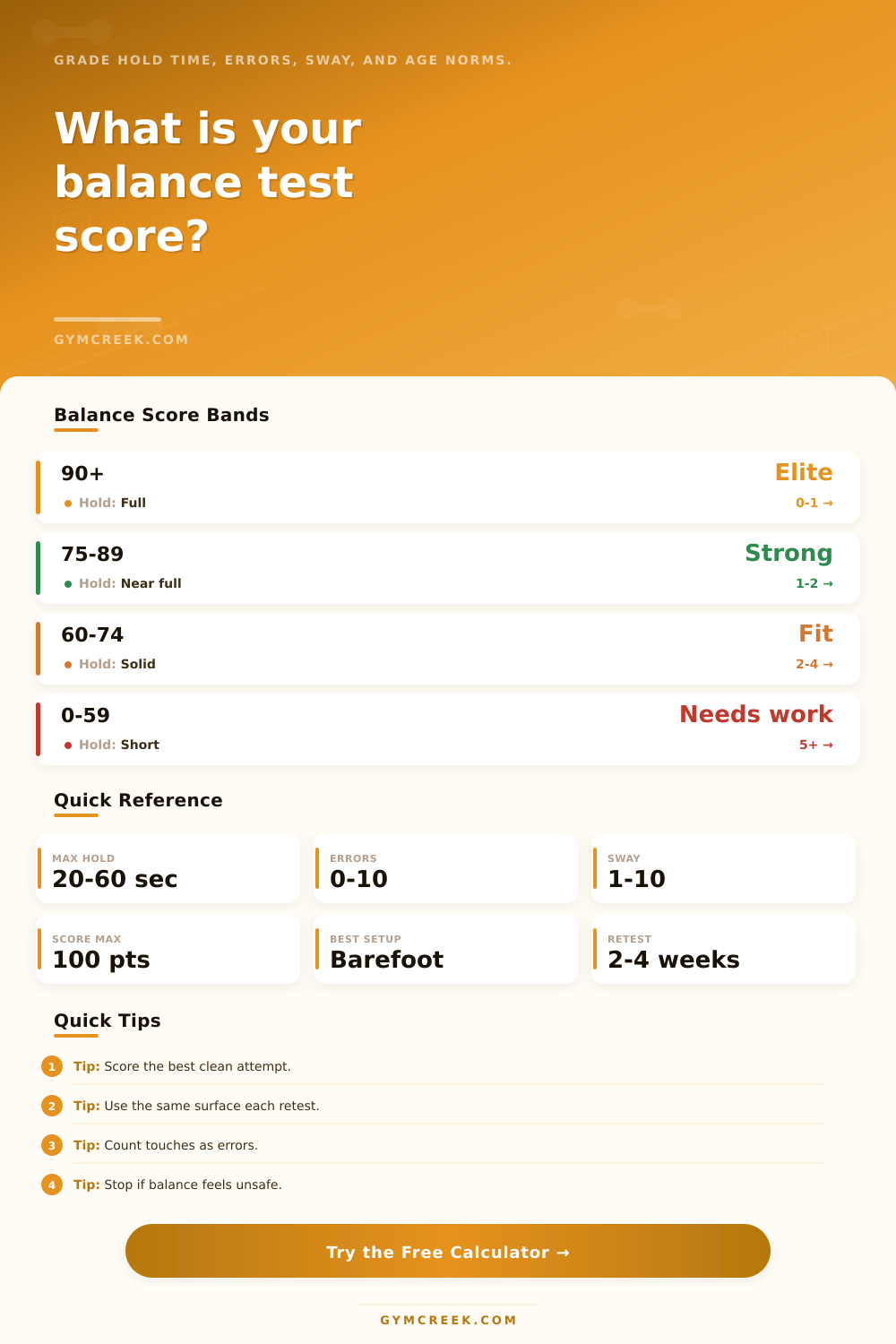
| 90-100 | Elite | Full hold, tiny sway | Harder condition |
| 75-89 | Strong | Near full hold | Reduce errors |
| 60-74 | Fit | Useful control | Sway control |
| 40-59 | Limited | Short or error-heavy | Base stability |
| 0-39 | Flagged | Unsafe or brief hold | Supervised retest |
| Test | Max Time | Challenge | Common Use |
|---|---|---|---|
| Tandem stance | 45 sec | Low | Screening |
| Single-leg stance | 45 sec | Moderate | Fitness checks |
| Stork stand | 60 sec | Moderate | Sport testing |
| BESS single-leg | 20 sec | High | Error scoring |
| Foam single-leg | 30 sec | High | Proprioception |
| Age Range | Strong Static Hold | Watch Point | Context |
|---|---|---|---|
| Under 30 | 40-60 sec | Sport demands | High ceiling |
| 30-49 | 30-50 sec | Side differences | General fitness |
| 50-64 | 20-40 sec | Vision changes | Control check |
| 65-74 | 10-30 sec | Touch errors | Safety screen |
| 75 plus | 5-20 sec | Supervision | Risk context |
| Formula | Variables | Output | Why It Matters |
|---|---|---|---|
| Hold ratio | Time, max | Base score | Compares tests |
| Error penalty | Touches, sway | Quality loss | Captures control |
| Difficulty factor | Surface, vision | Adjusted hold | Rewards harder tests |
| Age norm | Age, sex | Percentile | Fairer context |
💡Tips
It’s important for you to know that balance isn’t something you’re born with. You are either balanced or you aren’t. Many think this is true. That assumption leads them to think that if an exercise doesn’t go well it’s because they don’t has good balance. They then stop seeing results because their fitness test fail to account for the improvement they’re making.
In reality there are 3 components to balance (vestibular function, vision, proprioception). If any of those channels become fuzzy, the rest of the system gets wonky. By inputting your error count and hold time into the calculator above, it’ll crunch the numbers for you and adjust the score, allowing you to use both a 20 second test on foam and a 45 second test on solid ground. No more wondering if your short stance time means you suck at balancing or it was just challenging.
How to Test Your Balance Correctly
Inputs count, contrary to popular belief. No, I don’t mean hold time. Yes, that’s one metric, but it’s not the complete picture. Sure, you can move around a lot and still stay in one spot for a minute. That doesn’t make you stable. It makes you alive. And how good was the quality of that hold? That’s what the error count measures. Each tap-down of your foot or hand on wall represents a sign by your nervous system that it has been unable to maintain control.
Then there’s sway rating. If you’re swaying big-time, then you’re firing your muscles hard to regain position. That uses up energy quickly and causes fatigue at a greater rate different than being motionless and steady. These metrics is weighed by the tool against the vision conditions and difficulty level of the surface to provide you with a normalized number. Why? Because standing on your own two feet on hardwood with your eyes open is completely different than standing on foam with your eyes closed.
This adjustment is critical. All of this has a lot to do with age. For a 70-year-old, being able to hold a single leg stance for 30 seconds is elite. For a 20-year-old sprinter, perhaps that means there’s room to improve? The normative data allows the calculator to add context based off age. It moves the line so you aren’t measuring yourself against yesterday’s standard. This way you don’t get discouraged unecessarily and can identify true deficit.
For those using the test as part of post rehab clearances or return to sport, it’s much more valuable to compare sides rather than chase an absolute number. Oftentimes the weaker side will give away asymmetry that may be hidden within a total score. You don’t care about having a big number on paper. You care about symmetry.
Most folks shoot themselves in the foot here with testing consistency. One week they test barefoot then the following week in thick sneakers. They change their setup ever so slightly but it result in dramatic swings in the data. Ground feedback (proprioception) also requires you to be barefoot. So shoes dull this signal. Then there’s the issue of vision. Removing visual cues puts more demand on your joints and your sense of balance. Harder test. The tool takes into account all these conditions with difficulty factors. But you must maintain a consistent test environment. Use the same time of day, surface, and footwear. Do this for every test, if not then it becomes apples to oranges.
This is laid out nicely in the reference tables on the page. They present the band shift based off quality of performance. Full holds with very little sway and almost no errors are elite scores. Near full holds with small corrections are strong scores. Solid control with opportunities to refine are fit scores. Anything less should of been considered base stability work prior to testing any more difficult variations.
It’s tempting to push your body further into advanced tests. Resist the temptation to build a house without a foundation. Not only will it prevent injury but it will create long-term resilience. Before you chase longer hold times, reduce the amount of error. A clean twenty second stance is better than a messy forty five second one. It doesn’t need to get complicated. In fact, simpler is always better. Planned, simple static balance training will do more good than flashy looking dynamic balance drills executed poorly.
Start by standing on solid ground with your eyes open. Close your eyes, use the foam. Listen to your body. Stop if it isn’t feeling safe. Older folks, people who are still healing from an injury would be well served by having someone supervise their attempts at balance training. No one is trying to see how long you can hold a balance position. It’s about building a stable foundation to support all your other movements throughout your day. And that begins when we understand what we’re measuring.