Bag Work Calorie Calculator
Estimate calories burned during heavy bag, double-end bag, aqua bag, and boxing interval sessions using MET formulas, round timing, rest, body weight, and punch output.
📌Presets
Each preset loads a realistic bag work profile and recalculates the calorie estimate.
⚙Calculator
Bag work calorie snapshot
Enter round structure and intensity to estimate total bag work calories.
📊Fitness Metrics
🧮Formula Cards
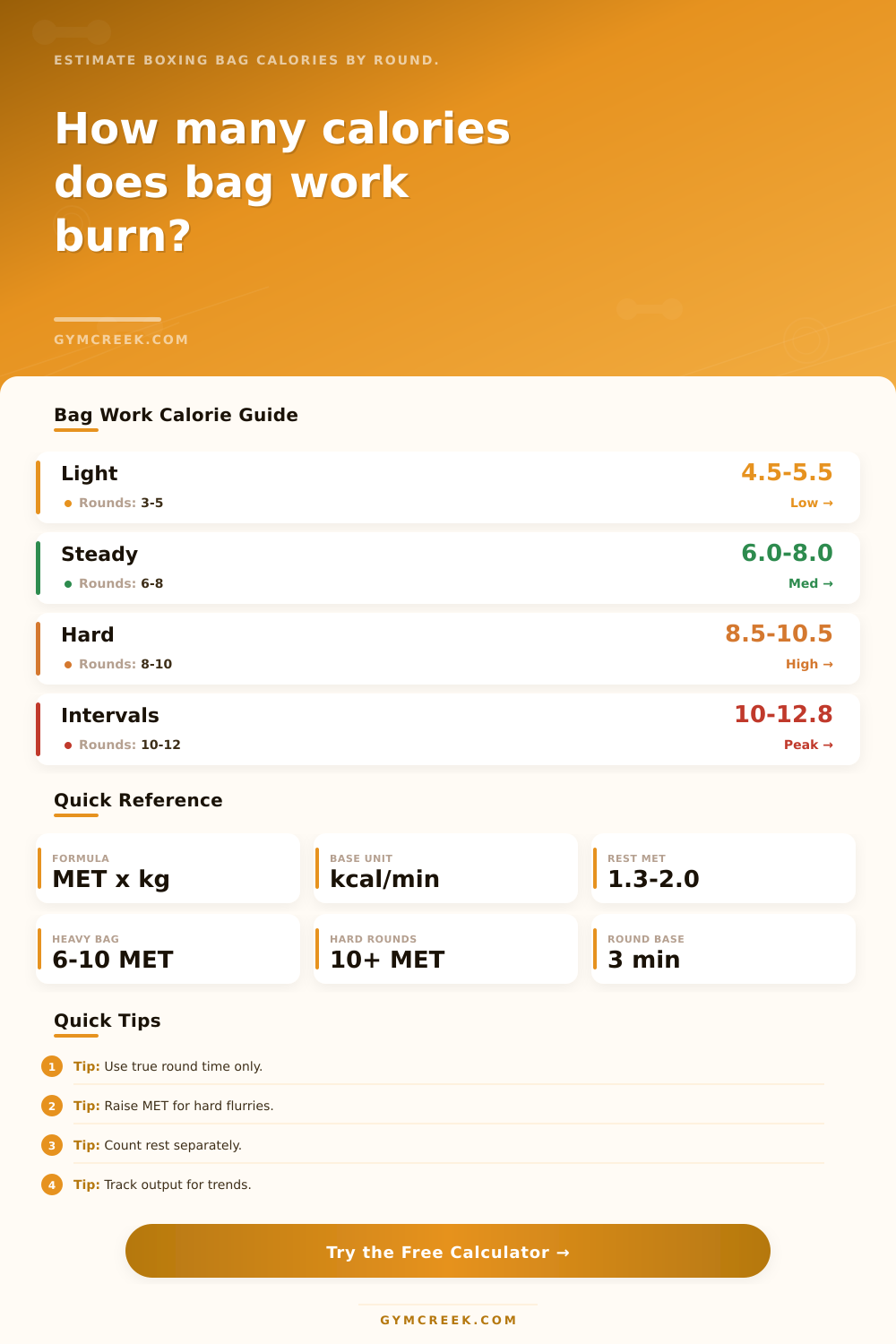
Calories per minute = MET x 3.5 x body weight in kg / 200. This is the main bag work energy equation.
Base MET comes from bag style and intensity, then punch rate, power, and movement multipliers tune the estimate.
Work calories use adjusted MET. Rest calories use 1.3 to 2.0 MET based on how active the break is.
Mifflin-St Jeor BMR estimates daily needs, then activity level converts BMR to estimated TDEE for comparison.
📑Reference Tables
| Bag Style | Light | Moderate | Hard |
|---|---|---|---|
| Heavy bag boxing | 5.5 MET | 7.5 MET | 9.5 MET |
| Aqua bag power | 6.0 MET | 8.0 MET | 10.0 MET |
| Double-end bag | 4.5 MET | 6.2 MET | 7.8 MET |
| Speed bag rhythm | 3.8 MET | 5.0 MET | 6.4 MET |
| Muay Thai bag | 6.5 MET | 8.8 MET | 11.0 MET |
| Round Setup | Work | Rest | Use Case |
|---|---|---|---|
| Beginner skill | 4 x 2 min | 90 sec | Learning pace |
| Fitness class | 8 x 3 min | 60 sec | Cardio base |
| Conditioning | 10 x 3 min | 45 sec | Hard effort |
| Fight camp | 12 x 3 min | 60 sec | Peak output |
| Punch Rate | Load | Modifier | Meaning |
|---|---|---|---|
| Under 50/min | Technical | 0.94x | Low output |
| 50-89/min | Steady | 1.00x | Base work |
| 90-129/min | Busy | 1.06x | High output |
| 130+/min | Flurry | 1.12x | Peak pace |
| Formula | Variables | Output | When Used |
|---|---|---|---|
| MET kcal | MET, kg, min | Calories | Main estimate |
| Rest kcal | Rest MET, kg | Break burn | Between rounds |
| Mifflin BMR | kg, cm, age | Baseline | Daily context |
| TDEE share | Calories, TDEE | Percent | Session context |
💡Tips
Here’s what you’re burning off while pounding away on heavy bag, according to this calorie-burn calculator. It makes you sweat in a unique way that are unlike the steady drip of a long run. For three minutes, you stand there throwing combinations and then step back and gasp for air. So how many calories did you just blow through? Answer: A bunch.
But the long version is that it depend on factors most people don’t consider. How? They use something called MET, short for Metabolic Equivalent of Task. It’s a measurement of exercise intensity. One MET is equal to your body at rest. Your heart rate increase from there when you punch the bag. And it increases.
How Many Calories Do You Burn?
You’ll see from the chart on the page that light technical work can be about five or six METs. In Muay Thai where you’re throwing hard power shots, it can shoot up into double digits. So what’s the impact? You expend more energy when you do a hard round then a moderate one; and we can measure that.
The other factor that goes into the calculation is body weight. Moving more mass takes more energy which means heavier bodies burns more calories when performing exact same task as a lighter person. It’s just basic physics. Two hundred pound you and one hundred and fifty pound you are putting in work. But you’re burning at different rates.
The tool automatically factors that in. There’s no need for you to try and figure out the math behind the conversion. Enter your weight and let formula do its thing.
When it comes to punch output, however, things gets interesting. Most folks think that the longer they’re on the bag, the more calories they’ll burn. That’s another fallacy. Tapping the bag gently with minimal movement while standing still won’t burn many calorie. You will burn much more by throwing rapid combinations with constant foot movement.
You can enter your average number of punches per minute into the calculator. Let’s say you throw fifty punches per minute. That means you’ll be burning much fewer calories than someone who throws ninety punches per minute. It doesn’t sound like much. But when you multiply that by eight rounds, throwing forty more punches per minute lead to burning noticeably more calories.
What about rest? Boxing rounds typicaly last three minutes. But how do you account for the other minute off the clock? Are you standing in place sipping on some water? That reduces your heart rate. You’re burning fewer calories (at almost-resting levels). Keep moving around and pace the ring. You’ll keep your metabolism high.
You can break up your workout time with rest time, which is what this tool does. It’s important because it helps make calorie estimation more accurate. Failing to count rest time will overestimate your calorie burn. When you add it back in, you see the picture clearly: It was a good workout.
Another factor is what type of bag you’re using. A heavy bag absorbs impact. Make it swing? Put some force into it. A speed bag bounces back at you. It requires hand speed and rhythm more than raw power. An aqua bag provides resistance similar to hitting an opponent. Each style use different energy systems and requires different muscles.
The calculator accounts for this with a preset for each style. It adjusts the base MET value based off the specific demand of the equipment.
Why does tracking calories matter? It is not only about losing weight. It’s also about learning how your body works. You won’t see results if you don’t know how many calories you burn and then eat all of them back in the same day. You’ll burn yourself out if you train hard but also undereat.
Tracking the approximate number of calories you’re burning during a bag session gives you a better idea of how to balance your diet. It lets you know when you should of had a post-workout meal or when you might be able to hold off until dinner time. It translates vague feelings of fatigue into solid information.
And these are estimates, mind you. A calculator doesn’t account for your stress levels, your hydration status, or your genetics. But as a baseline, it’s solid. It’s something to compare against. Is that six-round session this week easier than that ten-round session last week? The calories burned will tell you so. It offers a way to measure improvement.
You have both the mirror and the calorie counter. Training on the bag taxes your mind, your shoulders and your lungs. It’s one of the best things for building both strength and cardio at once. Respecting the work you’re doing by understanding how much it cost you in energy makes sense.
Each punch comes with a price. Knowing that price means training smart. You no longer guess. You know. You’ve got a better picture of what kind of fuel you’re burning the next time you stand up to the bag.
That is worth something. It transforms sweat into data. And data allows for progress.