Badminton Calorie Calculator
Estimate calories burned in singles, doubles, practice sessions, rallies, footwork drills, and match play using body weight, duration, game count, rest ratio, and adjusted MET logic.
📌Presets
Each preset loads a realistic badminton profile and recalculates calories from match structure, rally demand, drills, and rest time.
⚙Calculator
Badminton calorie snapshot
Enter match structure and rally demand to estimate badminton calories.
📊Fitness Metrics
🧮Formula Cards
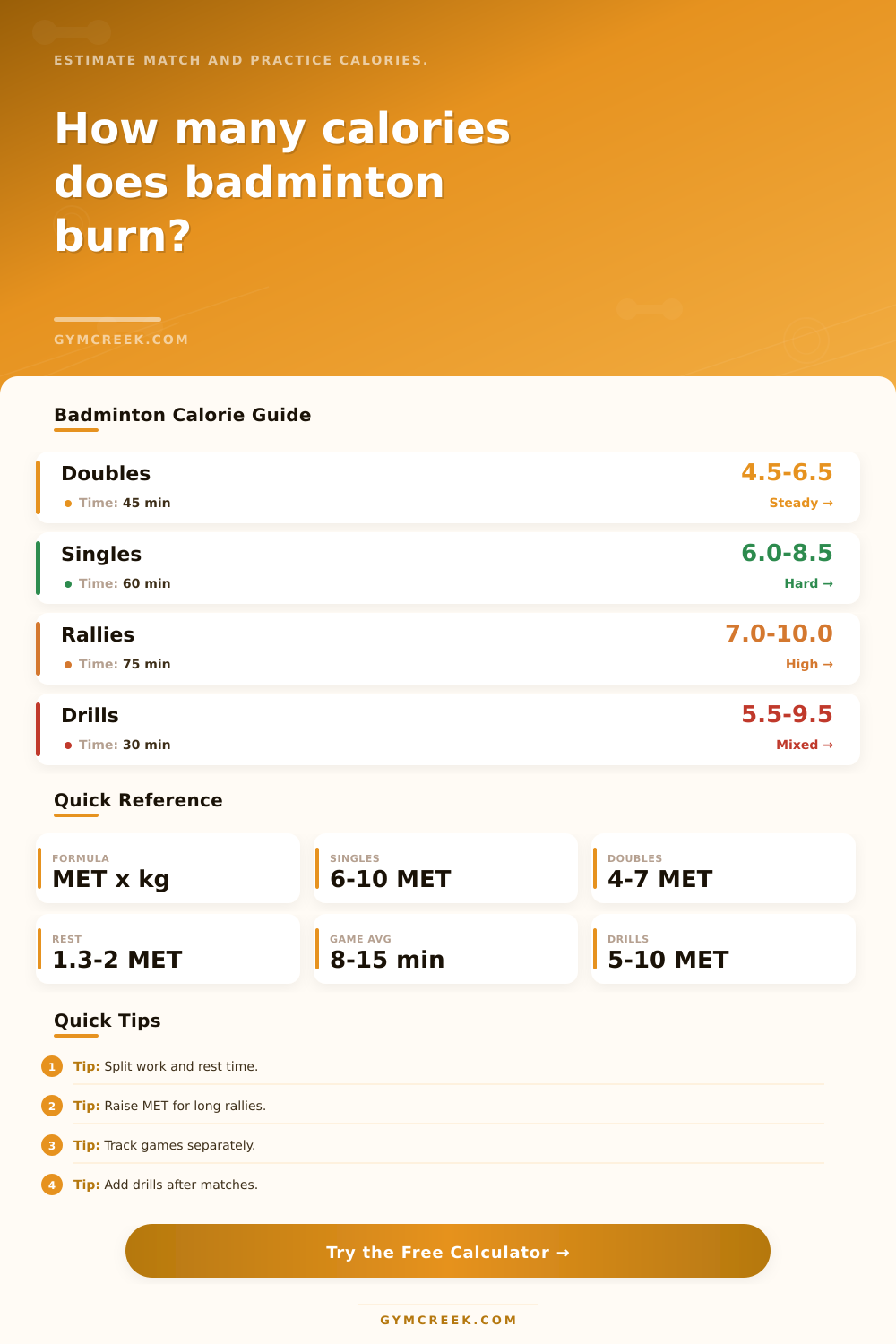
Calories per minute = MET x 3.5 x body weight in kg / 200. The calculator applies this to match work, drills, and rest separately.
Singles, doubles, practice, and tournament sessions start with different MET bands, then rally intensity and long-rally share adjust the load.
Game minutes estimate match work, drill minutes are added with a footwork multiplier, and rest ratio shifts part of the session to low MET burn.
Mifflin-St Jeor estimates BMR from age, size, and gender, then the activity multiplier gives TDEE so the session can be compared to a day.
📑Reference Tables
| Format | Easy | Steady | Hard |
|---|---|---|---|
| Singles match | 5.8 MET | 7.2 MET | 9.2 MET |
| Doubles match | 4.4 MET | 5.8 MET | 7.2 MET |
| Mixed doubles | 4.6 MET | 6.0 MET | 7.5 MET |
| Skill practice | 3.8 MET | 5.2 MET | 6.8 MET |
| Footwork drills | 5.4 MET | 7.4 MET | 9.8 MET |
| Session Type | Games | Rest Ratio | Best Input |
|---|---|---|---|
| Social doubles | 3 to 6 | 25 to 40% | Total time |
| Singles ladder | 2 to 5 | 15 to 28% | Game length |
| Tournament day | 6 to 12 | 30 to 55% | Match blocks |
| Coached practice | 0 to 3 | 15 to 35% | Drill time |
| Rally Demand | Long Rally | Modifier | Meaning |
|---|---|---|---|
| Serve focus | 0 to 15% | 0.94x | Low movement |
| Normal club | 16 to 40% | 1.00x | Balanced play |
| Pressure points | 41 to 70% | 1.08x | Hard recovery |
| Elite rallies | 71 to 100% | 1.16x | Peak coverage |
| Formula | Variables | Output | When Used |
|---|---|---|---|
| MET kcal | MET, kg, min | Calories | Main estimate |
| Drill kcal | Drill MET, min | Drill burn | Footwork work |
| Rest kcal | Rest MET, min | Break burn | Pauses |
| TDEE share | kcal, TDEE | Percent | Daily context |
💡Tips
If you think playing a round of badminton requires about as much energy as a slow jog, guess again. Badminton combines short intervals of intense exercise with periods of inactivity. This make it difficult to calculate just how many calories it truly expends. The process is more complicated than it seems.
Sure, you may spend some time standing around chatting between points, but then, boom: Your heart rate spikes as you lunge and jump like mad. With this variation, it’s impossible to estimate what you’re doing based off length alone.
Factors That Affect Calories Burned in Badminton
The other primary factors include singles vs. Doubles. Singles require nearly continuous movement around the entire court. There’s little time to rest as you race from one corner to another. In doubles, however, you have a partner to split up the workload and the rallies is frequently more intense and fast-paced. Doubles allow for more rest as you share the load with a partner.
Once you input your format choice into the calculator above, it do the math for you. For example, it assigns various metabolic equivalents based on the unique body burden of each activity. Covering an entire court by yourself is much harder work different than playing a half-court position.
Besides the format, there’s also the issue of intensity. Playing a casual social game where you clear easy shots and serve long burns burns many fewer calories then competing in a match full of deep drives and repeated smashes. To account for this, the tool allow you to set the percentage of long rallies and also the intensity of each rally. More long exchanges means your anaerobic systems kicks in, raising the energy cost per minute. This is just a slight tweak to the inputs but has a meaningful impact on the resulting total.
Don’t forget to include footwork and other drills. It may seem that running between courts in a drill or shuttling back-and-forth would be less intense than playing, but that’s because these activities often involve continuous movement without natural breaks found in match play. Because there are no natural breaks like in match play, continuous movement has a higher metabolism cost. If you’ve got some minutes set aside specifically for footwork drills, then make sure to account for those minutes in your overall estimation. For example, page includes general MET ranges for different activities (e.g., footwork). That will give you an idea if your session was a light touch or a serious grind.
The amount of rest is a factor as well. Walking to each point and standing between them lowers your overall calorie use over the whole workout. So even if you’re busting it during those active minutes with a high rest ratio, the total number of calories goes down.
And this is where getting a true picture of the structure of your workout becomes important. The duration you spend on court isn’t all that’s relevant. It’s how many minutes you spent actively engaged with the shuttle.
This is important because it gives some understanding of where badminton falls in the grand scheme of things. So if you’re playing to control your weight, you know exactly how much energy you should of expending and won’t underestimate yourself. If you want to train for stamina, recognize that this sport involves a lot of interval-type training. You can then understand why it’s so good for your heart.
These aren’t hard numbers, and they don’t reflect every single thing involved with playing badminton. But it does give you an idea of what you’re working with and lets you think realistically about your physical experience.
All in all, badminton is more than pure strength; it’s also about technique and recovery. This is reflected in the caloric expenditure. Dividing the workout into rest periods, drills, and actual playing time makes it easier to see exactly what your body has been through. It is no longer an ambiguous sense of fatigue, but a tangible expenditure of calories. This insight helps improve recovery and training efficiency.
By breaking down your session into active play, drills, and rest, you can get a clearer picture of what your body actualy endured. Now, you can measure how hard each stroke was.