Axle Bar Weight Calculator
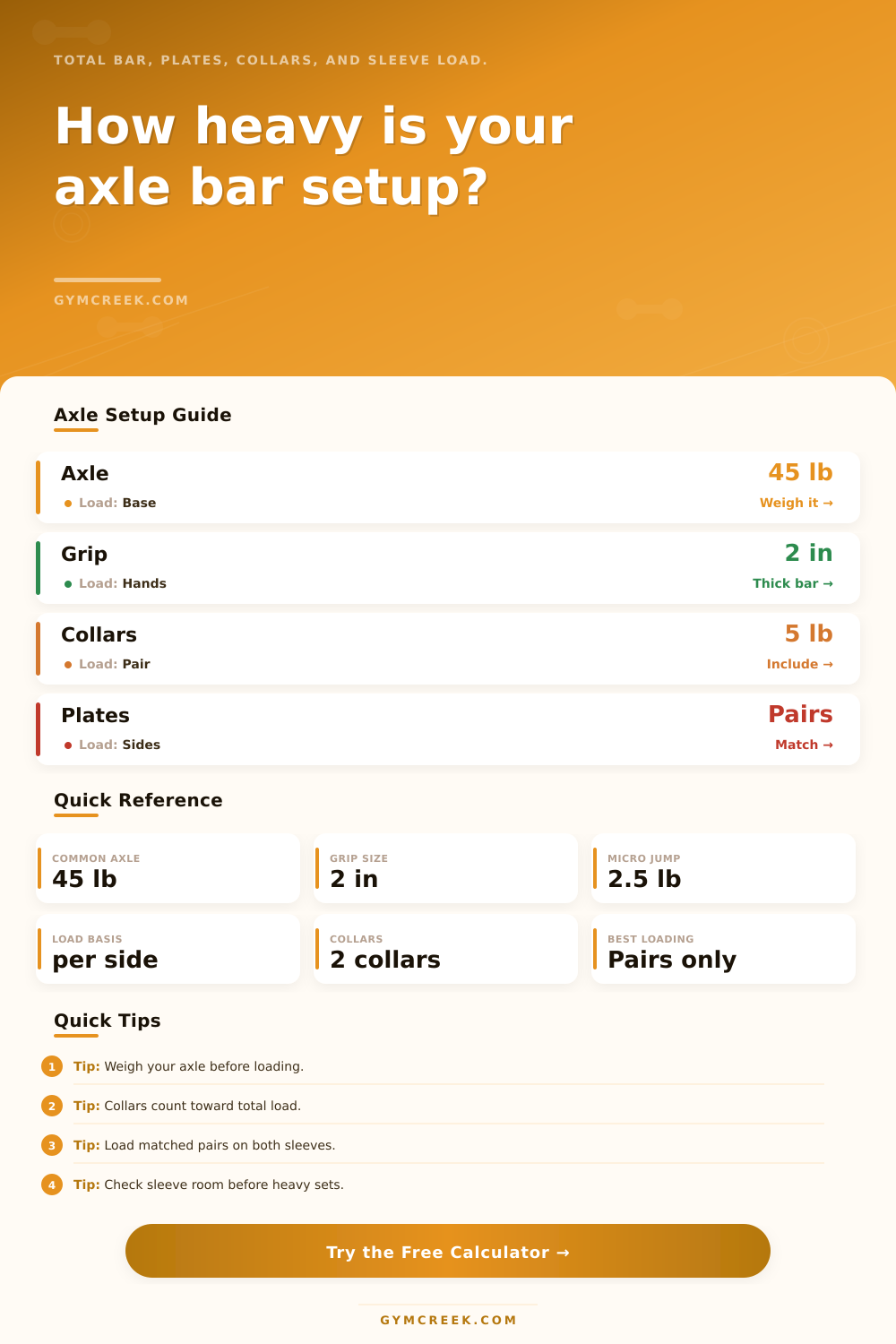
Total your axle, collars, paired plates, odd add-ons, grip diameter, sleeve room, and target load with thick-bar specific math.
📌Presets
Each preset loads a realistic thick-bar setup and recalculates the exact total including collars and any single-side correction plates.
⚙Calculator
Axle loading snapshot
Enter an axle and plate setup to total the load.
📊Setup Snapshot
📑Reference Tables
| Axle Type | Common Weight | Grip Diameter | Best Use |
|---|---|---|---|
| Empty training axle | 25-35 lb | 1.9-2 in | Technique work |
| Standard axle | 45 lb | 2 in | Press and deadlift |
| Heavy axle | 55-70 lb | 2 in | Contest practice |
| Fat grip bar | 35-55 lb | 2-2.5 in | Grip emphasis |
| Total Target | 45 lb Axle Load | Per Side Plates | Loading Note |
|---|---|---|---|
| 95 lb | 50 lb plates | 25 lb | Light warmup |
| 135 lb | 90 lb plates | 45 lb | One large pair |
| 185 lb | 140 lb plates | 70 lb | 45 plus 25 |
| 225 lb | 180 lb plates | 90 lb | Two 45 pairs |
| Sleeve Clue | What It Means | Action | Risk |
|---|---|---|---|
| Under 60% | Plenty of room | Load normally | Low |
| 60-85% | Check collars | Compress stack | Medium |
| 85-100% | Near full | Verify fit | High |
| Over 100% | Too long | Change plates | Do not load |
| Formula | Variables | Result | Use |
|---|---|---|---|
| Total load | Bar, collars, plates | Built weight | All sets |
| Per side | Plate load / 2 | Sleeve load | Loading check |
| Circumference | Diameter x pi | Grip wrap | Grip demand |
| Sleeve usage | Stack / sleeve | Fit percent | Safety check |
💡Tips
So much of the time you fixate on absolute amount of weight you can lift without recognizing from where weight originates. You can snatch up two hundred and twenty five pounds on a normal bar and think you are all set. But if you try it on an axle with the exact same number of plates, your hands quickly lose there grip.
The issue isn’t about what weight is going across your back, rather how your body use the weight through your hands. Being fooled by the printed weight on the bumper plate leaves you spinning your wheels with thicker bars. Because an axle setup is more than just iron plates, the math can get complicated.
Why Thick Bars Are Harder to Lift
There’s the bar itself… Which should weighs at least 45 pounds to be considered contest standard; plus those locking collars that keep stack in place. Many lifters fail to consider that their collars adds another five pounds of dead weight before even loading a single plate. By entering your gear weights into the calculator, it does all this math for you; there’s no need to wonder whether your collars will make your target ten pounds heavier or just a couple. It requires that you take everything into account, not assume bar doesn’t weigh anything.
Another less obvious limitation is sleeve space. Many people are used to loading big stacks onto a standard Olympic bar with long sleeves. But many common axles has much shorter sleeves that aren’t even as wide than sixteen inches on each side. So when you’re trying to put multiple thick plates on a short sleeve, there’s not enough room before it reaches what you want to lift.
This lets you put in both the sleeve length (the part you can actualy use) and the plate thickness to see whether the stack will clear the collar. It then provide a usage percentage letting you know how much wiggle room you have. Is it too snug? Is it dangerously stuffed? Because if a stack fall off during a heavy pull, it can be dangerous.
Many will tell you that grip diameter isn’t nearly as important. Sure, it’ll create more torque at the wrist, which means more tension in your forearm flexors. But a larger axle (i.e., 2-inch) have a much smaller circumference than average 1-and-three-quarter-inch shaft. See where I’m going with this?
Your grip will fail long before your back do. You may have a similar amount of shoulder strength, yet can press fifteen on thin bar while pressing two hundred on a thicker bar. That’s not a lack of strength. It is a mechanical disadvantage based off a longer lever arm. Once you understand this, you train smarter and realize that grip work is equally as important as developing your main muscles for these lift.
It gets harder when you’re trying to hit a certain target weight and can’t use microplates. You may be only five pounds away from a plateau, but there are no small plates to help you. Instead, you has to switch four plates at once. Knowing how much each add-on plate weigh helps you keep everything balanced. This allows you to get the exact load needed to progress without falling below your target weight because you are short on change plates.
It’s one thing to say “Oh, I’ve been pulling two-hundred pound axles,” but it’s another to really know what you have in your hands. If you realize that five pounds of collar weight and a fifty pound bar make up your two-hundred pound axle pull, then you’re able to progress with better control over training volumes and intensities. You’re no longer guessing, now you have real data.
Next time you pick up a thick bar, you’ll know exactly what those numbers represent long before your fingers close around the shaft.