Avocado Fiber Calculator
Estimate avocado fiber, edible grams, total carbs, net carbs, fiber-goal share, carb-cap fit, and a satiety score from serving size, form, and portion context.
📌Avocado Fiber Presets
Presets use edible avocado flesh unless the weight basis is set to whole avocado. The calculator applies a yield step, avocado form factor, fiber density, net-carb math, and satiety weighting.
⚙Calculator Inputs
Avocado fiber snapshot
Enter serving weight, yield, form, fiber target, and net-carb cap to estimate your portion.
📊Avocado Fiber Metrics
📑Reference Tables
| Serving | Edible Grams | Fiber | Net Carbs |
|---|---|---|---|
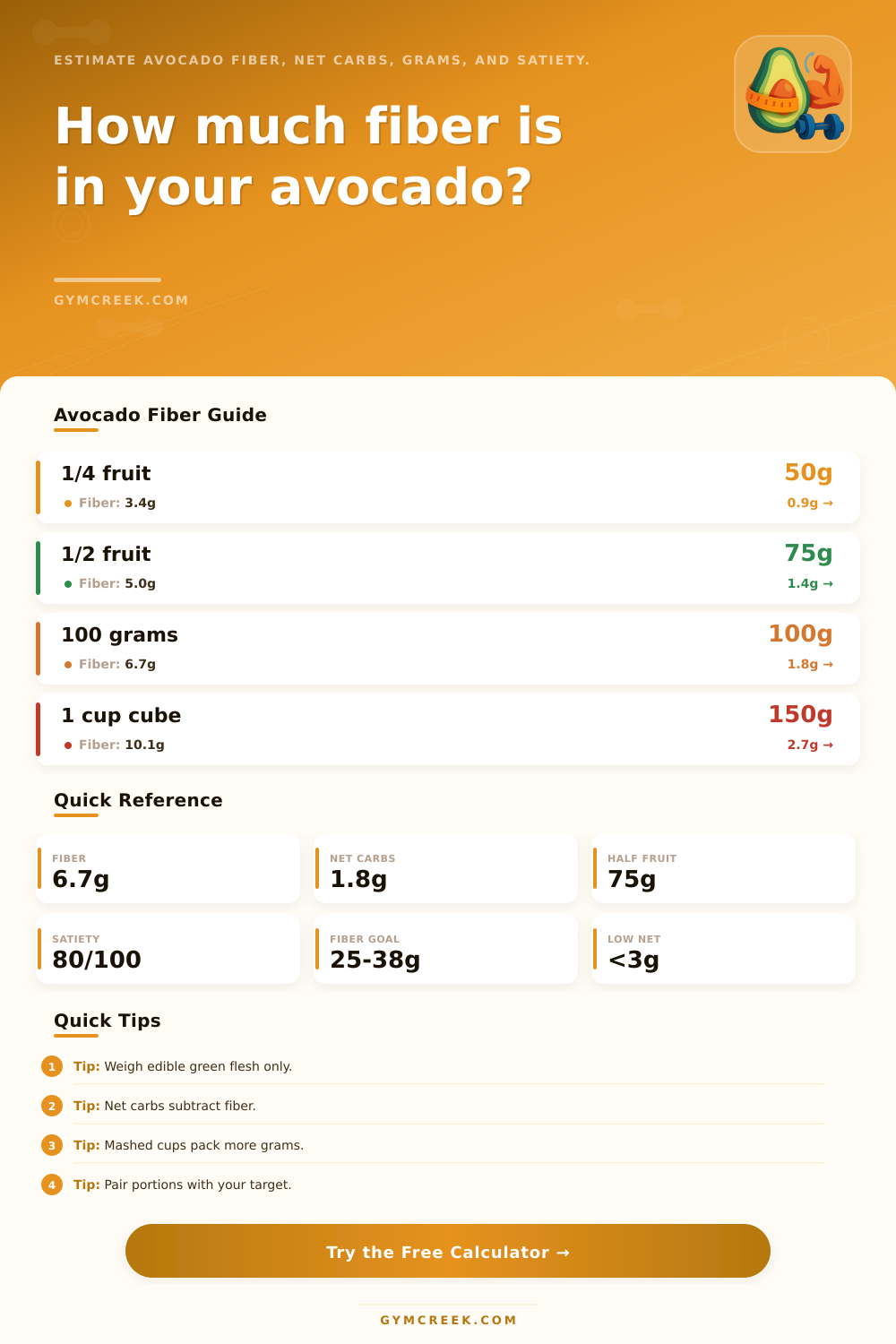
| 2 tbsp mashed | 30 g | 2.0 g | 0.5 g |
| 1/4 medium | 38 g | 2.5 g | 0.7 g |
| 1/2 medium | 75 g | 5.0 g | 1.4 g |
| 100 g weighed | 100 g | 6.7 g | 1.8 g |
| 1 cup cubes | 150 g | 10.1 g | 2.7 g |
| Avocado Form | Factor | Best Entry | Calculator Note |
|---|---|---|---|
| Raw sliced | 1.00 | Flesh grams | Baseline math |
| Diced salad | 1.00 | Diced grams | Same nutrition density |
| Mashed | 1.02 | Mash grams | Slightly packed serving |
| Guacamole mix | 0.92 | Mix grams | Diluted by vegetables |
| Thin spread | 1.00 | Spread grams | Portion often smaller |
| Fiber Goal | Avocado Portion | Goal Share | Net-Carb Cue |
|---|---|---|---|
| 3 g snack | 45 g flesh | About 100% | Under 1 g net |
| 5 g side | 75 g flesh | About 100% | About 1.4 g net |
| 8 g bowl | 120 g flesh | About 100% | About 2.2 g net |
| 10 g meal | 150 g flesh | About 100% | About 2.7 g net |
| Context | Typical Grams | Fiber Range | Satiety Use |
|---|---|---|---|
| Toast topping | 30-60 g | 2-4 g | Light boost |
| Snack side | 60-90 g | 4-6 g | Balanced |
| Salad bowl | 100-150 g | 7-10 g | Filling |
| Meal prep mash | 75-120 g | 5-8 g | Repeatable |
💡Tips
What’s the solution? When you pick an avocado (and it turns out to be smaller than advertised), you’re stuck. You’ll eat the fruit and feel full, but will you have had enough fiber? Or was it all fat and taste? Nutrition tracking can be a headache for anyone who eats whole foods where each item come in different sizes and variations.
How do we know what we’re getting when fruits changes shape and weight according to season and place of origin? Plus, there are many different kinds of each fruit. This problem can be solved by adopting structured approach to estimating intake. You do not need any lab equipment; just know what you are eating.
How to Calculate Avocado Nutrition Accurately
One key variable to consider is yield. For example: you purchase an avocado; you pay for both the flesh and the pit and skin. Usually, about sixty-five to seventy-five percent of it is edible. So if you weigh the complete fruit and simply use that number unadjusted, you’ll overestimate your fiber. The tool on this page converts for you so long as you indicate whether you weighed intact fruit or just the flesh inside. This saves you from having to guess how many grams or ounces you should subtract for skin and stone.
Density also depends off the physical form that the avocado takes. For example, diced cubes of avocado has more space between them than mashed avocado do. After being pureed into a paste, air pockets vanish and a cup of mashed avocado becomes heavier then a cup of sliced avocado. That’s important in terms of feeling full. To keep nutrition information accurate, there is a minor adjustment to take into account the density difference between raw sliced avocado and a mashed version (which we include in the calculator).
Similarly, if you dice up some onions and tomatoes to make your guac, the resulting food will have fewer grams of fiber per serving than it did before. This is because those ingredients don’t add much fiber. The interface allows you to input how much they are diluted, ensuring that your net carb count is still correct even with other ingredients included.
For those on low-carb diets, an avocado can sometimes be subject to close examination… And it all comes down to net carbs. It’s nothing more than simple math that people get confused over. To calculate net carbs, simply take the total carbohydrates and subtract the number of grams of fiber, since fiber doesn’t spike your blood sugar as simple sugars will. What’s left? That’s your net carb load. And typically, a half-avocado contains roughly one point four grams of net carbs, which isn’t much at all for most meal plans. But pair it with some beans or toast and things start to add up fast. We have reference tables built into the calculator that provide benchmarks so you can see how an avocado fits into a broader meal, ensuring you don’t go over your carb allotment.
Less talked about (but perhaps even more critical) is a metric called satiety. High-fat/high-fiber combos like avocado signals to your brain that “you’re full” better than a single nutrient can on its own. This is reflected in the satiety score. It accounts for your portion size, your meal’s context, and those two nutrients. That way you don’t only know what’s inside the food, you also have an idea of how it’ll work in your digestive system.
You could have a small snack that hits your fiber goal but leaves you ravenous within an hour. Or you can eat a bigger bowl with enough fiber and protein to help you feel fuller longer. So what’s a girl to do? Enter: the avocado/nutrition calculator. Once you input your specific parameters, it does the math for you so you don’t have to waste time guessing or getting anxious about checking each bite. This lets you eat, and enjoy the food (it’s creamy!), instead of thinking about how it will factor into your day’s goals.
Knowing that will help you better understand what you’re eating. That said, the key is knowing what you’re measuring. Whole foods change; nutrition labels show fixed numbers. A food’s weight depends on its ripeness; its density depends on how you prepare it. Your body cares about more than just isolated macros, and those numbers don’t show you all the nutrients at work.
But there’s nothing restrictive about precision. Knowing that an avocado provides a solid chunk of your fiber needs and keeps net carbs low allows you to eat more intentionaly. Precision becomes a way to be more confident in what you’re putting in your body. You get to turn all this fuzzy business about “eating healthy” into some solid numbers you can believe. Next time you look at the ripe fruit on your countertop, you’ll have precise information about how that contributes to your plan. It is not just something to eat but a thought-out piece of the puzzle.