Autoregulation Calculator
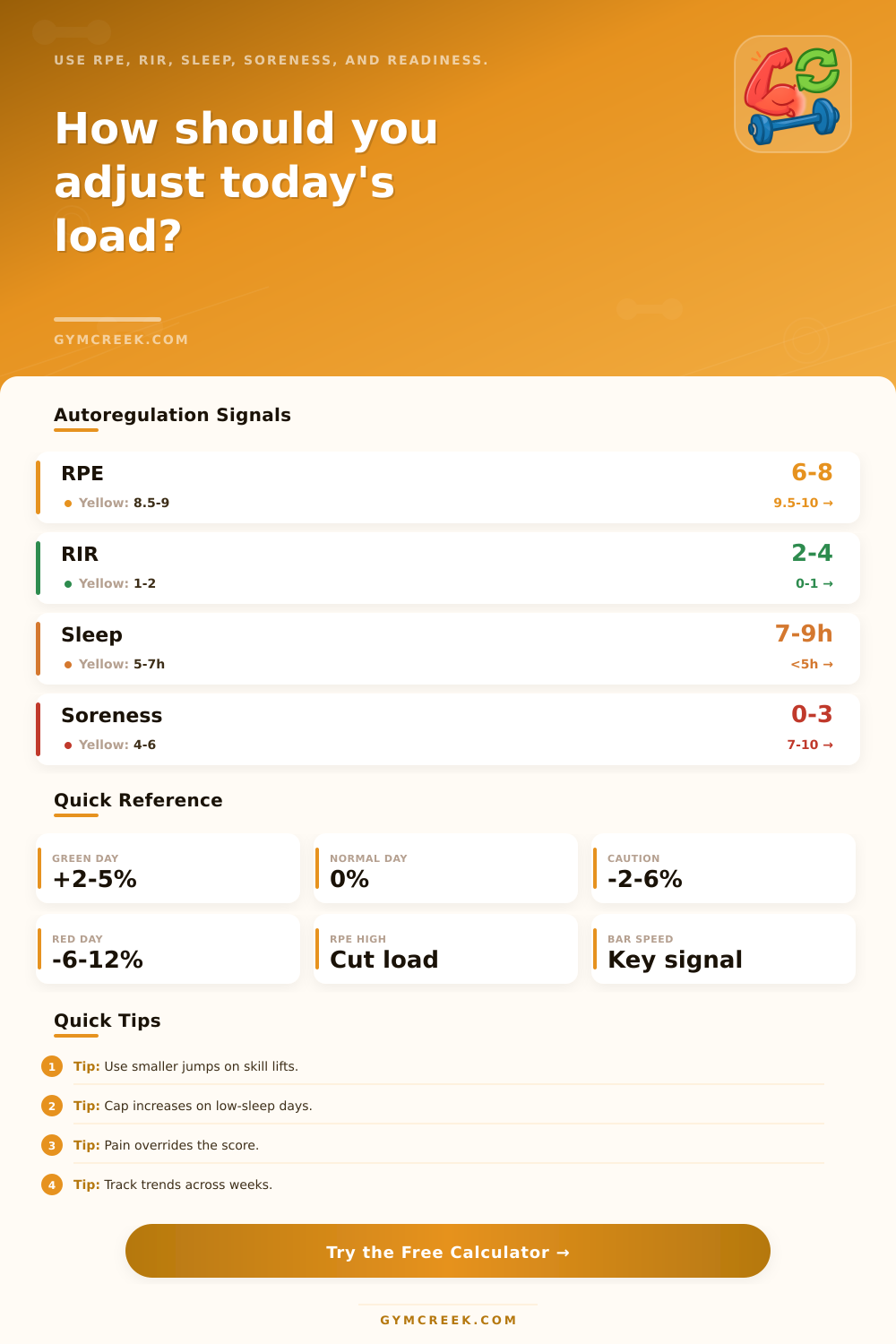
Adjust today’s planned load from RPE or RIR, recovery signals, bar speed, exercise type, and training goal.
📌Training Presets
Each preset uses a named lifting scenario with its own recovery, effort, and goal profile.
⚙Calculator Inputs
Autoregulated load snapshot
Enter today’s effort and readiness signals to calculate the recommended training load.
📊Fitness Metrics Grid
📑Reference Tables
| Signal | Green Range | Caution Range | Load Bias |
|---|---|---|---|
| RPE vs target | 0.5+ below | 0.5-1.0 above | Raise or cut 2-5% |
| RIR vs target | 1+ extra rep | 1+ rep short | Raise or cut 2-6% |
| Sleep | 7-9 hours | Under 6 hours | Cap increases |
| Soreness | 0-3 out of 10 | 6+ out of 10 | Cut volume first |
| Exercise Type | Increase Cap | Cut Bias | Why It Matters |
|---|---|---|---|
| Competition barbell | +5% | Moderate | Specific but technically demanding |
| Olympic or speed lift | +3% | High | Bar speed and timing drop fast |
| Machine compound | +8% | Low | Stable path tolerates small pushes |
| Accessory isolation | +10% | Volume | Effort can vary with less systemic risk |
| Goal | Target Effort | Load Choice | Volume Choice |
|---|---|---|---|
| Strength top set | RPE 7.5-9 | Protect quality reps | Trim backoffs if needed |
| Hypertrophy volume | RPE 7-9 | Small load shifts | Adjust sets first |
| Power and speed | RPE 6-7.5 | Cut if slow | Keep reps crisp |
| Deload week | RPE 5-7 | Bias downward | Leave fresher than planned |
| Decision Band | Score | Action | Session Note |
|---|---|---|---|
| Green | 70-100 | Hold or add | Warm-ups move well |
| Yellow | 45-69 | Trim 2-6% | Keep the goal but reduce strain |
| Orange | 25-44 | Cut 6-10% | Switch to quality work |
| Red | 0-24 | Deload | Technique or pain takes priority |
💡Autoregulation Tips
Most of the time, you don’t train according to plan. Maybe you roll into training with a number in mind. But maybe your body feels tired from something else. There might be a small injury or you might not have gotten enough sleep. So what do you do? You adjust silently, either lift the intended weight or not. That’s autoregulating. Instead of fighting most important signals for that day, you’re reading them and letting them dictate the workout.
This translates subjective feedback (how it feels) into objective measures (effort markers). So an RPE of eight on a heavy single indicate that you controlled the bar but still had some energy in reserve. The same applies to having two rep in reserve. You’ll use effort markers like RPE and RIR to measure how your sets feel, and if those numbers don’t line up with your plan, you’ll get some useful info from the divergence. Then if those numbers don’t line up, you’ll get some useful info from the divergence. Once you plug them into the calculator it does all the math for you. You won’t have to guess how far you are off-target.
How To Adjust Your Workout Based On How You Feel
Recovery inputs reflect your body’s ability to absorbs stress from both nervous system and tissue. Recovery blends sleep time, bar speed and local soreness into one recovery number. Even when you’re fired up, six hours never gets you as far than eight hours does. And when the soreness is higher than four or five on the working muscle, adding an extra set (or two) will likely cause more stress than benefit.
This output is calculated by blending the planned reps and sets with this day’s recovery inputs. The output is simply the difference between what the day ought to feel like and how it actualy feels. What it feels like today.
And then there’s the matter of what exercise it is, as well as your desired training goal. Not all exercises are created equal; neither are all sets or reps. You don’t make exact same adjustment on your last rep on a set of 12 leg presses as you would on your last rep during a heavy single on squats. A peaking goal calls for tighter caps than a hypertrophy block, because the priority has shifted from accumulating work to protecting quality repetitions. Different tolerances will apply based off whether your goal is a muscle-building block or peaking towards an event. Once you choose both session objective and lift category, the calculator takes care of this for you.
Consider the output not as a directive but as a jumping off point. Going lighter than recommended is fine. Maintain set count and move crisply. Going heavier than recommended is fine too. Just verify that the bar speed on your warm-ups matches higher load and then make the leap. A little bit goes a long way in terms of compounding over time. Following a pattern of small daily decisions often tells you more then a single random score alone.
You should of followed it. With practice, these cues become second nature. You figure out what to pay attention to, and more importantly what not to pay attention to. This is where the calculator speeds up the learning process. Before you even put plates on the rack, it combines all of those random observations into a single definitive tweak.