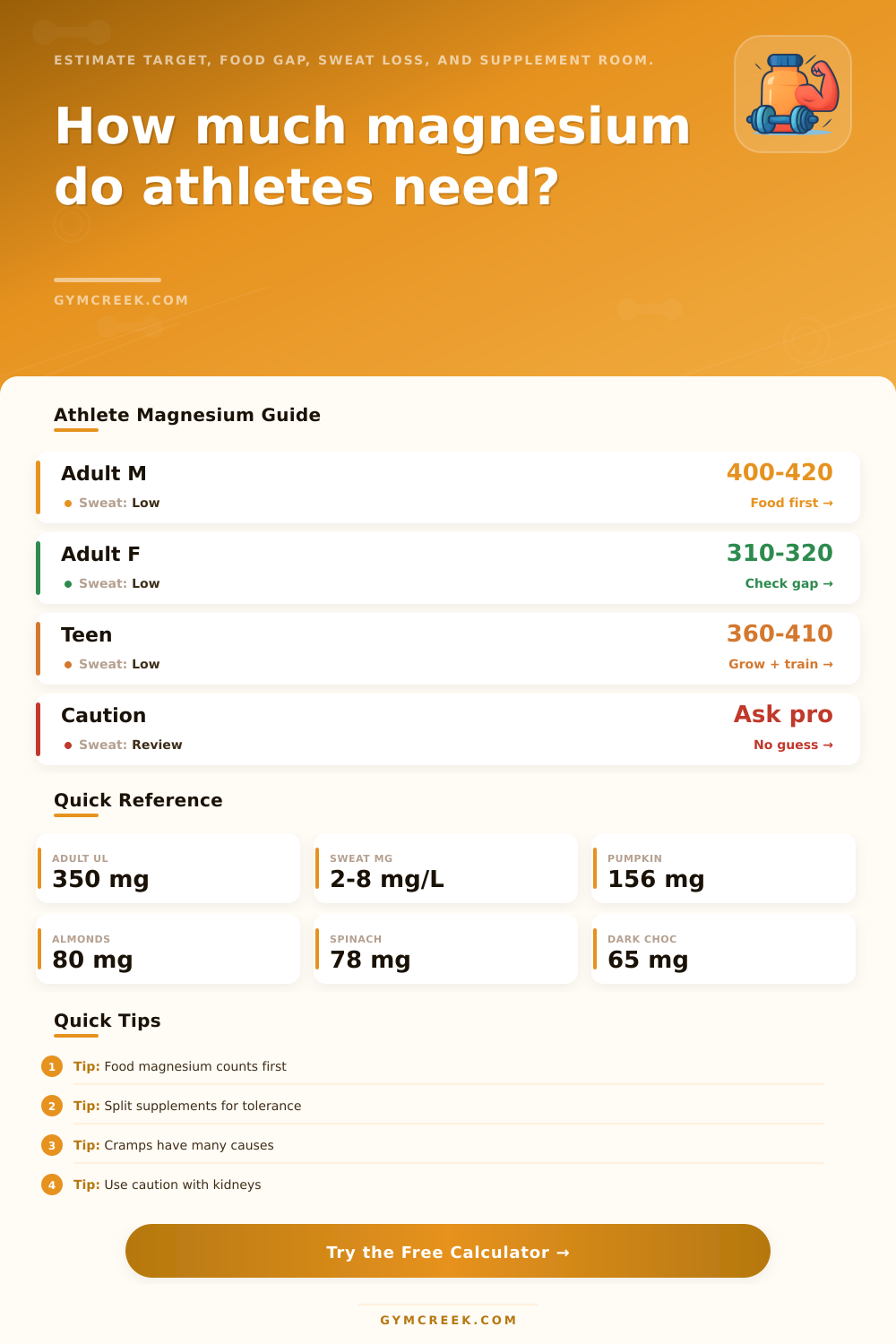
Magnesium Intake Calculator for Athletes
Estimate a food-first magnesium target, diet gap, sweat-related loss, supplement room, heat adjustment, and cramp-context flag from athlete-specific inputs.
⚡Athlete Presets
Presets load realistic training and diet scenarios. They are educational starting points, not diagnosis or a directive to supplement.
⚙Calculator Inputs
Magnesium plan snapshot
Target, food estimate, supplement room, and training context update as inputs change.
📊Metrics Grid
📘Exact Rules Used
📑Magnesium Reference Tables
| Group | Base used | Training note | Calculator cue |
|---|---|---|---|
| Male 19-30 | 400 mg/day | Common base reference for adult male athletes | Add cushion only when load or gap warrants it |
| Male 31+ | 420 mg/day | Slightly higher adult reference | Default for masters male athletes |
| Female 19-30 | 310 mg/day | Common base reference for adult female athletes | Watch low-calorie phases |
| Female 31+ | 320 mg/day | Slightly higher adult reference | Useful for masters endurance profiles |
| Teen athletes | 360-410 mg/day | Growth and training both matter | Use adult guidance only with professional input |
| Pregnancy or breastfeeding | 310-360 mg/day | Needs depend on age and medical context | Clinician guidance is preferred |
| Diet pattern | Model value | Common foods | Gap tendency |
|---|---|---|---|
| Low whole grains, nuts, legumes | 2.2 mg/kg plus 90 mg | Refined grains, low nut and bean intake, few greens | Often below target |
| Mixed omnivore | 2.8 mg/kg plus 135 mg | Mixed meals, some whole grains, dairy, meat, vegetables | Often close with good food quality |
| Balanced high-fiber athlete | 3.4 mg/kg plus 165 mg | Oats, beans, seeds, nuts, greens, whole grains | Usually strong |
| Plant-forward legumes and seeds | 3.9 mg/kg plus 190 mg | Beans, tofu, pumpkin seeds, almonds, grains, greens | Usually high |
| Cutting phase / lower calories | 2.5 mg/kg plus 105 mg | Smaller portions, fewer calorie-dense nuts and seeds | Gap risk rises |
| Endurance carb-rich day | 3.1 mg/kg plus 150 mg | Oats, rice, potatoes, fruit, sports foods, recovery meals | Depends on whole-food share |
| Training context | Magnesium sweat loss | Planning cushion | Practical move |
|---|---|---|---|
| Under 1 hour cool | Usually tiny | 0 to 10 mg | Normal meals usually cover it |
| 1 to 2 hours warm | Small but measurable | 10 to 30 mg | Prioritize magnesium-rich meals |
| 2 to 4 hours hot | Still modest vs sodium | 30 to 60 mg | Plan food across the day |
| Heavy sweater in heat block | Higher volume, still low concentration | 40 to 80 mg | Retest sweat and review full fueling plan |
| Form or pattern | Typical use | Tolerance cue | Calculator treatment |
|---|---|---|---|
| Food magnesium | First-line intake source | Usually well tolerated | Counts toward total intake, not supplement cap |
| Glycinate or malate | Often used for tolerance | Still dose-dependent | Count all supplemental mg |
| Citrate | Common supplement form | May loosen stool | Split or lower if sensitive |
| Oxide | High label mg, variable absorption | GI effects are common | Count label supplemental mg |
| Large single dose | Not ideal for many athletes | More GI risk | Flagged when cap or tolerance is exceeded |
| Kidney or medication caution | Individual medical review | Do not guess | Use professional guidance |
💡Tips
Magnesium is an essential mineral for the body, and magnesium are necessary for muscle function and muscle recovery. Many athletes wants to know if they are consuming enough magnesium for they bodies. Athletes may need more magnesium than nonathletes due to training or sweating.
A magnesium intake calculator allow you to determine your target for magnesium intake. The calculator will use your inputs to determine the target for your magnesium intake. One of the first inputs that you will need to enter into the calculator will be your body weight.
Magnesium Intake Calculator for Athletes
Magnesium requirements is in milligrams per kilogram of body mass. Another set of inputs will be the number of training hour that you perform each day and the rate at which you sweat. These two values will determine the amount of magnesium that you lose through sweating.
The heat setting that you select will also be an input into the calculator because higher temperatures will result in more higher sweating rates. Magnesium loss through sweating is one of the cause of magnesium loss in the body, but it isnt the only cause. The diet pattern that you follow will be another input into the calculator.
Depending on the diet that you follow, your estimate of magnesium intake will change. If your diet contains many legumes or whole grain, your magnesium intake estimate will be higher than if you follow a mixed omnivore diet. If you consume fewer dietary fiber or calories, your estimate of magnesium intake will be lower.
Many athletes may follow diets that are low in fiber and high in refined foods, creating a magnesium deficit. The calculator will make this visible to you so that you can decide whether to increase your magnesium intake from food or supplement source. Supplement room will be one of the output of the calculator.
The magnesium that you consume from food does not count towards your upper limit of magnesium intake from supplements. However, the magnesium that you consume from supplements will count towards your upper limit of magnesium intake from supplements. If you have a sensitive stomach that often leads to loose stools when you consume certain supplements, the calculator will adjust the supplement room that it calculates for you.
This is because your supplement ceiling will be lower if your stomach is more sensitive to supplements. This output will allow you to control your total magnesium intake. Another factor that the calculator will consider is whether you experience muscle cramp.
If you do, you can select the frequency with which you experience these cramps. If you experience frequent cramps or cramps that occur during sleep, the calculator will increase your target for magnesium intake. These cramps can be caused by many other factors other than a lack of magnesium intake.
However, increasing your magnesium intake may create a margin of error for the causes of your muscle cramps. The reference tables to the left of the calculator will show you the base values and the estimates of dietary magnesium intake that will be used to calculate your magnesium intake target. These tables will help you understand why two individual of the same body weight could have different targets for magnesium intake.
These tables will explain how different dietary patterns affect magnesium intake. There are a few variables of the body and athlete that will change your magnesium needs beyond what the calculator can determine. For example, if you are traveling to another part of the world, your access to food may change.
If you are suffering from an illness that affect magnesium absorption, your needs may change. If you are increasing your training hours while in a heat wave in your area, your sweating losses increase, which will increase your losses of magnesium. These variables may require that you adjust the magnesium intake target that the calculator calculates.
The output from the magnesium intake calculator is only a guide for your daily magnesium intake. If you are not getting enough magnesium from food, you can adjust your diet accordingly. If the supplement room is quite small, you can split your supplements between meals to ensure that you are getting the magnesium that you need while also avoiding any issue with your stomach.
The calculator removes the need for manually perform the calculations for magnesium intake and provides you with information that will allow you to make decisions regarding your supplement intake.