Assisted Pull Up Calculator
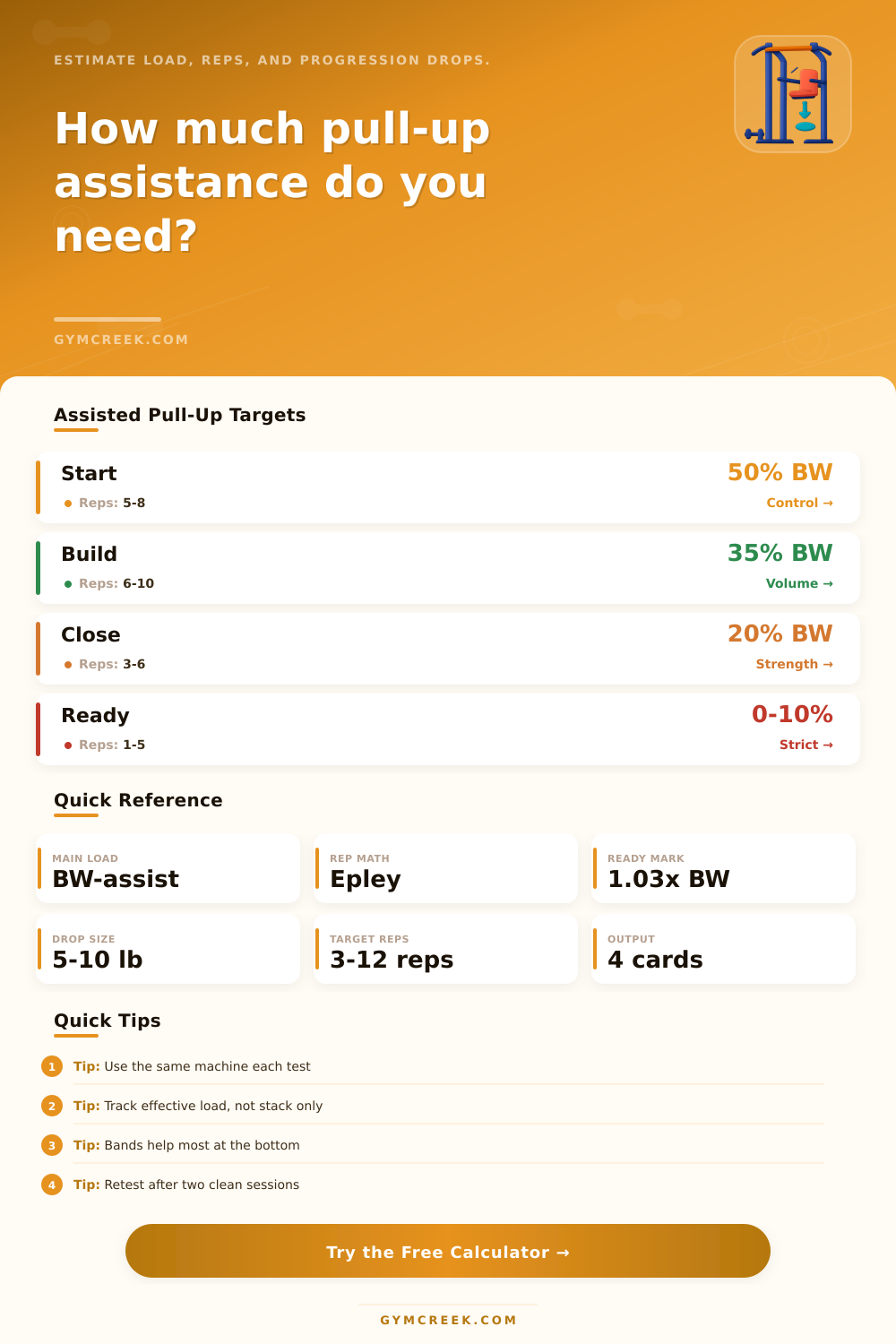
Estimate effective lifted load, projected pull-up strength, assistance needed for a target rep set, and the next realistic drop on a machine or band setup.
📌Pull-Up Presets
Each preset uses a different bodyweight, assistance source, rep goal, activity level, and progression step so the calculator shows realistic changes.
⚙Calculator
Assisted pull-up snapshot
Enter your set and calculate effective load, target assistance, and readiness.
📊Progress Metrics
📑Reference Tables
| Assistance | Effective load | Typical rep range | Training read |
|---|---|---|---|
| 50%+ BW | Under half BW | 5 to 12 | Pattern practice and control |
| 35% to 50% | Half to two-thirds BW | 6 to 10 | Volume base and groove |
| 20% to 35% | Two-thirds to 80% BW | 4 to 8 | Strength transition zone |
| 10% to 20% | 80% to 90% BW | 3 to 6 | Close to strict singles |
| 0% to 10% | 90%+ BW | 1 to 5 | First-rep readiness work |
| Source | Usable factor | Why it changes | Best comparison |
|---|---|---|---|
| Machine | 0.95x | Guides and friction reduce perfect transfer | Same machine, same tempo |
| Heavy band | 0.78x | Most help comes near the bottom | Same band and anchor height |
| Medium band | 0.72x | Assistance changes across the rep | Same band stretch |
| Light band | 0.66x | Less bottom help, less top help | Same setup each test |
| Partner assist | 0.60x | Hard to apply evenly across reps | Use as rough estimate |
| Lane | Men | Women | What it suggests |
|---|---|---|---|
| Build base | Under 0.90x | Under 0.82x | Keep assistance moderate |
| Developing | 0.90x to 1.00x | 0.82x to 0.95x | Start smaller assistance drops |
| Near ready | 1.00x to 1.06x | 0.95x to 1.03x | Practice low-assist singles |
| Ready | 1.06x to 1.15x | 1.03x to 1.12x | Try strict bodyweight reps |
| Strong | 1.15x+ | 1.12x+ | Add reps or light weight |
| Piece | Formula | Input | Output |
|---|---|---|---|
| Effective load | BW - assist | Bodyweight and usable assist | Load moved |
| Rep estimate | Epley | Load and clean reps | Max load |
| Target help | BW - target load | Max load and target reps | Assist need |
| Readiness | Max / BW | Estimated max load | Ratio lane |
| Work estimate | Force x distance | Load, height, standard | Mechanical work |
💡Tips
Assisted pull-ups are a method of training the muscle used in performing a pull-up. Assisted pull-ups can also be used as a means of measuring the strength of an individual performing the exercise. While many individual use the assisted pull-up machine or band to make performing a pull-up easier, the value of the assisted pull-up come from being able to measure the exact amount of load that an individual is moving.
If an individual performing assisted pull-ups does not track the amount of load, then the progress that the individual make with assisted pull-ups will remain vague. The feeling of strength may wax and wane for an individual while performing assisted pull-ups, but without a means of measuring the load moved by that individual, the measurements will not reflect the individuals efforts. The single most important variable in assisted pull-ups is the effective load that an individual must move.
How to Measure Strength with Assisted Pull-Ups
The effective load is the amount of force that an individual must produce in order to perform each set of assisted pull-ups. An individual calculates the effective load by subtract the amount of assistance produced by the assisted pull-up machine from the bodyweight of that individual. This figure is more important than the weight loaded on the assisted pull-up machine because not all assisted pull-up machine produce the same amount of assistance for each individual.
Assisted pull-up machines that have guides for the assistance of assisted pull-ups will allow an individual to produce more assistance than an assisted pull-up band, for instance, since the assistance provided by assisted pull-up bands is not consistent throughout the range of motion of the assisted pull-ups. By knowing the effective load that an individual can produce, that individual can calculate the maximum strength level that they can produce with assisted pull-ups. To calculate the maximum strength level, the individual can use the same math as is use to calculate the strength of an individual performing barbell lift.
For instance, an individual can calculate the maximum strength level by using a formula that determines that the more repetitions of assisted pull-ups that are performed at a specific load, the greater the strength of the individual performing those assisted pull-ups. Several factor can modify the strength of an individual, though, such as the age of the individual, the level of activity of that individual, the grip that they use when performing assisted pull-ups, and the standards that they use for the number of repetitions of assisted pull-ups that are performed. If an individual perform a partial repetition of assisted pull-ups with a loose grip, for example, their strength level will be different than that of an individual performing a strict repetition of assisted pull-ups.
An individual may want to know the amount of assistance that they should use in their next performance of assisted pull-ups. An individual can determine the amount of assistance that should be used by knowing the number of repetition that an individual wants to perform. An individual who desires to be able to perform five assisted pull-ups may find that the calculation of their strength with the assistance of the assisted pull-up bands indicates that the individual can handle a load that is higher than their bodyweight.
In this instance, an individual should reduce the assistance with their assisted pull-ups. If, however, the individual finds through the calculation of their strength that they can only perform one or two assisted pull-ups with the reduced assistance, then the individual should leave the assistance as it is for this training session. An individual’s bodyweight can change over time.
If the individual is losing bodyweight, the amount of assistance that they use does not necessarily need to be altered, but the effective load that they produce is a higher percentage of their bodyweight. If, however, an individual is gaining bodyweight, the individual needs to increase the amount of assistance that they use with their assisted pull-up exercises. An additional factor that influence the data that is collected with assisted pull-ups is the grip that is used when performing those assisted pull-ups.
Chin-ups use the biceps more than do pronated pull-ups. This means that an individual can perform assisted pull-ups with a higher effective load for chin-ups then for assisted pull-ups that use pronated grip. In addition to the grip that is used for assisted pull-ups, the range of motion that is used also alter the data that is collected with assisted pull-ups.
Chest-to-bar assisted pull-ups have a greater range of motion than assisted pull-ups that require an individual to reach chin height. Greater range of motion for assisted pull-ups make the task more difficultly to perform. Each of these factors is the same as the others in strength, but each change how that assisted pull-up data can be compared between sessions for an individual.
Another dimension to assisted pull-ups that many individuals disregard is the mechanical work that is performed in performing assisted pull-ups. The distance that an individual move with each repetition of assisted pull-ups can increase with the increase of the height of the individual. An individual who is tall will move the assisted load a greater distance than an individual who is short.
Thus, an individual who is tall will perform more mechanical work than an individual who is short with the same amount of bodyweight and the same number of assisted pull-ups performed. Many individuals make mistake when they change many of the variables of assisted pull-ups at once. For instance, if an individual changes the type of assisted pull-up band that they use, the grip with which they perform assisted pull-ups, and the range of motion that they use for assisted pull-ups, it is impossible to know if the improvements in the strength of that individual are the result of improved strength or of the easy setup of the assisted pull-up exercises.
Additionally, if an individual reduces the assistance that they use when they feel that they can comfortably perform the assisted pull-ups with the current amount of assistance, they may find that they can only perform one or two assisted pull-ups. In this case, the individual would not experience any improvement in their performance with assisted pull-ups. One of the purpose of incorporating an assisted pull-up tool into an individual’s training can be to treat the assistance as data.
By treating the assistance as data, an individual can better understand when to reduce the assistance with their assisted pull-ups and when to increase the volume of their assisted pull-up exercises. Thus, while the assisted pull-up exercise itself may be simple to perform, the data that is provided by the assisted pull-up allow for the individual to have a plan for performing assisted pull-ups for many month.