
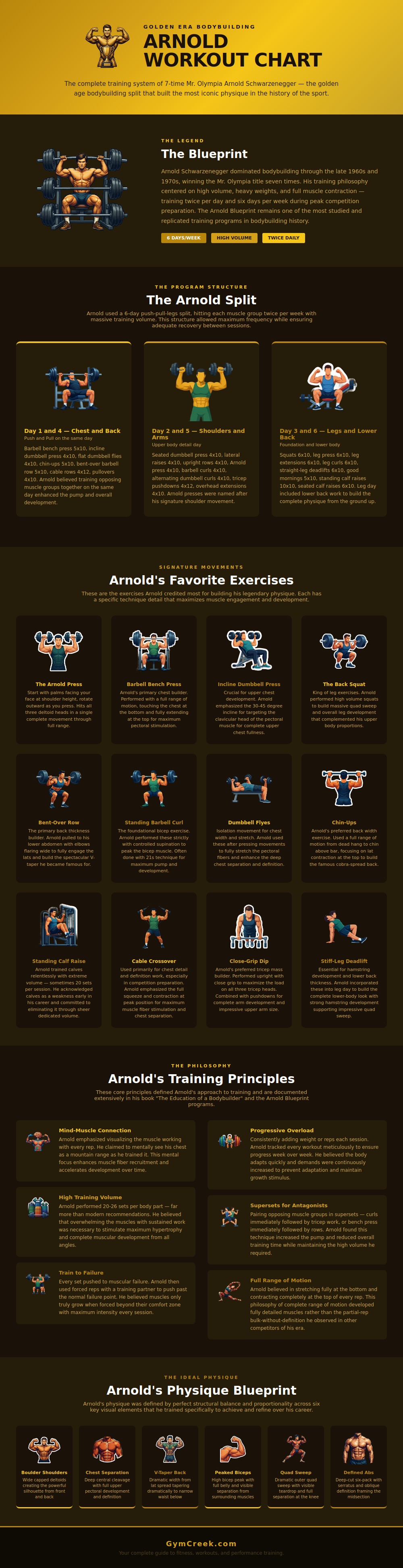
The Arnold Schwarzenegger training system is a method for muscle growth. Arnold Schwarzenegger created this training system and forces the muscles to adapt to the work that is provided to them. There is charts within the training system that illustrate the structure of the training split for this system, preventing individuals from having to guess at the split that they will execute.
There is a six-day training split with this training system, but the structure of these six day will ensure that every muscle group is trained twice each week. There will be two days to train chest and back muscles together, two days to train the shoulder and arm muscles together, and two days to train the leg and lower back muscles together. Training opposing muscle groups allow for the blood to continuously move through the muscles being trained, and Arnold Schwarzenegger felt that allowing the blood to move through the muscles being trained will allow individuals to maximize there long-term muscle growth.
Arnold Schwarzenegger Training System for Muscle Growth
The chart makes clear which muscles will be trained on which days to ensure that there is no overlapping of training sessions. The exercises for this training split include classic bodybuilding exercises. Classic bodybuilding exercises include exercises like the bench press, rows, presses, squats, and curls.
Individuals perform these types of exercises with this training split because they will allow individuals to provide the best return for their effort in these exercises. One exercise is the Arnold press. For the Arnold press, an individual will start in the same position as the bench press but will rotate their palms outward.
This exercise allow for all three heads of the shoulder to be exercised at the same time. For each exercise, individuals should utilize a full range of motion with their movements. Utilizing a full range of motion for their exercises will prevent individuals from only developing partial muscles within the body.
For each exercise, individuals will stretch their muscles at the bottom of the exercise and contract their muscles at the top of the exercise to ensure the development of those muscles in their range of motion. The training principles for this training system, as represented within the training split chart, are just as important as the list of exercises. The training principles include using the mind-muscle connection and training with high training volume.
The mind-muscle connection is the use of visualizing the target muscles contracting during each exercise. Focusing on visualizing the target muscles will ensure that only those muscles are activated during the exercise. For an individual to focus on the mind-muscle connection will prevent them from using momentum to perform the exercises.
Utilizing momentum and other muscles will prevent the target muscles from having to do the work required to perform the exercise. High training volumes are used for the training split because using quality training work performed at a high volume will allow for the muscles to grow. Using techniques like training to failure and performing forced repetitions will allow for higher training volumes for each muscle group.
High training volumes are encouraged for each muscle group so that the body can gain more strength from those muscles. Another principle for this training split is the concept of progressive overload. For this exercise, an individual will find ways to add more weight or repetitions to the exercises once their muscles have adapted to the current workload.
Not adding more weight or performing more repetitions will result in the body adapting to the workload, leaving no stimulus for the body to grow more muscle. Using supersets for opposing muscles allow for the cutting of training time while increasing the pump in the trained muscles. For each exercise within the split, individuals must use a full range of motion.
Using a full range of motion will allow individuals to continue to grow those muscles; performing only partial movements will leave gap within the developed muscle. There are physique goals that are to be achieved with this training split. The physique goals for this training split will include the individual having wide shoulders, chest separation, a V taper in their physique, peaked biceps, quad sweep in their legs, and visible abs.
These physique goals will result from training each muscle group adequately within the body. This training split treats the body as one whole system rather than the individual parts of the body. If any area of the body is not trained properly, the body will not be developed as a whole.
The training of the leg and lower back muscles should of been focused on as much as the upper body muscles. Many individuals believe that this training split only works for individuals with special genetics. However, this training split is a method that can actualy be applied to all individuals with any type of genetics.
If an individual can commit to the training split as illustrated in the chart, then the individual can adjust the training split according to the individuals strength and their ability to recover from training. An individual should start the training split in the same way that it is illustrated in the chart. Focus on performing each exercise with a full range of motion and with progressive effort into each split.
The chart will act as teh map for the training split, but the individual is in charge of actually performing the exercises.
