Army Combat Fitness Test Calculator
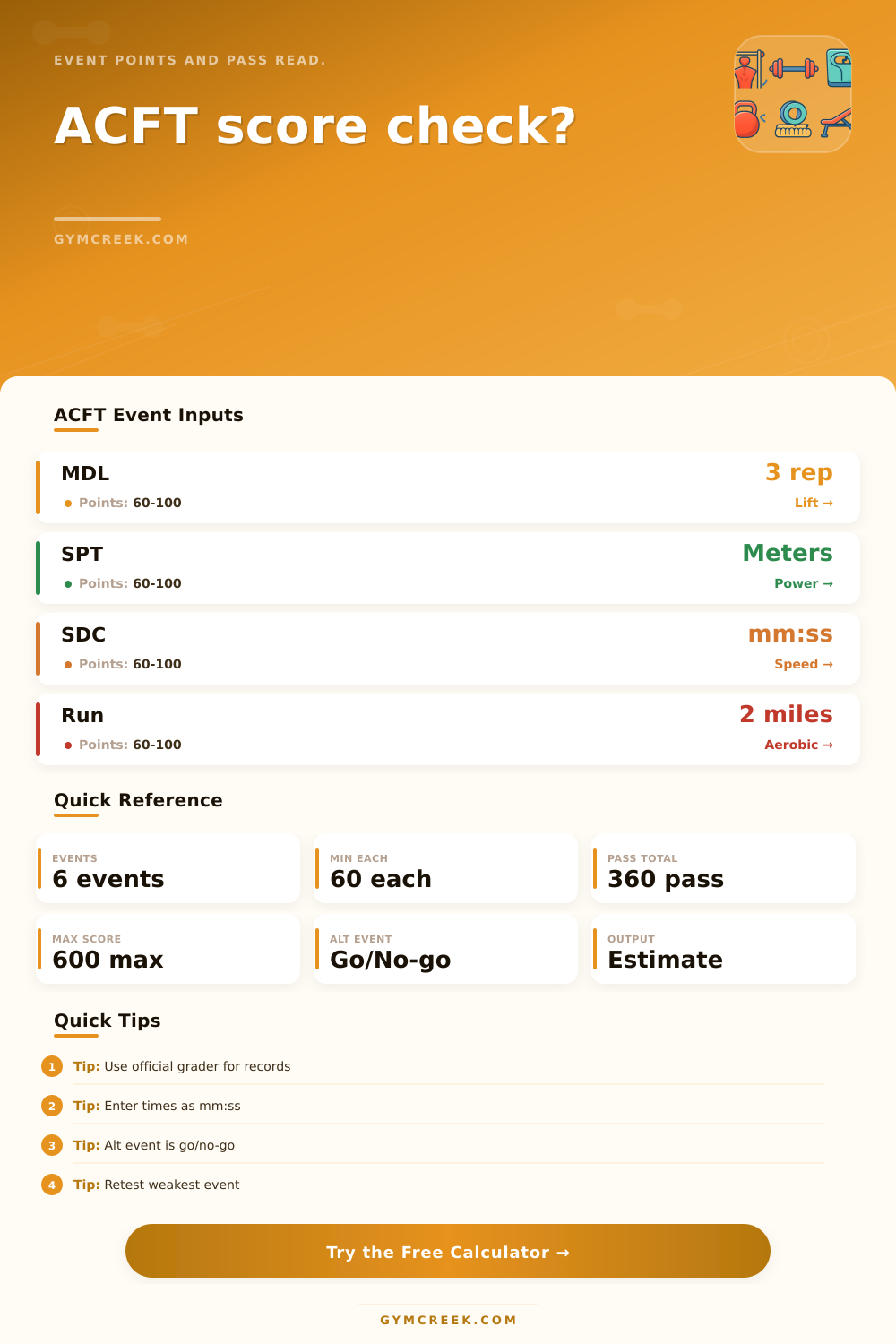
Estimate legacy six-event ACFT points from age, sex, deadlift, power throw, hand-release pushups, sprint-drag-carry, plank, run, and optional alternate aerobic event.
📌ACFT Presets
Presets load realistic six-event ACFT scenarios. Replace them with your own raw event results before interpreting the estimate.
⚙Calculator Inputs
ACFT score estimate
Enter raw event results to estimate points and pass status.
| Event | Raw | Points | Needed |
|---|---|---|---|
| --- | --- | --- | --- |
📊Metrics Grid
📑Reference Tables
| Event | Input | Better result | Calculator role |
|---|---|---|---|
| 3RM Deadlift (MDL) | Pounds lifted | Higher | Strength points estimate |
| Standing Power Throw (SPT) | Meters thrown | Higher | Explosive power estimate |
| Hand-release Push-up (HRP) | Reps in 2 minutes | Higher | Upper-body endurance estimate |
| Sprint-drag-carry (SDC) | mm:ss time | Lower | Anaerobic speed estimate |
| Plank (PLK) | mm:ss hold | Higher | Core endurance estimate |
| 2-mile Run (2MR) | mm:ss time | Lower | Aerobic endurance estimate |
| Score item | Typical value | Meaning | Calculator treatment |
|---|---|---|---|
| Minimum event score | 60 points | Each scored event must meet the floor | Below 60 is flagged |
| General passing total | 360 points | Six events at 60 each | Displayed as pass context |
| Maximum score | 600 points | Six events at 100 each | Shown as total ceiling |
| Combat context | 350+ total | Extra total-score context for some roles | Shown when selected |
| Alternate event | Distance | Typical pass window | Scoring note |
|---|---|---|---|
| 2.5-mile walk | 2.5 miles | About 31-35 min | Go/no-go estimate |
| 12 km bike | 12 km | About 26-30 min | Go/no-go estimate |
| 5 km row | 5 km | About 26-34 min | Go/no-go estimate |
| 1 km swim | 1 km | About 26-35 min | Go/no-go estimate |
| Event type | If below 60 | If passing | Practical read |
|---|---|---|---|
| Lift or reps | Add pounds, meters, or reps to the 60 anchor | Gap to 100 anchor is shown in detail | Higher raw result helps |
| Timed event | Reduce time to the 60 anchor | Gap to 100 anchor is shown in detail | Lower time helps |
| Alternate event | Reduce time to go/no-go limit | No extra points estimated | Profile rules apply |
| Weakest event | Lowest point estimate | Best first retest target | Improves total and pass chance |
💡Tips
The Army Combat Fitness Test is a test that has replaced the older versions of the Army Combat Fitness Test. The old test require soldiers to demonstrate there aerobic endurance, but the Army Combat Fitness Test requires soldiers to have strength, power, speed, and aerobic endurance. The combination of these different physical attribute is required of soldiers due to the types of tasks that soldiers are to perform; for instance, soldiers may be required to both drag a teammate and then sprint to a new location.
The specific event that make up the Army Combat Fitness Test each have specific purposes within the test. For instance, the deadlift measure how much weight a soldier can lift from the ground, simulating moving heavy equipment or a teammate. Similarly, the power throw measures the amount of explosive strength a soldier possesses in they’re hips or shoulders.
How the Army Combat Fitness Test Works
Simulating the movement of an obstacle or sandbag. Additionally, the hand release pushups test a soldier’s upper body endurance, the sprint drag carry tests a soldier’s anaerobic endurance, core strength and grip strength, and the plank tests a soldier’s core strength and stability; events that replaced the leg tuck event because the plank tests measure better core strength with less risk of injury. Finally, the two mile run tests a soldier’s aerobic endurance; different scoring table for various ages and sex of soldiers allow the Army to ensure that all soldiers has a fair test.
In addition to providing a total score for the Army Combat Fitness Test, the calculator also provides information regarding a soldier’s strength and weaknesses in the test. For instance, while a poor score in a specific event will impact the total score for the test, regardless of the soldier’s score in other events, the calculator will identify that event as the soldier’s lowest scoring event. Additionally, the calculator can determine how close a soldier is to the next scoring anchor for that event; knowing the distance to the next scoring anchor allow for soldiers to make decisions regarding there training goal.
Many soldiers make the mistake of only training the event in which they are performing well in the test. By only training the events that soldiers are performing well in, they will not have a balanced level of physical fitness require for the test. The Army Combat Fitness Test is a test of balanced fitness; soldiers may be strong and have excellent aerobic endurance, but if they cant drag a teammate or perform the other physical task, they will struggle during there mission.
Thus, the calculator allows soldiers to recognize these weakness in their physical strength and address those weakness before the test occurs. The use of age and sex adjustment within the test is an attempt to adjust for the difference in physical strength based off an individual soldier’s age and sex. Soldiers of different age have different levels of strength and endurance; older soldiers may be unable to perform as well as a younger soldier due to these different physical ability.
Additionally, female soldiers may have different physical strength then male soldiers. These adjustments provides a fair test for all soldiers, allowing them to compare there physical strength to other soldiers within there own demographic. Finally, soldiers who cannot run the two mile run due to there medical profile can perform alternate aerobic event of walking, biking, rowing, or swimming.
These events are represented as a “go” or “no go” event within the calculator; they do not generate a score for the soldier since the official Army Fitness test does not allow these event to earn point for the soldier. However, the calculator can show soldiers if there time for these alternate event meet the time required for those event.