Ape Index Calculator
Compare wingspan against height, standing reach, sport or lift context, grip style, bodyweight class, and mobility for a practical leverage profile.
📌Ape Index Presets
Presets load realistic body dimensions and training contexts, then calculate an adjusted leverage score instead of treating wingspan alone as the whole answer.
⚙Calculator
Ape index leverage profile
Enter wingspan, height, reach, bodyweight, grip, context, and mobility to classify your setup.
📊Reach Metrics Grid
📑Reference Tables
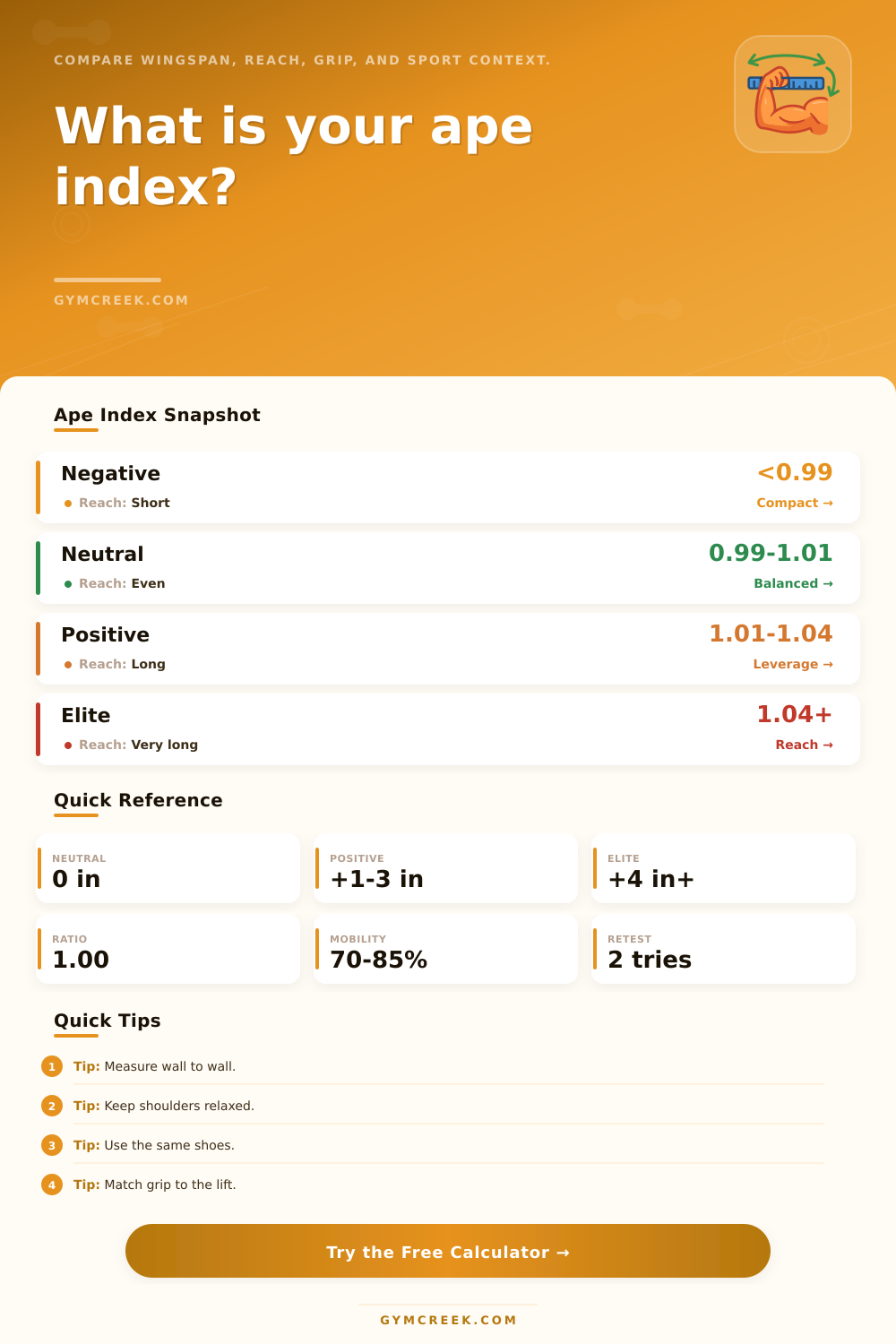
| Ape Index | Ratio Band | Reach Class | Interpretation |
|---|---|---|---|
| Negative | Under 0.990 | Compact | Shorter span than height; compact pressing may feel natural. |
| Neutral | 0.990-1.010 | Balanced | Wingspan and height are close; setup matters more than limb length. |
| Positive | 1.011-1.040 | Long reach | Extra reach may help climbing, pulling, defense, and lane coverage. |
| High positive | 1.041+ | Very long | Reach is a clear trait; control and joint position become important. |
| Context | Long-Reach Edge | Possible Tradeoff | Setup Cue |
|---|---|---|---|
| Climbing | Far holds and lock-offs | Wide moves stress shoulders | Keep scapula engaged |
| Deadlift | Shorter pull distance | Grip and lat tension matter | Pull slack before lift |
| Bench press | Less direct edge | Longer bar path | Use stable arch and touch point |
| Basketball | Contest, finish, rebound | Reach needs timing | Train high-point control |
| Swimming | Catch length and stroke reach | Needs shoulder rhythm | Do not overreach the catch |
| Olympic lifting | Rack and overhead options | Pull path can get long | Set grip by mobility first |
| Grip Style | Best Fit | Modifier | Watch For |
|---|---|---|---|
| Neutral grip | General lifting | Balanced | Wrists stacked |
| Wide grip | Bench, snatch, swim | Adds reach feel | Shoulder comfort |
| Narrow grip | Pressing, rings, calisthenics | Reduces reach | Elbow path |
| Hook grip | Deadlift and Olympic lifts | Grip security | Thumb tolerance |
| Open hand | Climbing | Finger reach | Tendon load |
| Limiter | Good Range | If Low | Training Note |
|---|---|---|---|
| Shoulder mobility | 75-90% | Reach stays theoretical | Use pain-free overhead work |
| Standing reach | 128-135% height | Check measuring setup | Retest with ribs down |
| Bodyweight class | Context-dependent | Compare within class | Leverage is not strength |
| Grip comfort | Stable and repeatable | Narrow the setup | Choose joint-friendly width |
💡Tips
You might see a deadlifter position themselves for a lift with very little range of motion. You might also see an ape climb onto a hold that looks impossible to reach from ground. In both cases, what you’re witnessing is ape index. Ape index measures your height against your wingspan.
Why does it matter? The way your body move under load affects how you choose your grip and meets the demands of your sport. After entering the variables (standing reach, wingspan, bodyweight, mobility rating, and grip style) the calculator do the rest of the math. Why do all that? Because long reach is almost never an isolated advantage.
How Your Body Helps You Play Sports
Does a long wingspan aid climbing? Maybe, if you have enough mobility to get your shoulder under full stretch while keeping your torso tight against a long bar path. Is a long wingspan a disadvantage on the bench press? It could of be a disadvantage if your mobility isn’t good enough and you are forced to go through a longer bar path. The tool allows you to choose the situation in which you want it used, and then it changes final score to match these tradeoffs.
For example, if you have a positive ape index as a climber, you can skip some intermediate hold, which is nice. If you’re a powerlifter with similarly proportioned body parts, you might notice less hip travel on the deadlift, though you need to pay closer attention to engaging your lats to prevent bar from wandering. Similarly, basketball players apply same measurement when going for rebounds and contesting shots, but their footwork and timing is what really make the extra inches turn into blocks or not. The calculator shows all of those differences without suggesting that one number are a magic bullet.
The other wrinkle is bodyweight class. Long-limbed athletes, such as calisthenics experts and climbers, often find that their reach allow them to support less weight per contact point than a lighter person. Conversely, heavy lifter such as those in rowing and deadlifting sometimes gain stability from these proportions because their extra mass helps keep bar close. With the tool, we plot your numbers into these real-world buckets so you can see how you stack up against folks who train similar.
Shoulder mobility vs. Grip style: These are distinct fields because they each change fraction of your hypothetical range that can be used. For instance, a wider grip provides more effective span for the bench press (or other) while requiring more external rotation from the shoulder. Lower mobility scores warn that this potential advantage remains theoretical until enough mobility exist in the joint to achieve it without compensations. That’s why the calculator doesn’t simply leave you guessing at these weights (it folds them into the final cue).
For similar reasons, training age is important. Beginners should prioritize a repeatable setup before chasing marginal reach gains. Instead, competitive athletes builds that base and use the measurement to dial-in touch point or grip width. Expectations adjust with output.
Now that you know what I think about measuring ape index, here’s the main point: When can you use your proportions? And when should you compensate for them? Here’s what I’d do: Take the measurement one time while standing up straight. Run the number through whatever applies to your sport. Use it as a set-up clue, not a verdict. Chances are that whether or not you have a long reach will depend largly upon how well the rest of your training supports it.