Ankle Dorsiflexion Angle Calculator
Estimate weight-bearing dorsiflexion angle, knee-to-wall equivalent, left-right difference, and target gap for squats, running, field sport, and return-to-training checks.
📌Presets
Presets load realistic ankle mobility screens and then recalculate the angle, target gap, and symmetry result.
⚙Calculator
Ankle dorsiflexion snapshot
Enter your ankle test numbers to estimate angle, symmetry, and target gap.
📊Fitness Metrics Comparison Grid
📑Reference Tables
| Knee-To-Wall Distance | Approx Angle | Training Read | Common Next Check |
|---|---|---|---|
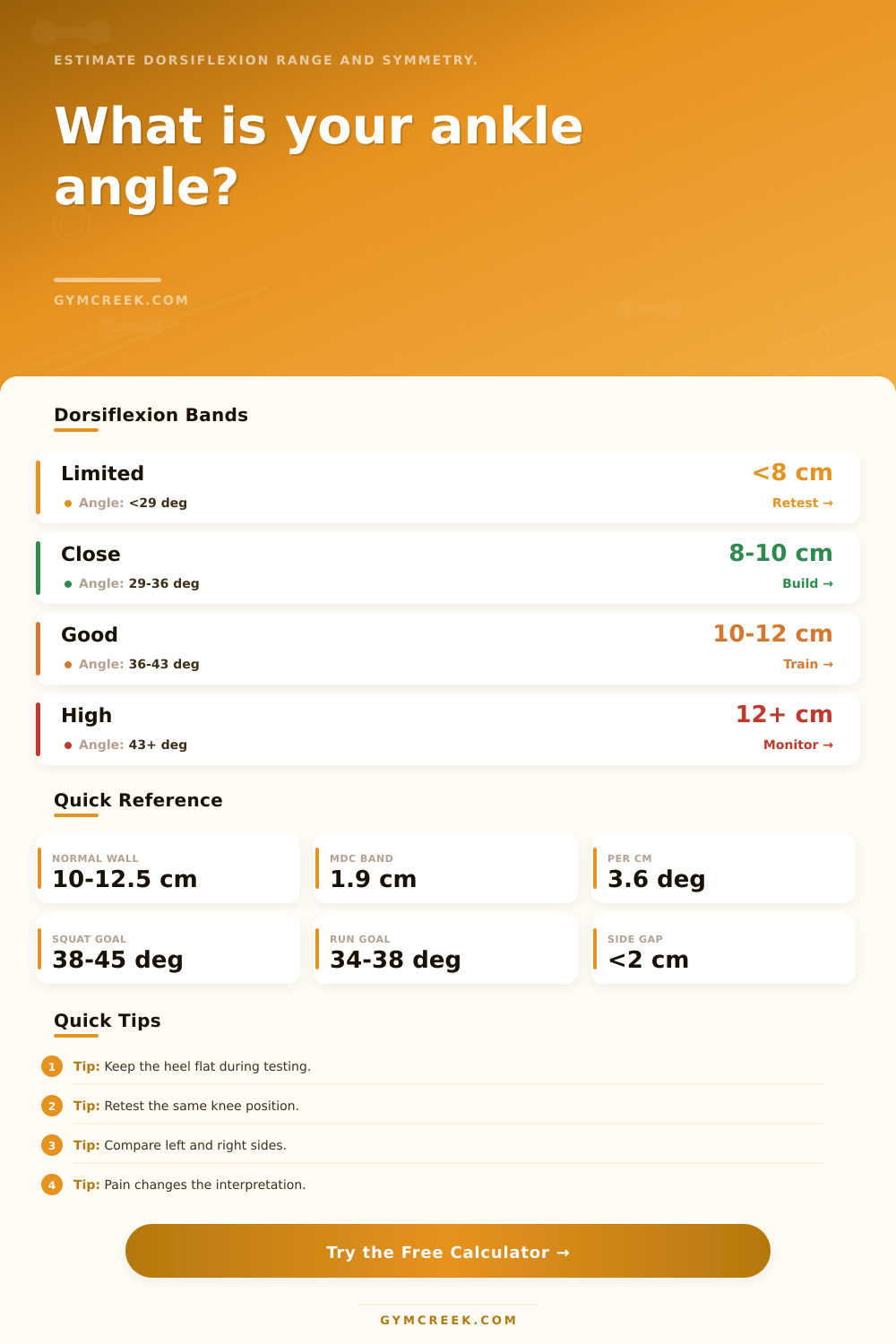
| Less than 8 cm / 3.1 in | Less than 29° | Limited for many loaded positions | Retest heel position and symptoms |
| 8-10 cm / 3.1-3.9 in | 29-36° | Usable but may restrict deep squat depth | Compare side-to-side difference |
| 10-12.5 cm / 3.9-4.9 in | 36-45° | Common functional band for training | Match the test to your sport stance |
| More than 12.5 cm / 4.9 in | 45° plus | High mobility if controlled and pain-free | Check calf strength and control |
| Training Target | Useful Angle Band | Distance Guide | Why It Matters |
|---|---|---|---|
| General lifting | 32-38° | 9-10.5 cm | Allows normal knee travel in lunges |
| Deep squat | 38-45° | 10.5-12.5 cm | Helps depth without heel rise |
| Running | 34-38° | 9.5-10.5 cm | Supports stride and landing mechanics |
| Court or field sport | 36-42° | 10-11.7 cm | Useful for deceleration and change of direction |
| Olympic lifting | 40-46° | 11.1-12.8 cm | Supports upright catch and receiving positions |
| Method | Best Use | Formula In Calculator | Watch For |
|---|---|---|---|
| Knee-to-wall | Field testing and retesting | Distance cm × 3.6 | Heel lift or foot turnout |
| Inclinometer | Direct tibia angle tracking | Direct angle blended when entered | Phone alignment on the shin |
| Goniometer | Open-chain clinical ROM | Direct angle reported with lower target | Different from loaded lunge angles |
| Combined check | Cross-checking field data | 70% direct, 30% distance estimate | Large mismatch means retest |
| Formula | Variables | Output | Use |
|---|---|---|---|
| Wall angle estimate | Toe-wall distance | Dorsiflexion angle | Quick WBLT conversion |
| Tibia travel geometry | Distance, foot, tibia | Shin inclination check | Flags unusual body-measure effects |
| Symmetry deficit | Test side, other side | Degrees and distance gap | Side-to-side comparison |
| Readiness score | Target, gap, pain, heel | 0-100 score | Training context only |
💡Testing Tips
How well do you move your ankles? The knee-to-wall test answer that question. Stand facing a wall, then put one foot out in front at a specific distance from the wall. Keep your heel down as flat as possible against the ground. Now attempt to bring your knee to the wall.
At least initially, this seem more like a geometry quiz than anything else. Before you reach the wall, your shin seem to hit some kind of stop. That’s typically your maximum amount of ankle dorsiflexion. This determine how deeply you can squat. It also impacts how you land after jumping and whether your calves feels tight afterward.
How to Use the Knee-to-Wall Test Tool
But the tool above converts that tactile sensation into numbers, degrees of movement. This help you stop guessing what “good” mobility feels like for you. So here’s how it works: Distance from your toe to the wall = Lever arm The tool accounts for limb proportions to convert distance into an angle estimate. Why? Because we’re used to comparing inches (or centimeters) as if they were equal. Shorter legs vs. Longer legs. The mechanics are different.
So the tool takes that into consideration once you enter in your measurements. No more vanity metrics. It is just a practical range estimate. Next, it queries you on quality of your heel lift. That’s the most difficult portion of the test, keeping the back of your heel grounded. Any time your heel come up, then you’re not measuring ankle mobility. You’re just measuring how far you can bend at your knee with toes on the ground.
Admitting the heel came off result in a drop in the score. And that is fair. We want an accurate measurement. We want to track progress honestely. The other half of the story that few people think about until it hurts is symmetry. Everyone has their favorite leg. It’s typically whichever one they put weight on more in an office job or an awkward conversation.
And that dominant leg tend to have just a little bit more range. But when your left and your right are very different than each other, that’s a red flag for potential injury. The system will compare them and let you know precisely what side you’re out of whack on. Generally speaking, anything under two centimeters is safe noise. If it’s larger, then one side may be picking up the slack for the other while you’re sprinting or carrying heavy loads. Perfect symmetry isn’t necessary. It is important to know which ankle is doing way less work.
But there’s a catch: context matters. An Olympic weightlifter need more dorsiflexion to receive a clean in a deep position than a distance runner does. That’s why the tool loads those objectives into its presets. What you do then is see how mobile you are relative to what’s required of you in your sport. Are you lifting heavy squats? The target angle will be higher. You want to stand up tall and not lean over too far. Why? Because when you lean forward, you shift the load off your quads and onto your lower back. It is rarely good.
These bands outline the ranges clearly in the reference tables. Now you can assess whether you’re in a functional range or pressing up against a hard limit. Numbers shouldn’t trump pain. When you get that stinging pinch on the front of your ankle joint, you’re done. That’s usually a sign that you aren’t stretching tissue as much as you are jamming bone into bone. That’s why there’s a pain rating section on the tool.
High angle + high pain = bad. Low angle + no pain = good. You want mobility work to be more like releasing tension versus weakening structure. Most people rush through calf stretches and forget to address the joint capsule or neuromuscular control around the ankle. Static holds help, but dynamic movement patterns tend to translate more to the real deal training sessions.
Don’t check-in every day. Check in every month. Things like fatigue from your last workout, hydration levels, and the time of day will cause daily variations. Any individual number would of told you less than what the trend line does. Slow, steady improvement coupled with stable numbers indicates the routine is doing its job. That’s what you’re looking for: that tiny bit of wiggle room you need to get your knees past the wall safely.
The idea isn’t turning into some sort of contortionist. It’s creating space. This space allows your strength training to be limited by muscle failure rather than joint restriction. Trust the process, keep your heel down and let the geometry handle the heavy lifting. Focus on the quality of the movement.