Altitude Acclimatization Calculator
Build an altitude arrival plan from home altitude, target altitude, ascent speed, sleep quality, prior exposure, training intensity, oxygen strategy, and pace adjustment needs.
⛰Altitude Scenario Presets
Presets are planning examples for athletes, hikers, and travelers. Replace them with your real itinerary, symptoms, and coaching or medical guidance.
⚙Calculator Inputs
Acclimatization snapshot
Enter your route and training plan to estimate adjustment needs.
📊Metrics Grid
📘Calculation Rules
📑Altitude Reference Tables
| Sleeping altitude | Common effect | Training cue | Planning note |
|---|---|---|---|
| Under 5,000 ft | Usually minor | Normal training for most people | Sensitive athletes may still notice travel fatigue |
| 5,000 to 8,000 ft | Pace and sleep may shift | Keep first workout controlled | Arrive one to three days early when possible |
| 8,000 to 11,500 ft | Breathing and recovery change | Reduce intensity and watch symptoms | Staged ascent is strongly preferred |
| Above 11,500 ft | Higher illness risk | Avoid hard work until stable | Use conservative ascent and descent rules |
| Profile | Best use | Risk effect | Adjustment |
|---|---|---|---|
| Fly or drive same day | Short trips and races | Raises risk quickly | Keep first 24 to 48 hours very easy |
| Staged ascent | Events above 8,000 ft | Moderates risk | Add lower sleep stops when possible |
| Gradual ascent | Trekking and camps | Best default | Increase sleep altitude slowly after 9,000 ft |
| Climb high, sleep low | Mountain routes | Can help adaptation | Use only if recovery remains good |
| Session type | First 48 hours | Day 3 to 5 | Watch point |
|---|---|---|---|
| Rest or walking | Best for fast arrivals | Build if sleep is stable | Headache trend |
| Easy aerobic | Often acceptable | Progress duration before intensity | Breathing at easy pace |
| Moderate workout | Usually delay | Use shorter repeats or lower power | Recovery heart rate |
| Hard race or summit | Highest stress | Needs the largest buffer | Symptoms override goals |
| Signal | Meaning | Action | Do not ignore |
|---|---|---|---|
| Mild headache | Common early sign | Rest, hydrate normally, avoid alcohol | If it worsens overnight |
| Nausea or vomiting | Possible altitude illness | Stop ascent and consider descent | Repeated vomiting |
| Poor coordination | Danger sign | Descend and seek urgent help | Confusion or stumbling |
| Breathless at rest | Danger sign | Descend and seek urgent help | Blue lips or severe fatigue |
💡Altitude Planning Tips
An altitude acclimatization calculator are a tool that can help you plan for the changes in oxygen pressure. When you travel to higher altitude, the oxygen pressure in the air decrease. That decrease in oxygen pressure can impact your ability to:
train
recover
perform physical activity
The altitude acclimatization calculator can help to ensure that you arrange your travel plan and itinerary in a way that minimize the guesswork that you must perform in creating an acclimatization plan for yourself.
To utilize an altitude acclimatization calculator, you will have to provide several different input into the calculator. Such inputs can include your home altitude, your target sleep altitude, the number of days that you have available before you must reach your goal, your ascent profile, your training and sleep expectations, your level of exposure to altitudes prior to this trip, and any altitude strategy option that you have for your trip. The altitude acclimatization calculator will provide you with several different output based off the input that you provided.
How to Use an Altitude Acclimatization Calculator
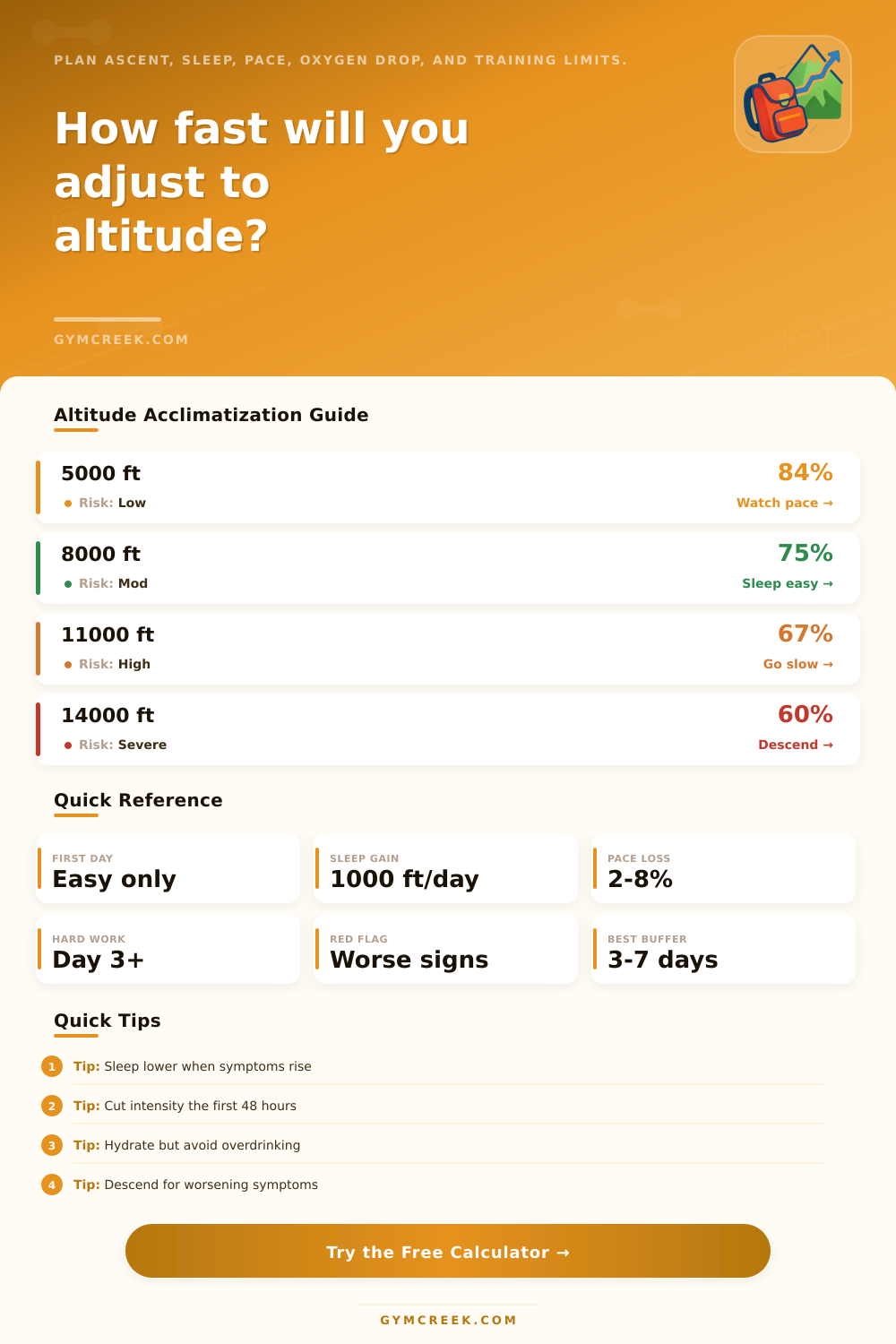
These outputs can include a readiness score, a suggested buffer in days, an estimated pace penalty, and a risk category. Your readiness score and risk category will establish a limit as to the level of activity that you can perform. For instance, if your risk score are moderate and you are provided with a suggested buffer of three days, it means that you can perform activities, but your first forty-eight hours should be performed at an easy pace.
A high risk score, however, will provide you with a suggestion that your travel plan may be more physically difficult than you have estimated, and you may have to plan for descent options along your travel route. Finally, the pace adjustment will provide you with an estimate of how much slower your performance will need to be with your physical activities while at altitude. There are reference tables included within the altitude acclimatization calculator that provide a detailed explanation of the calculations.
These tables will show you that sleeping altitude is more important than the high points that you will reach during the day, that your first two days at altitude should be conservative in their physical activity, and that your ascent speed will impact the level of training that you can perform. Additionally, a symptom guide are included in the altitude acclimatization calculator. Because the calculator will not be able to detect any physical symptoms that you may be experiencing (like headaches), if you do experience such symptoms, you should stop using the altitude acclimatization calculator and descend to a lower altitude immediately.
An altitude acclimatization calculator will consider sleep disruption during your travel. For instance, sleeping at high altitudes for short periods of time can increase your resting heart rate. Additionally, sleeping at high altitudes for short periods of time can reduce your ventilatory drive, and your ability to perform physical activities can decrease as a result.
Because of these factor, an altitude acclimatization calculator provides for sleep quality to be one of the most important factor in the calculation of your ability to perform physical activities at altitude. Additionally, if you have recently been exposed to altitudes, you will receive some credit for that exposure, but the benefits of such exposure fade quickly with time. Therefore, the calculator will provide only a modest credit for your recent exposure to altitude.
The output of an altitude acclimatization calculator should be used as a minimum guideline for your travel. For instance, the suggested buffer in days is the minimum amount of time that you should allow before you can begin to perform any hard sessions or races. An additional day should be provided if you have poor sleep, if you are not properly hydrated, or if you feel ill.
Additionally, your physical load should be at or below the load that the altitude acclimatization calculator calculated during your first forty-eight hours at altitude. Even if you feel good after the first forty-eight hours, you should still adhere to the load cap that the altitude acclimatization calculator calculates. This is because the effect of altitude may not be immediately visible in the early portion of your travel.
Thus, your physical signals will match the numbers that the altitude acclimatization calculator provided, or you can use the plan to adjust your physical activities early during your travel to high altitudes.