Allometric Strength Calculator
Normalize a lift by body mass using an exponent model, compare it with simple strength-to-weight ratio, and translate the result to a reference bodyweight without pretending every kilogram scales the same way.
📌Allometric Strength Presets
Each preset loads a different lift, body size, rep range, and exponent. The point is not just a bigger estimated max; the calculator asks how much of that max remains after bodyweight scaling.
⚙Calculator Inputs
Allometric strength snapshot
Enter bodyweight, lift, reps, exponent, and reference bodyweight to compare scale-adjusted strength.
📊Fitness Metrics Grid
📑Reference Tables
| Use case | Typical exponent | Why it is used | Calculator default |
|---|---|---|---|
| General strength normalization | 0.67 | Two-thirds power often approximates how strength scales with body mass and cross-sectional area | Default for squat and custom tests |
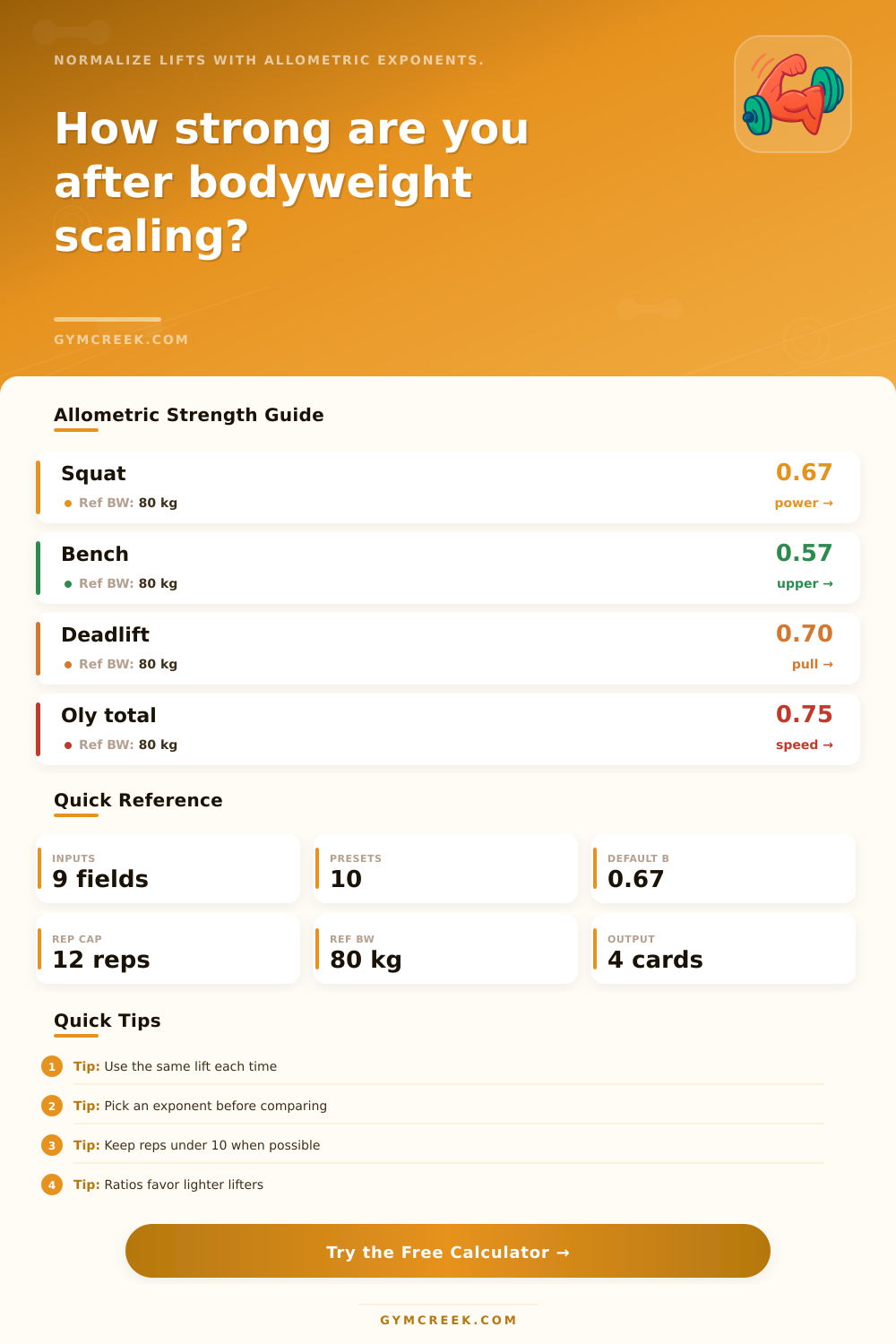
| Upper-body barbell lifts | 0.55 to 0.60 | Bench and press performance can show a slightly lower mass exponent than lower-body pulls | 0.57 for bench, 0.60 for overhead press |
| Heavy pulling strength | 0.68 to 0.72 | Deadlift and loaded pulls often retain more benefit from larger total mass | 0.70 for deadlift and weighted pullup |
| Olympic lifting total | 0.73 to 0.78 | Explosive totals blend strength, speed, leverage, and body mass effects | 0.75 for Olympic total |
| Simple strength ratio | 1.00 | Dividing max by bodyweight is easy but usually over-rewards lighter athletes | Shown only as a contrast |
| Lift group | Developing | Solid | Advanced |
|---|---|---|---|
| Back squat score | Under 14.0 | 16.5 to 20.5 | Over 20.5 |
| Bench press score | Under 10.0 | 12.0 to 15.5 | Over 15.5 |
| Deadlift score | Under 16.0 | 19.0 to 24.0 | Over 24.0 |
| Overhead press score | Under 6.5 | 8.0 to 10.5 | Over 10.5 |
| Olympic total score | Under 22.0 | 27.0 to 34.0 | Over 34.0 |
| Weighted pullup total score | Under 8.5 | 10.5 to 14.0 | Over 14.0 |
| Scenario | Bodyweight | Max lift | Allometric read |
|---|---|---|---|
| Lighter lifter with a high ratio | 60 kg | 120 kg squat | Excellent ratio, but exponent scaling softens the advantage |
| Middleweight balanced lifter | 82 kg | 185 kg squat | Often looks similar under ratio and allometry near the reference size |
| Heavy lifter with large absolute load | 120 kg | 255 kg squat | Ratio may look modest while allometry gives more credit for mass scaling |
| Upper-body specialist | 75 kg | 130 kg bench | A lower exponent can separate bench-specific strength from body size |
| Olympic total comparison | 90 kg | 260 kg total | A higher exponent reflects the event's body-mass and power relationship |
| Step | Formula | Variables | Purpose |
|---|---|---|---|
| Rep max estimate | Estimated max = load x (1 + reps / 30) | Load, reps capped at 12 | Converts a rep set into a comparable max estimate |
| Allometric denominator | Denominator = bodyweight kg ^ exponent | Bodyweight, selected b | Prevents bodyweight from being treated as a linear divisor |
| Scaled score | Score = max kg / denominator | Estimated max, denominator | Main allometric strength result |
| Reference max | Reference max = score x reference kg ^ exponent | Score, reference bodyweight | Shows the equivalent lift at a chosen body size |
| Ratio bias | Bias = simple ratio index - allometric index | Bodyweight, reference weight | Shows whether ratio is flattering or harsh compared with allometry |
| Band lookup | Score compared to lift-specific bands | Lift type, sex category | Provides a broad training context without official ranking claims |
💡Allometric Notes
When two lifter of different masses are lifting the same weight on a barbell, it is easy to assume that the lifter with the higher body mass worked harder to lift the weight. This assumption, however, is typicaly incorrect due to the fact that the strength of an individual’s body does not have a linear relationship to the mass of that individual’s body. An individual with a higher body mass typically has extra tissue in there body that does not contribute to they strength; thus, it is necessary to determine whether the extra mass of the stronger individual is an advantage to their performance in lifting weights or a disadvantage to their performance in lifting those weight.
Allometric scaling can be used to solve this problem with the use of a single exponent. The allometric exponent will be a number between zero and one, and it will recognize that the growth of an individual’s strength do not have the same relationship to their body mass as the growth of their body mass with age. Furthermore, different lift will have different allometric exponents, based off the body’s leverage in performing those different types of lifts.
How to Compare Strength of Lifters with Different Body Sizes
Thus, it is necessary for individuals to choose the appropriate allometric exponent to reflect the specific type of lift that is to be performed. A calculator can be used to calculate these exponents for lifters of any size. To use the calculator, the lifter can provide the body weight of the lifter, the specific type of lift that they performed, the load that they lifted, and the number of repetitions that they performed.
The calculator can utilize these values to determine the lifter’s allometric score, which will be expressed in the same units as other lifters of any size. Furthermore, the calculator can also reveal the value of that allometric score at a reference body weight, which allows for the body weights of those lifters to be accounted for in the comparison of their relative strength. The calculator allows lifters to compare their performance in relative terms to other lifters’ performance in the same types of lifts.
However, people typically use the simple ratio of the strength to the weight of the lifters in the gym settings, as it is much easier to calculate the strength-to-weight ratios than to input the data into the calculator. Furthermore, because people typically calculate the strength-to-weight ratios without the use of additional arithmetic, these ratios tend to reward lifters with lower body weights than the physiology of the human body justifies. The calculator can reveal these inaccuracies in calculating strength-to-weight ratios by comparing the value of the strength-to-weight ratio to the allometric score.
The difference between these two numbers indicates whether the simple ratio overestimated or underestimated the true strength of those lifters. The calculator allows these comparisons to be made when lifters are tracking their performance in weight cutting or bulking. Because lifters of all ages and experience levels have different abilities, it is additionally necessary for the calculator to account for the training age and experience of the lifters.
For instance, novice lifters often have a better grasp of the techniques necessary to perform the required lifts. Furthermore, returning lifters often have some degree of fatigue remaining in their muscles after performing their lifts. These two factor can affect the allometric score calculated by the calculator.
Thus, the calculator will account for the training age and experience of the lifters to help adjust the confidence interval for the score provided to the lifters. The allometric score itself will not change based upon these factors, but the interpretation of that score will. An individual’s height is also related to their strength.
While height is not directly accounted for in the calculations of the allometric exponent, the height of the lifters can be accounted for in the calculation of the amount of work that they perform in performing those lifts. For instance, lifters of greater heights will have a greater range of motion in performing the lifts. Thus, the calculators will record the height of the lifter as a means of providing context to their relative strength, but it will not be used in any calculations of the allometric exponent.
For the same reasons that the height of the lifter is not accounted for in the calculations of the allometric exponent, the length of the limbs of the lifters is also not accounted for in the calculations. The length of the limbs of the lifters could not of been easily accounted for in calculations using simple numbers. Thus, although the allometric score is a useful measurement of the strength of an individual, it isnt a complete measurement of the strength of that lifter.
For the calculator to provide accurate results, the conditions in which the lifters performed the stated number of repetitions of the specified lifts must be consistent. For instance, if any of the other variables than the body weight, lift type, load lifted, and number of repetitions are changed, the results will change. Thus, the allometric score will only be accurate if these variables are held constant.
Thus, if the conditions are held constant, the allometric score can be accurately used to determine whether the added body mass of a lifter is increasing their proportional strength or acting as a ballast.