Air Force PT Test Calculator
Estimate PFRA component points, minimums, pass status, and score tradeoffs using age group, sex, event choices, and body composition inputs.
📌Presets
Presets load realistic test combinations and immediately recalculate so you can compare event options quickly.
⚙Calculator
PT test estimate
Enter your events and calculate the component score estimate.
📊Fitness Metrics
📑Reference Tables
| Component | Max points | Minimum value | Calculator method |
|---|---|---|---|
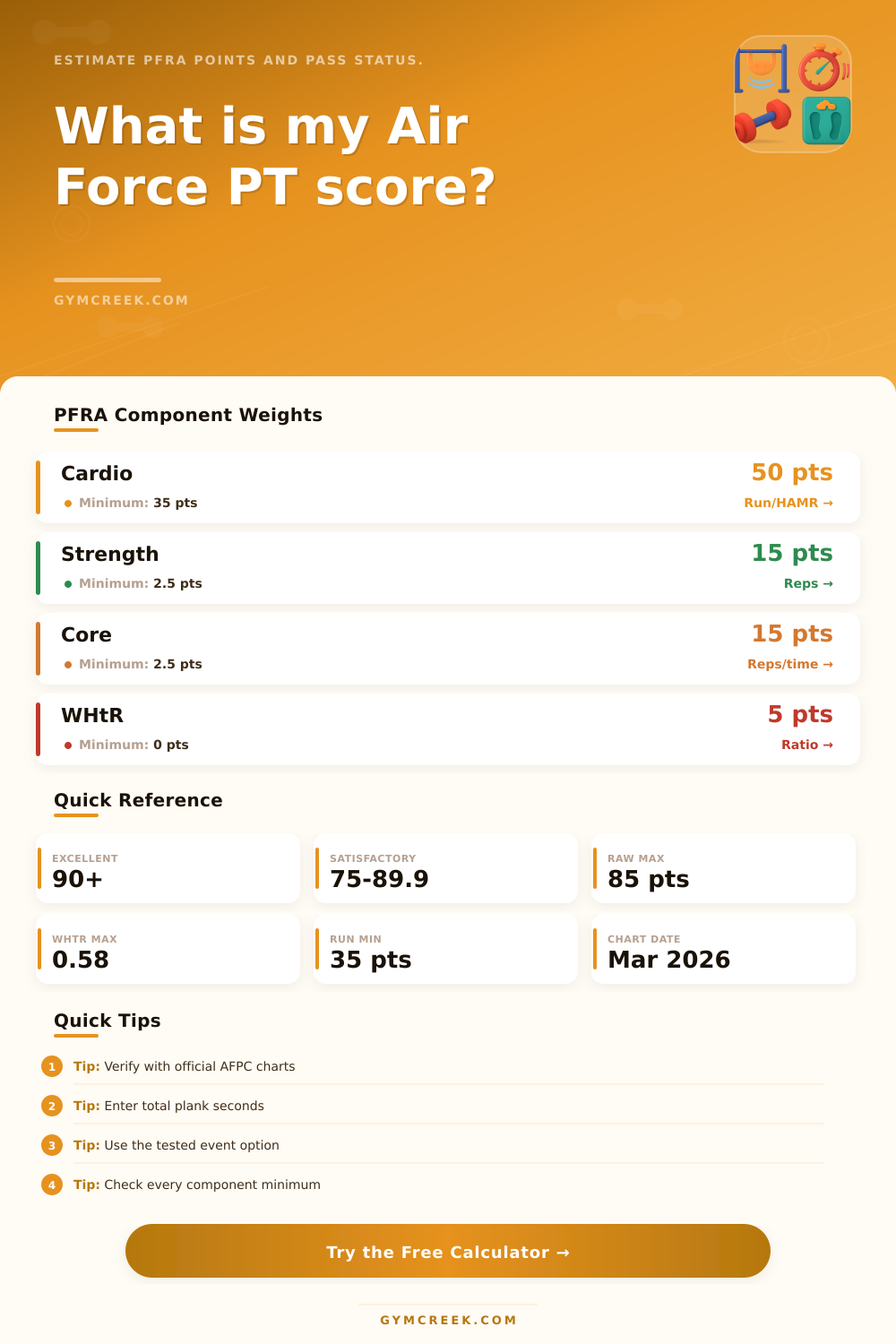
| Cardiorespiratory fitness | 50 | 35 planning points | Interpolates run or HAMR threshold |
| Muscular strength | 15 | 2.5 planning points | Age and sex rep threshold |
| Core endurance | 15 | 2.5 planning points | Rep or plank time threshold |
| Waist-to-height ratio | 5 | 0 if high risk | Waist divided by height |
| Age group | Male max push-up | Female max push-up | HAMR max M/F |
|---|---|---|---|
| Under 25 | 67 | 50 | 87 / 68 |
| 25-29 | 63 | 47 | 85 / 65 |
| 30-34 | 60 | 44 | 84 / 63 |
| 35-39 | 56 | 42 | 82 / 63 |
| 40-44 | 52 | 39 | 81 / 59 |
| Score band | 100-scale equivalent | Raw equivalent | Meaning |
|---|---|---|---|
| Excellent | 90.0+ | 76.5+ | Strong total score |
| Satisfactory | 75.0-89.9 | 63.8-76.4 | Passing total if minimums met |
| Unsatisfactory | Below 75 | Below 63.8 | Total score is short |
| Component fail | Any score | Any score | One event missed minimum |
| Event choice | Input format | Best check | Common mistake |
|---|---|---|---|
| 2-mile run | Minutes.seconds | 15.30 means 15:30 | Entering 15.5 for 15:50 |
| HAMR | Total shuttles | Count final completed shuttle | Using level instead of shuttle count |
| Forearm plank | Total seconds | 3:00 equals 180 | Entering minutes only |
| WHtR | Same units | Waist / height | Mixing inches and cm |
💡Tips
For many people, running the Air Force physical fitness test isn’t like hitting gym; it’s like getting audited on your life. They show up with a waist tape in hand and a stopwatch around their neck, feeling anxious that they haven’t trained enough for one part of the test. That part of the test has strict math to it because it doesn’t leave any wiggle room for fuzzy effort. If you’re not at least the minimum score in each event, you’ve failed the whole thing, period.
That’s what creates this all-or-nothing pressure that leads most Airmen to pull out a calculator before lacing up their running shoe. And it’s much more accurate with the scoring changes. This time around, the Physical Fitness Assessment is broken up into different area. The areas includes body composition, core endurance, muscular strength, and cardiorespiratory fitness.
How to Use the AFPT Score Calculator
All are important in their own right. Run a speedy two-miler and can’t crawl an inch on your belly? Tough luck. When you input your information, sex, age, events, the calculator does all that math for you. Then it determines where you fall on the AFPC charts. You won’t need to furiously flip through a spreadsheet while gasping for air between push-ups.
The problem with most plans is that no one understands their input variables. For example, the system split core endurance into forearm planks, crunches, or situps. It also splits strength into hand-release pushups or regular pushups. That’s fine if you’re savvy about how your body works. Do you have weak shoulders but strong legs? Can you hold a plank for minutes but only do 10 crunches? You can switch them out and see what combo produces the highest total with this tool.
If you’re stronger at holding a plank than you are at doing crunches, it shows the benefit of replacing a traditional situp with a cross-leg reverse crunch. That’s where the real power lies: in knowing when to trade off events. It’s not that simple, because there’s body comp to consider. There are also five bonus points if your waist-to-height ratio is good enough. In other words, it takes away an opportunity for people who have bigger muscles to cheat the system. If someone is lean but has bad fitness numbers, they’re considered higher risk compared to someone who has more mass but has more elite fitness in the new system.
The ratio gets plugged into the calculator itself and displayed on the results page to let you know instantly how much you need to change based off where you fall right now. Knowing that instant number will alter everything about what you do during your next training and diet cycle. Everyone’s age bracket moves around. As you age, so do expectations. But the adjustment is never large enough to make you think you got a freebie. Just being an Airman who’s thirty doesn’t suddenly mean they score better than a guy who’s twenty-two.
Sure, they don’t have to do as many reps and they’ve had a little longer to build up points on the clock…but the bar stays high; the standard of excellence stays high. And those preset profiles in the tool mimic this. Load one for a senior airman and you’ll notice how your points adds up differently than aging. It shows why you must begin early. Because if you fall off at twenty-five, it’s difficult to catch back up at thirty.
It’s often only five points between good enough and outstanding. And that’s typically five points of core or strength, which are easier to gain by doing one more rep than by shaving a second off a run time. Because cardio has the biggest “Wow!” factor, that’s what most people obsess over; they neglect to realize that doing 10 more pushups might be more valuable then running half a minute faster. You have to look at the breakdown the estimator provides to shift that mindset.
What it will do is tell you which piece of the puzzle is easiest for you to improve based on your background. When you look at the numbers, test preparation turns into a time/energy management game. There’s only so much time and energy available. You could spread out evenly, which feels fair but typically leaves you with mediocre scores everywhere. It is better to target your weak components while keeping your strong ones intact, giving better overall results. The tool lets you safely model that set of tradeoffs.
Try this mix and that one… Different times and rep counts, to discover your best balance before stepping onto the actual testing line. Every time: Preparation is better than panic. By knowing the points that are required for you to make your score, you alleviate any pressure that comes with being in front of the machine. Because you’ve prepared beforehand, you’ll know right when you walk into formation exactly where you stand.
You still have to worry about hitting those strict minimum requirements, but the machine handles the interpolation so you don’t have to. Your job is to give it the data and let it do the math. What once was a stressful audit becomes something totaly predictable. Service fitness isn’t measured by who’s the strongest in the room.
Service fitness is about having your head on a swivel, day after day, month after month, year after year. This is how you know if you’re keeping up; this is how you measure yourself against the standards. With this as your guide, prepare for each cycle of training and check where you are. Because this isn’t about passing. This is about establishing a level of fitness that carries you through whatever duty or deployment comes next. And that’s where it all begins, knowing the score before you start doing the work.