Air Force PFA Calculator
Estimate Air Force physical fitness readiness points from age, sex, body size, waist-to-height ratio, aerobic event, push-ups, and core option.
📌PFA Presets
Presets load realistic assessment snapshots. Adjust any field to model your own official event choices.
⚙Calculator Inputs
PFA score snapshot
Enter component results to estimate pass status and point distribution.
📊PFA Metrics
📑Reference Tables
| Result | Composite | Component rule | Meaning |
|---|---|---|---|
| Excellent | 90.0 and up | All minimums met | Strong passing score |
| Satisfactory | 75.0 to 89.9 | All minimums met | Passing score range |
| Unsatisfactory | Below 75.0 | Or minimum missed | Retest or fail risk |
| Minimum gate | Required | Each component | Composite alone is not enough |
| Component | Max points | Typical minimum | Calculator input |
|---|---|---|---|
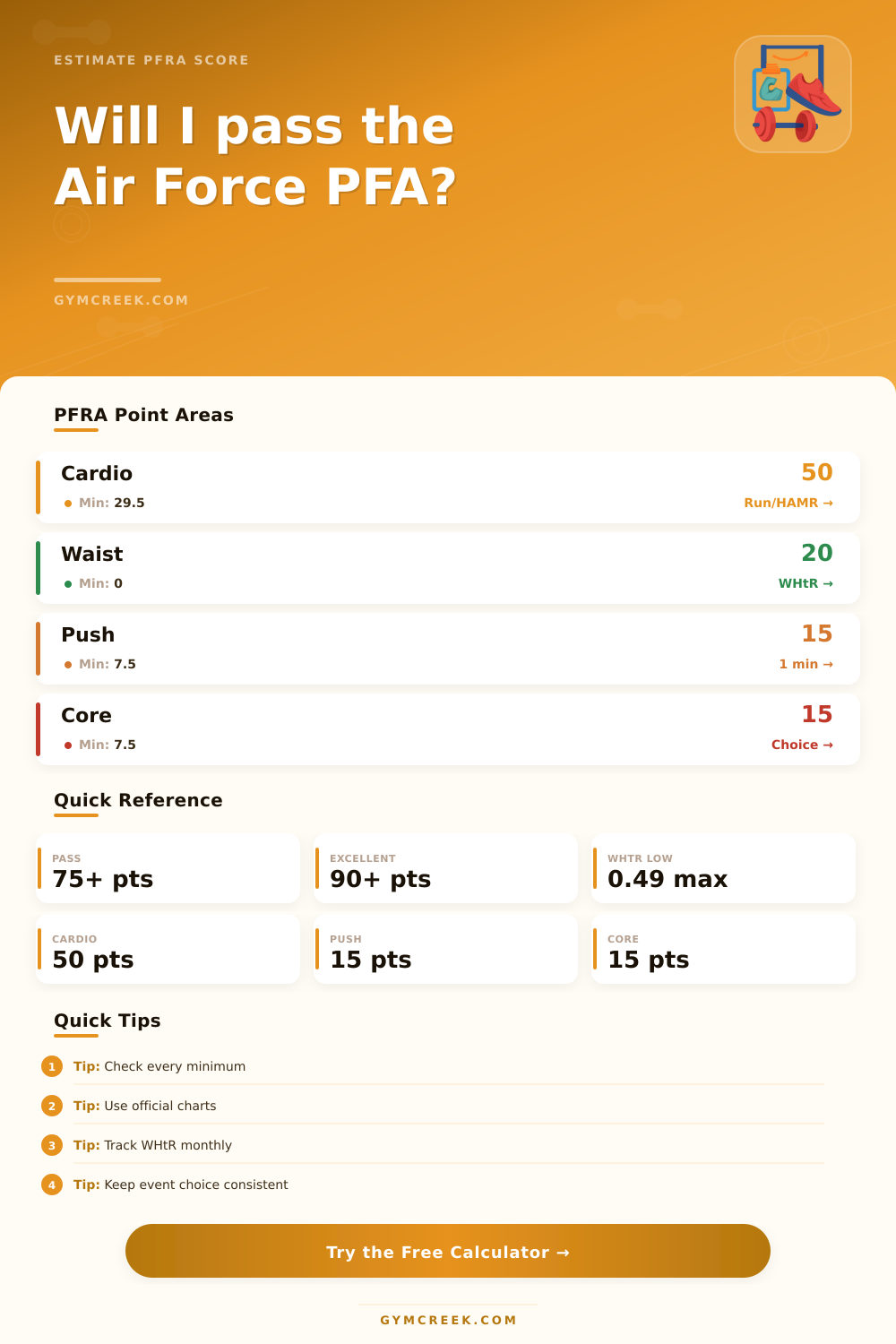
| Aerobic fitness | 50 | 29.5 points | 2-mile, 1.5-mile, HAMR, or walk |
| Body composition | 20 | No fixed minimum | Waist-to-height ratio |
| Upper body | 15 | 7.5 points | Push-ups or hand-release reps |
| Core fitness | 15 | 7.5 points | Sit-ups, crunches, or plank time |
| WHtR | Risk band | Estimated points | Action |
|---|---|---|---|
| 0.49 or less | Low | 20 | Maintain measurement habits |
| 0.50 to 0.54 | Moderate | 15 to 19 | Watch trend and consistency |
| 0.55 to 0.59 | High | 2.5 to 12.5 | Prioritize body composition |
| 0.60 and up | High | 0 | Official review recommended |
| Output | Method | Inputs | Use |
|---|---|---|---|
| Composite | Component sum | Cardio, WHtR, push, core | Pass estimate |
| Run points | Age/sex interpolation | Event time or HAMR reps | Aerobic estimate |
| WHtR points | Official risk bands | Waist / height | Body composition |
| BMR/TDEE | Mifflin-St Jeor | kg, cm, age, sex | Fitness context |
💡Tips
So when you get word, usually on a Tuesday morning… That it’s your time for the Physical Fitness Assessment, it isn’t anything dramatic. But it breaks up your day and tells you something that you haven’t known before: You’re going to be slightly more different than you were just moments ago. Your physical profile is shifting, and now you have an actual timeline on the idea of being in shape.
And even though that timeline is intended to be fair to everyone regardless of age, it’s still a personal assessment; it compares you against a grid. The grid doesn’t factor in injury or a particularly stressful week at work. Once you know what that grid is, you can use it as a tool to plan ahead rather than freak out.
How to Prepare for the Physical Fitness Test
These scores is broken down into four categories that make up a one-hundred point total. Fifty of those points come from cardiovascular fitness, unsurprising given the nature of their work. Twenty are for your body composition. The other half (thirty) are split evenly between your core and upper-body fitness. That breakdown indicates where Air Force places its priorities: endurance first, then health second, and strength third. It may not be great news if you’re someone who prefers to lift weights more than run long distances, but it does make sense when you consider how the Air Force operates.
While many Airmen obsess over their overall score, they tend to overlook minimum standard for each section. That’s a mistake. You might get killer scores in every event except one, yet still fail the assessment because you fell below the bar in that single category. The gates is all handled by this calculator, which displays whether you’ve met the bare minimum for any given event, regardless of how many additional points you earn towards your final tally. Think of it as a safeguard. Just because you’re crushing everything else doesn’t mean a deficiency elsewhere will go unnoticed.
The reason is the waist-to-height ratio. It’s a waist-to-height ratio instead of weight-based, which confuses people regarding body composition, but the thing is, it makes sense, it’s correlated with metabolic risk and doesn’t need fancy scans. How: Divide your waist size in inches (or centimeters) by your height in inches (or centimeters). That result is your WHtR. A WHtR under 0.5 earns most points. For reference, this ratio predicts health outcomes better then BMI. What: So while BMI is about weight-to-height ratio, this one is really about how much fat is stored centrally around your organs.
These categories use age brackets and sex. These scorecard systems level the playing field for older personnel. They take into account your age bracket. The time standards are based off a large dataset and represent the norm for populations, not elite athletic performance. To pass the Physical Fitness Assessment, you must be fit. But you don’t have to run marathons. It’s better to maintain a steady pace instead of trying to sprint and burn yourself out early, this results in poor form on later events. You should of known that.
The aerobic portion establish the tone for the remaining test. It burns through the body’s energy stores required for muscular components. Unlike the previous generation of tests, there are options in the upper body and core portion. Your upper body choice is either hand-release push-ups or straight up push-ups. For core, you’ll pick one: Planks, Reverse Crunches or Sit-Ups. So you can play into what’s strong for you, but still get the minimum required. But don’t let these options become an excuse to not train your weak spots. They’re tools, not loopholes.
This isn’t about heroics, it’s about habit: training for the assessment. It doesn’t matter as much how hard you train; it matters how consistently you train. One brutal workout per week (at the risk of injury or exhaustion)… Is inferior to a quick run each day. Same goes with weight management and nutrition. Make small, sustainable changes to what you eat and move yourself toward, and you’ll see improvements in both your times and ratio over time. Crash diets don’t work. You’re creating a baseline that enables your career, not scrambling for a number for an afternoon.
As testing day approaches, make sure that your prep looks and feels like something you know how to do. Use the tools above to visualize where you are before you set foot on the track. Test out various scenarios. Cross-check minimums. Take the guesswork out of it. Fitness is both a number and an attitude. Once you accept the system’s logic instead of trying to fight it, anxiety dissapears. On test day, you’ll welcome the notification as nothing more than another routine check in with what you’re capable of doing.