Air Force Fitness Assessment Calculator
Estimate an Air Force-style fitness assessment score from age, sex, body size, aerobic event, push-up option, core option, profile context, and training activity level.
📌Assessment Presets
Each preset loads a realistic assessment pattern. The score is an estimator for planning, not an official chart replacement.
⚙Calculator Inputs
Assessment score snapshot
Enter your event results to estimate score, category, and the component most worth improving.
📊Fitness Metrics
📑Reference Tables
| Band | Score range | What it means | Next check |
|---|---|---|---|
| High readiness | 90 to 100 | Strong margin if all components are valid | Keep event balance |
| Passing | 75 to 89.9 | Pass estimate with smaller buffer | Protect weakest event |
| Borderline | 70 to 74.9 | Close to passing threshold | Retest priority gap |
| At risk | Below 70 | Needs component improvement | Confirm official chart |
| Component | Max points | Primary input | How to interpret |
|---|---|---|---|
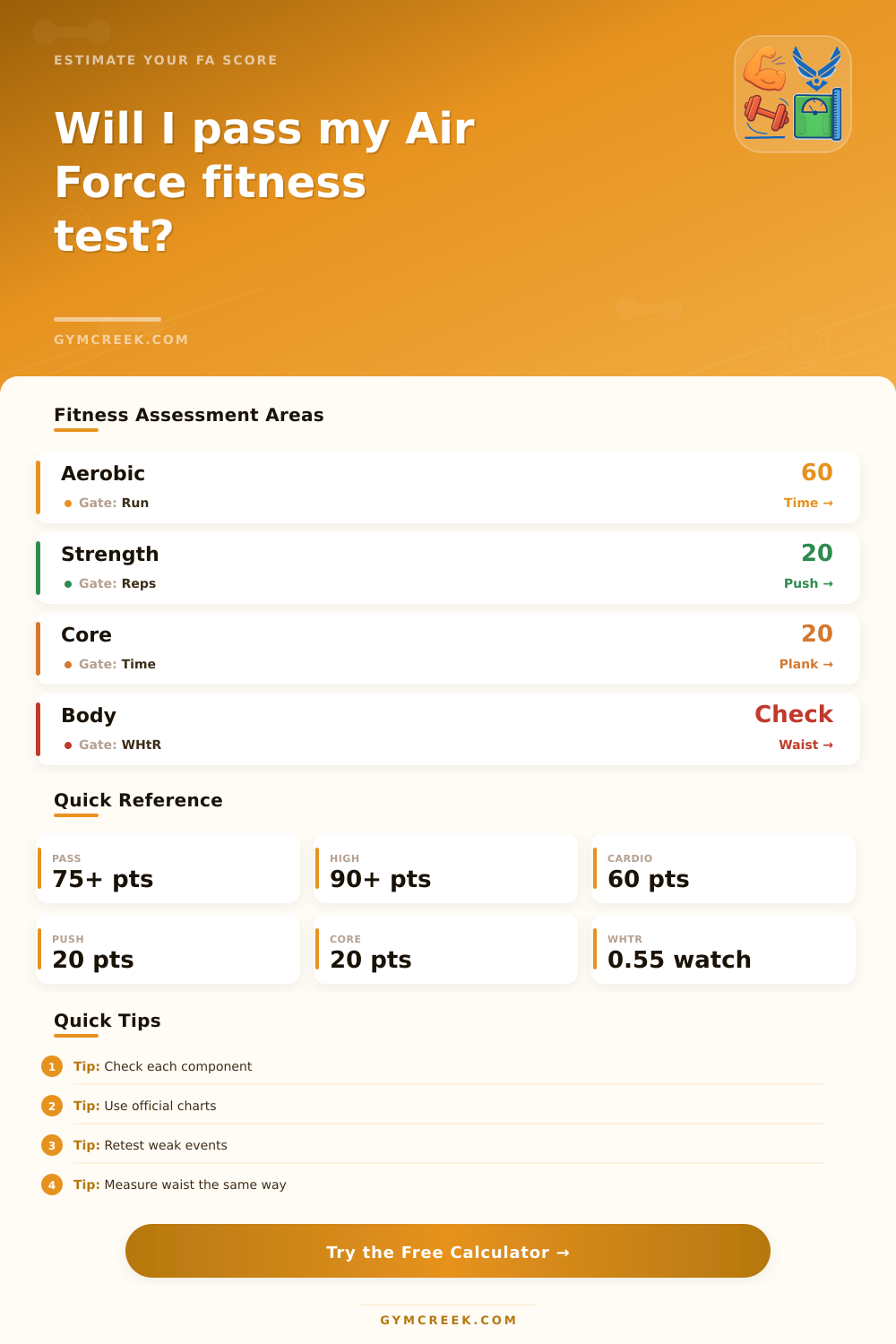
| Aerobic fitness | 60 | Run time, walk time, or HAMR shuttles | Largest score driver |
| Upper-body endurance | 20 | Push-ups or hand-release reps | Separate strength-endurance signal |
| Core endurance | 20 | Sit-ups, crunches, or plank time | Often the easiest retest gain |
| Body composition | Context | Waist-to-height ratio | Flags trend and review risk |
| WHtR | Band | Fitness context | Practical note |
|---|---|---|---|
| 0.49 or less | Low | Generally favorable body-size context | Maintain consistency |
| 0.50 to 0.54 | Watch | Worth tracking before the next test | Measure monthly |
| 0.55 to 0.59 | High watch | May affect readiness review | Confirm method |
| 0.60 and up | High | Needs official guidance context | Use chain guidance |
| Output | Method | Inputs | Use |
|---|---|---|---|
| Assessment score | Weighted component sum | Aerobic, push, core | Readiness estimate |
| Event points | Age/sex target curve | Age, sex, event result | Planning estimate |
| WHtR | Waist / height | Waist, height | Body context |
| BMR/TDEE | Mifflin-St Jeor | Weight, height, age, sex | Fitness context |
💡Tips
On test day, you’re anxious. Your head hurts, and there’s a clipboard waiting for you to record which event and age group you want to be tested in. Sixty seconds of max effort on the push-ups, another minute of core exercises, and now it’s time to run or do some sort of shuttle. No time to play around. The stakes are high, and you can’t afford any mistakes.
On top of that, this thing test you in several different domains all at one time. It requires you to maintain your body composition in a certain band, balance muscular stamina and cardiovascular endurance, and it does so in a way where most folks view it as a one-time event they need to survive. In reality, though, it’s a collection of skills that require management well before the start of testing battery.
How to Prepare for the Fitness Test
In the scoring structure, the most heavily weighted aspect is aerobic portion. It’s worth sixty percent of your overall score so no matter how good your upper body might feel, the outcome of the shuttle or run will determine if you pass or not. This is why Airmen stress pacing but ignore their plank time. They’re worried about their strength but don’t realize how much of an impact aerobic ability will make based off your final score.
By choosing which event you plan to complete and entering your scores into the calculator above, you’ll see the math run itself, helping explain just how far you can go to offset a slow run with perfect core scores. What you should of known: there are limitations when it comes to trading one category for another. If your cardio is borderline passing, you don’t have a lot of wiggle room anywhere else. Generally speaking, improving your mile time by even two minutes will provide more useful benefits than increasing your push-ups by five reps (the point-curve is steeper on the aerobic side).
The other forty percent is upper-body and core endurance. Half of that is core (including abs) and half is everything else. That’s what makes this so cool: It’s more about muscle stamina versus strength. So while you’re not required to be the strongest in the game, you just need to avoid failing before the minute is up. You can’t fall apart before the minute expire.
In fact, form break-down is the quiet assassin in this scenario. Too many will let their hips descend too far into the floor during a crunch or a sit-up, not knowing they’ve invalidated those reps until someone marks ’em down at the end. In the reference table on the page, we lay out how all of these inputs factor into points. What you’ll notice is which one will contribute most to your overall deficit. If you’re weak in push-ups, maybe you can switch to hand-releases, but only if you’ve trained specifically for that movement pattern before.
Beyond the stopwatch, there’s another wrinkle: body composition. Waist-to-height ratio (WtHR) is not a direct measurement of muscle mass; instead, it’s an indicator for a health-risk assessment. Why does it matter? Because if you’re heavy but very fit, the ratio ensures your fitness scores reflect actual conditioning rather than just high body weight, so a low WtHR reduces administrative flags from your career-ready profile.
Measure yourself consistently with the same technique and same tape each month so you’ll see trends. Even modest fluctuations in this number over several months indicate whether or not your diet matches your training load.
But most folks fall short because they train what’s easiest for them. They only train what they feel good at. Or they train what they think matters most, like thinking if they can’t run fast, there is no point in trying. They bench press heavy and can’t hold a plank position for a minute. They run fast but their planks is poor.
The assessment should be balanced. Find your weak link and go after that specifically, staying strong in other areas. Don’t jump on the track without first estimating where the gaps may exist. Let the test help you change how you think: instead of feeling anxious about not knowing your starting point, use it to plan how to bridge any gap. Knowing exactly where you start is half the battle won before you’ve even tied your laces. That mindset switch makes the clipboard look less like a threat and more like a checklist.